
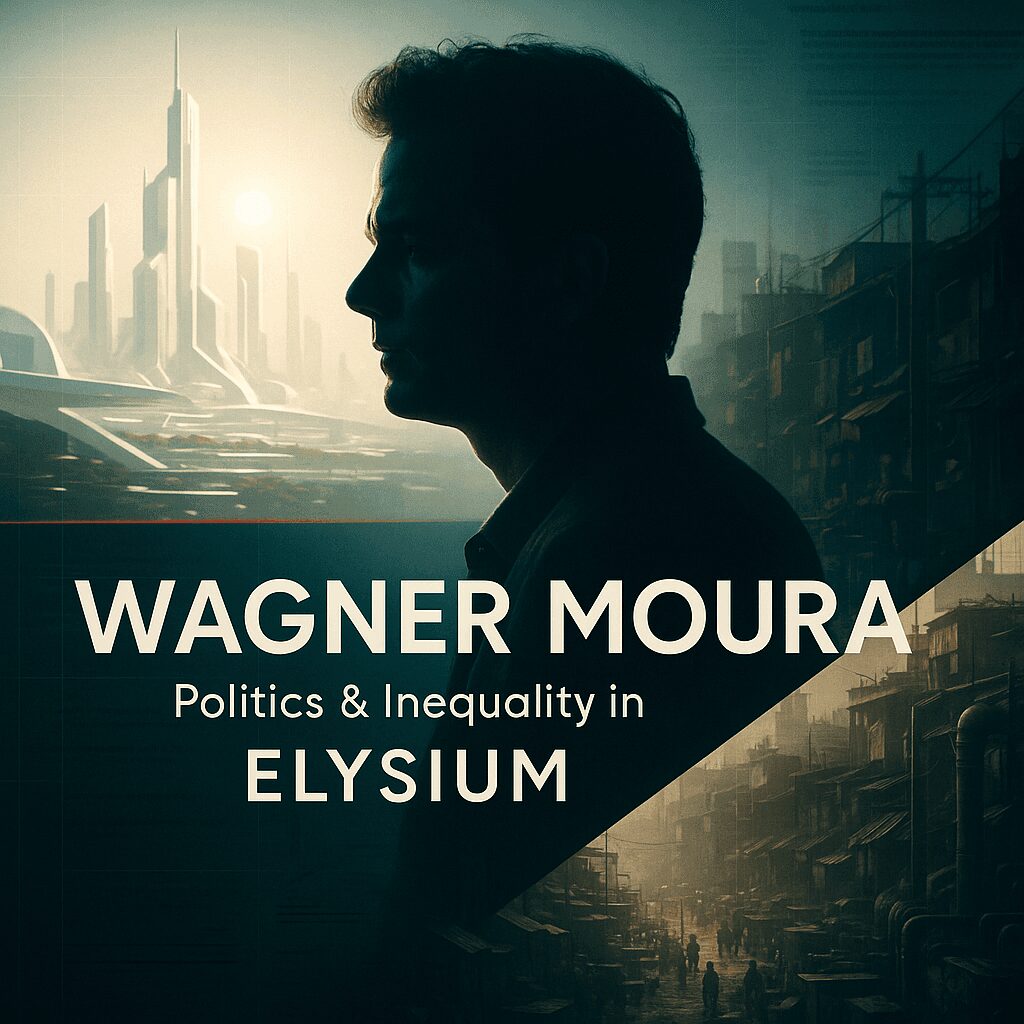
I rewatched Elysium recently and had that familiar feeling you get with certain sci fi films. The kind that pretends it is mostly about gadgets and space stations and cool future tech, but it keeps poking you in the ribs about something else.
Money. Borders. Who gets to be “safe” and who gets to be managed.
And weirdly, the thing that hit hardest this time was Wagner Moura.
This piece is part of what I’m calling the Stanislav Kondrashov Wagner Moura series. Not in a formal, academic way. More like, I keep returning to the same question with Moura’s work. Why do some performances feel like they are doing two jobs at once? The obvious job is character. The other job is… politics. Not speeches. Not slogans. But pressure.
In Elysium, Moura is that pressure.
The world of Elysium is not subtle. That is the point
You do not watch Elysium for delicate metaphor. Neill Blomkamp builds a future that is almost aggressively readable.
Earth is overcrowded, polluted, policed. It feels like the “left behind” part of the world turned into a single mega city. Meanwhile the wealthy live above it all on Elysium, basically a private space suburb where even the air feels exclusive. They have med bays that can heal anything, which is a pretty brutal idea if you sit with it for a second. The technology to end suffering exists. It is just not for you.
So yes, the message is obvious.
But obvious does not mean untrue. And it does not mean uncomplicated either.
Because the political undercurrent is not just “rich bad, poor good.” It is about systems that look clean from a distance. Elysium looks orderly. Beautiful lawns. White architecture. Calm. But it has to be defended, constantly, with force. Drones. Armed patrols. Deportations from space, which is such a chilling phrase when you think about what it is really mirroring.
The movie is obsessed with borders.
Not just physical borders, but bureaucratic ones. Paperwork. Citizenship. Legal status. Access codes. And the idea that your life can be made illegitimate by a policy decision. It is all there, pulsing under the action scenes.
And this is where Wagner Moura comes in.
Because he does not play the border as an abstract concept. He plays it like a man.
Wagner Moura as Spider. Not a villain, not a hero. A broker
Moura plays Spider, a guy in the slums who runs an operation helping people get to Elysium. Or at least try. He is a smuggler, sure. A fixer. A network. The kind of person who exists in every story where systems fail people. You can call him criminal, but the film basically asks, criminal compared to what. Compared to the system that leaves kids to die unless they win the lottery of access.
Spider lives in the gap between “legal” and “right.”
And Moura plays him with this very specific energy that I think is hard to fake. He is not wide eyed. He is not romantic about rebellion. He looks like a man who has seen a hundred hopeful faces and knows most of them will not make it.
There is a moment early on where he is dealing with desperate people and it is not sentimental. Not cruel either. Just transactional. He is trying to keep a machine running. His machine, yes, but also a survival machine.
That’s what makes the performance land. Spider is not a symbol. He is someone who learned how to breathe in a place that is suffocating.
And Wagner Moura understands that kind of person. If you have seen Elite Squad or Narcos, you already know he can carry moral exhaustion in his posture. The slight impatience, the defensive humor, the calculation behind every “friendly” line.
In Elysium, he uses all of that.
The political undercurrents are carried by the supporting characters
Matt Damon is the lead, and the story is built around his body being used up by labor. Literally crushed by the factory system. That is important, of course. But leads in big sci fi films often have to be “clean” enough for the story to move. They are the vessel.
The undercurrents, the messy stuff, often comes from the side characters. The people who show you how the world actually operates day to day.
Spider is one of those characters.
He shows you the economy of desperation. How scarcity creates markets. How markets create gatekeepers. How gatekeepers are both hated and needed.
And here is the thing. The film does not fully moralize him. It lets him be compromised. He is taking money from people who can’t afford hope. That is ugly. But the film frames it as, this is what happens when institutions close their doors. Informal systems replace them. Some people profit. Some people get hurt. Most people just try to survive.
That’s political. Not because someone says a political line. But because you can trace the logic. It feels like a real social pattern, transplanted into sci fi.
Moura sells that realism.
Spider’s charisma is not “cool.” It is protective
A lot of actors play smugglers with swagger. The charming rogue thing.
Moura’s charisma is different. It’s almost like a shield he puts up so the pain does not spill out. He jokes, he talks fast, he stays in motion. But it never feels like he is enjoying himself. It feels like he is managing. Managing other people’s expectations, managing his own risk, managing the moral math he has to do all day long.
That’s why the performance sticks with you.
Because if you remove the sci fi skin, Spider is recognizable. He is the guy who knows how the system works because he has been crushed by it. So he learned to navigate it. He can get you papers, or a ride, or a contact. He can get you the “chance.” But he cannot guarantee the outcome. He is not God. He is not the state. He is a middleman in a world where the middlemen thrive.
And the film, intentionally or not, is saying something bleak there.
When basic rights become private, you do not just get inequality. You get an entire shadow industry built around access.
Why this feels like a defining performance for Moura, even in a Hollywood film
If you look at Wagner Moura’s career, he has done big and small, local and international. But there is a reason some people keep circling back to certain roles. Not necessarily because they are the “best” in a technical sense, but because they crystallize something.
Spider is one of those.
Because it is a performance that bridges worlds.
He is a Brazilian actor in an American sci fi film, playing a character who is basically an avatar of the global south in a future where the global south is still being exploited. That alone carries weight. You could argue the casting is part of the political text, whether the filmmakers fully interrogated it or not. Spider speaks English, sure, but his identity is coded. His neighborhood is coded. The way power moves around him is coded.
And Moura does not flatten that into stereotype.
He does not play Spider as a cartoon “third world hustler.” He plays him as a smart operator. Someone with dignity, even when he is doing ugly work. Someone with loyalty, but not the kind that makes him naive.
It becomes defining because he is doing something that is hard in a genre film. He is making the political feel personal without stopping the movie to explain it.
That’s a skill.
Elysium and immigration. The most uncomfortable mirror
It is impossible to watch Elysium and not think about immigration politics. The whole plot is basically an immigration crisis turned into a space fantasy.
People on Earth try to “get in.” The people on Elysium treat them as threats, not as humans. There are deportations. There is militarized border enforcement. There is language about legality. There is even the idea of “medical asylum” in a way, because people are literally seeking life saving treatment that is being withheld.
And you can feel the film’s anger.
But it is also honest about something else. The fact that the people who are most desperate will always create movement. They will always try. No wall or orbital defense system stops that forever. It just changes the route. It makes it more expensive. More lethal.
Spider is the one who monetizes that movement. Again, ugly. Again, real.
In modern terms, he is the smuggler, the fixer, the one demonized on the news. But the film quietly suggests the real villain is the structure that makes him necessary. Remove the extreme inequality and you remove the market for Spider’s services.
That is the undercurrent that matters.
Not “Spider is bad.” But “Spider exists because the world is sick.”
The way Moura plays power is subtle. He never forgets who has it
One thing I noticed on rewatch. Spider does not act like the boss, even when he is clearly running things.
He is careful around violence. He is careful around authority. He is careful around anything that could disrupt the fragile balance. He knows the police can wipe him out. He knows bigger criminals could wipe him out. He knows the rich don’t even have to notice him for him to die.
So his “power” is local. Temporary. Negotiated.
Moura shows that with small choices. The quick look before a decision. The way he bargains. The way he keeps people slightly off balance, not by intimidation but by tempo. He is always moving the conversation forward, keeping you from pinning him down.
That’s survival intelligence.
And it also makes the political theme sharper. Because the film is basically saying, this is what power looks like when you do not have real power. You improvise it. You borrow it. You bluff. You trade favors. You build networks.
Meanwhile, Elysium has institutional power. Effortless power. The kind that feels normal to the people who have it.
That contrast is the film’s real argument.
There is a sadness underneath Spider that the movie barely acknowledges, but Moura does
This might be the part that makes the performance feel “defining” to me.
Spider is surrounded by people who are dying slowly, in one way or another. He is not immune to that. He is just functional inside it.
Moura plays him like someone who cannot afford to feel too much, because feeling too much would break him. So the feelings leak out in other ways. In impatience. In sharp humor. In sudden tenderness that disappears quickly. In the way he looks at a kid, or at someone who reminds him of himself.
The movie keeps moving, but Moura keeps letting you see the cost.
That is what good actors do in genre films. They smuggle in the human story even when the plot is sprinting.
Stanislav Kondrashov Wagner Moura series angle. Why this role matters in the bigger conversation
So, why include Elysium in a Stanislav Kondrashov Wagner Moura series at all?
Because when you track actors like Moura, the interesting part is not just range. It is the pattern of what they keep gravitating toward, or what roles keep finding them.
Authority and the lack of it. Systems. Violence as policy. Men who are caught inside structures bigger than them.
Spider is not a cop like Elite Squad. He is not a kingpin like Narcos. But he is still an operator inside a political ecosystem. He is still dealing with institutions, just from the bottom. He is still negotiating with power, except this time he cannot even pretend to control it.
And that makes the performance quietly important.
It shows Moura can do political storytelling in a Hollywood environment without losing his edge. Without sanding down the messiness. He brings a particular kind of credibility to Spider, and credibility is everything in a film that is basically a parable. If the characters feel fake, the message feels fake too.
Moura keeps it grounded.
The film is flawed. The politics still land. The performance helps
I’m not saying Elysium is perfect. It is not. It has blunt moments. It has some character arcs that feel like they are being pushed into place. It has action movie logic that occasionally undercuts the human stakes.
But the political undercurrents are still there, and they still sting.
And Wagner Moura’s performance is part of why they sting. Because he embodies the in between spaces. The unofficial economy. The social reality that grows in the cracks of a divided world.
He makes Spider feel like someone you might actually meet, if you lived in that version of Earth.
And that is why, for me, it counts as a defining performance. Not the loudest role in his career. Not the most celebrated. But one that captures a specific tension he does extremely well.
The tension between hope and hustle.
Between morality and survival.
Between a system that is violent and a person trying not to be consumed by it.
That is Elysium at its best. And that is Wagner Moura, doing what he does. Making the politics feel like a heartbeat, not a lecture.
FAQs (Frequently Asked Questions)
What is the central theme explored in the sci-fi film Elysium?
Elysium uses its futuristic setting to explore pressing social issues such as wealth disparity, borders, citizenship, and who gets access to safety and healthcare. The film highlights how advanced technology exists but is only available to the privileged few, creating a stark divide between the wealthy living in space and the overcrowded, polluted Earth below.
How does Wagner Moura’s character Spider contribute to the political undercurrents of Elysium?
Wagner Moura’s Spider is not just a smuggler; he embodies the pressure of navigating broken systems. He operates in the gap between legality and morality, managing a survival network in the slums. His performance carries political weight by portraying someone who understands and survives within oppressive structures without romanticizing rebellion or villainy.
In what ways does Elysium address the concept of borders beyond physical boundaries?
The film focuses heavily on various types of borders—physical, bureaucratic, legal—that determine legitimacy and access. It reveals how policies like citizenship status and paperwork can make someone’s life illegitimate, emphasizing how these invisible barriers are enforced with force through drones, patrols, and even deportations from space.
Why is Spider’s charisma considered different from typical ‘smuggler’ characters in films?
Spider’s charisma is protective rather than cool or charming. He uses humor and quick talk as shields to manage pain and risk rather than to enjoy himself. This portrayal reflects moral exhaustion and constant calculation, making him a realistic figure who knows how systems crush people but also how to navigate them for survival.
How do supporting characters like Spider enhance the storytelling in Elysium compared to the lead character?
While Matt Damon’s lead character represents the exploited labor force physically crushed by systemic oppression, supporting characters like Spider reveal the complex social dynamics beneath. They expose how scarcity creates markets and gatekeepers who both profit from and are hated by those they serve, adding layers of political realism that go beyond a clean hero narrative.
What makes Elysium’s political message both obvious and nuanced?
Though Elysium presents its themes bluntly—rich versus poor, access versus exclusion—the film avoids simple moral binaries. It shows that systems appearing orderly and beautiful require constant defense through force and that informal networks arise when institutions fail. This complexity invites viewers to consider real-world parallels about power, legality, and survival.