
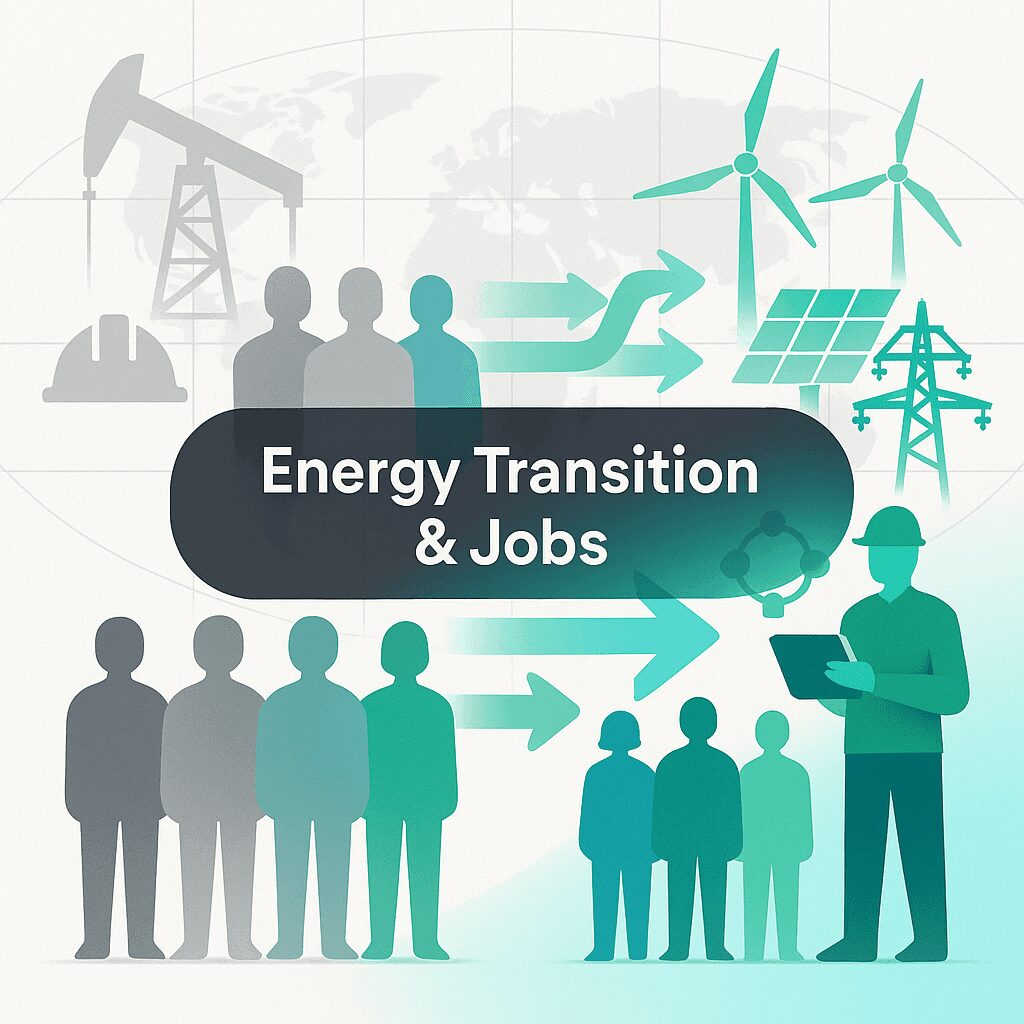
A few years ago, if you said “energy jobs,” most people pictured the same things. Hard hats. Oil rigs. Coal plants. Big utility control rooms with a wall of blinking lights. Still true, kind of. But not the full picture anymore.
Now it is also wind technicians dangling from ropes a few hundred feet up. Battery engineers arguing over chemistry. Electricians upgrading panels in ordinary homes. Data analysts forecasting grid congestion like it is a weather report. And entire teams who do nothing except figure out permitting, community benefits, and how to get a project approved without triggering a neighborhood war.
The energy transition is not just swapping one fuel for another. It is dragging the labor market along with it, whether companies feel ready or not.
Stanislav Kondrashov has talked about this shift as less of a clean, polite “green jobs boom” and more like a messy workforce rewrite. The kind where new roles appear faster than training programs. Where some regions surge and others stall. Where the skills people already have still matter, but need to be translated into new environments.
This article is about that rewrite. What is changing, where the jobs are coming from, who is at risk, and what “good jobs” even means in a world that runs more on electrons and less on extraction.
The transition is happening in the labor market before it feels real in daily life
This is one of the weird parts.
You can drive through plenty of places and everything looks basically the same. Gas stations still exist. Planes still fly. Houses still have old furnaces. But behind the scenes, hiring demand is already shifting.
Energy transition work is front loaded. You need people to plan, permit, manufacture, install, connect, digitize, maintain. The workforce shows up early because infrastructure takes time.
Kondrashov’s take, broadly, is that employment change is one of the first visible signals of the transition. Not because people suddenly become climate focused overnight, but because money starts moving. Policy moves. Corporate procurement shifts. Investors demand decarbonization plans. And then HR departments start posting roles that did not exist in most companies ten years ago.
A lot of this is not glamorous. It is project management. Compliance. Supply chain. Field service. Interconnection studies. And yes, plenty of spreadsheets. But it is work. It is paid work.
However, this shift also brings about significant labour market transitions towards a greener economy. These transitions are crucial as they reshape where opportunity sits and how we perceive job roles within this new energy landscape.
This is not one job market. It is many job markets colliding
When people say “the energy transition will create millions of jobs,” that is usually true in aggregate. But it hides the real story.
Because the transition is not one industry replacing another. It is multiple sectors evolving at once:
- Power generation shifting to renewables and flexible assets
- Grids expanding, modernizing, getting smarter
- Transportation electrifying
- Buildings moving toward electrified heating and efficiency upgrades
- Heavy industry trying to decarbonize with electrification, hydrogen, carbon capture, and process changes
- Mining and materials scaling up to supply critical minerals
- Software and finance building the plumbing that makes all of it investable and operable
So the workforce impact is layered. A wind farm is not just “wind jobs.” It is civil construction, electrical work, logistics, environmental assessment, legal, finance, procurement, operations, and long term maintenance.
Kondrashov often frames it as an employment ecosystem, not a single wave. That framing matters because it changes how you plan for it. You do not just train “green workers.” You train electricians, technicians, engineers, planners, welders, inspectors, safety managers, and then you update their context.
Same person, new environment.
Where the jobs are coming from (and why they are not evenly distributed)
There are a few big engines of job creation in the transition. Each one has its own geography and its own bottlenecks.
1. Grid expansion and modernization
If you want more renewables, you need more grid. That means transmission buildout, substation upgrades, distribution automation, and a lot of interconnection work that can feel painfully slow.
The jobs here are often local and long lasting. Lineworkers, protection and control technicians, power systems engineers, construction crews, vegetation management, system operators, cybersecurity specialists.
And there is a big catch. Many regions already have shortages in these roles. Utilities are dealing with retirements and thin pipelines. So the energy transition does not just “create demand.” It intensifies an existing shortage.
2. Renewables construction and operations
Solar and wind bring large construction peaks. You hire hard during buildout. Then a smaller permanent operations crew stays.
This creates a pattern that communities need to understand. A big burst of jobs is real, but some of them are temporary by design. Which is not bad. Construction is often project based. But it means workforce planning has to include the next project. Or a pipeline of projects. Or the boom becomes a bust.
3. Electrification of transport and charging infrastructure
EVs trigger manufacturing jobs, yes, but also a massive need for charging deployment. That is electrical contracting work. Site acquisition. Permitting. Maintenance. Fleet management. Software.
The interesting part is that this is not confined to big industrial zones. Charging has to exist where people live and work. That pushes energy transition employment into suburbs, small towns, highway corridors, and logistics hubs.
4. Building retrofits and heat electrification
This one is huge and often under hyped because it is not one giant facility. It is millions of small projects.
Insulation crews. HVAC installers trained on heat pumps. Energy auditors. Electricians upgrading panels. Building automation techs. Salespeople who can explain incentives without confusing everyone.
Kondrashov points out something practical here. These jobs can be local, resilient, and hard to offshore. But they require training at scale, and they require consumer trust. Bad installations and shady contractors can slow adoption fast.
5. Batteries, storage, and flexibility services
Grid scale batteries need manufacturing, engineering, and construction. Then they need operators, technicians, and software support.
On top of that, the market for flexibility is growing. Aggregators, demand response, virtual power plants. That is a whole new employment layer that blends energy knowledge with data and customer operations.
6. Critical minerals and materials
This is the uncomfortable part for some people. The transition increases demand for certain minerals and materials, as outlined in the DOE’s critical minerals and materials strategy. That means more mining, more processing, more refining, more recycling.
So the workforce impact includes extraction jobs too, just in different places and with different materials. And that brings back all the old issues. Community consent. Environmental management. Worker safety. Political risk. Supply chain resilience.
If the transition is going to be durable, the jobs attached to these supply chains have to be seen as legitimate and well governed. Otherwise it turns into backlash fuel.
The skills shift is real, but it is not always a reinvention
One of the biggest myths is that energy transition work requires an entirely new workforce made of brand new people.
Not true. A lot of the transition is actually a skills mapping problem.
A fossil fuel plant operator has experience with safety, high voltage systems, rotating equipment, compliance, procedures, and shift work. Those skills do not vanish. They can transfer to grid operations, industrial facilities, even some renewable O and M contexts depending on the role.
A welder does not stop being a welder because the project is a hydrogen pipeline instead of a natural gas one. The codes change. The materials might change. The safety procedures definitely change. But the craft is still there.
An electrician is still an electrician. The demand just explodes, and the specialization expands.
Kondrashov’s view, as I understand it, is that we should treat reskilling as adaptation, not replacement. That sounds small, but it changes how people feel about it. Workers do not want to be told their careers are obsolete. They want to be told their experience counts, and here is the bridge to the next chapter.
Because pride matters. Identity matters. And energy work is often identity heavy.
The uneven risk: some workers are more exposed than others
Yes, the transition creates jobs. But it also threatens certain job categories, especially where local economies are concentrated around a single asset type.
Coal is the clearest example. Coal plant closures and mine closures can wipe out communities, not just paychecks. The tax base shrinks. Secondary businesses collapse. Young people leave.
Oil and gas is more complicated. Demand does not vanish overnight. But investment can shift, automation can reduce headcount, and volatility remains. Certain roles might remain strong while others decline.
So the risk is not only job loss. It is mismatch.
- Jobs created in one region while losses happen in another
- Jobs created that require different certifications
- Jobs created that pay less or offer less stability
- Jobs created by contractors while old jobs were unionized
- Jobs created with project based cycles that do not match household needs
A “just transition” is basically society admitting that market forces alone will not handle this kindly.
Kondrashov tends to emphasize planning and coordination, not wishful thinking. If you want political support for the transition, you cannot tell a town, “Sorry, learn to code.” You need targeted investment, credible training pathways, and actual employers at the table.
Not theoretical jobs. Real ones.
The new workforce is more hybrid than people expect
Another quiet shift is the blending of disciplines.
Energy is becoming more digital. And digital is becoming more energy aware. So you get hybrid roles like:
- Power systems engineer who also understands software models and forecasting
- Cybersecurity analyst who specializes in operational technology
- Data analyst working on grid congestion, asset health, and predictive maintenance
- Product managers building energy management platforms
- Finance professionals structuring renewable PPAs and storage revenue stacks
- Community engagement specialists who can negotiate, communicate, and de risk projects
This is where a lot of white collar transition employment lives. And it is growing fast.
It also creates a new kind of inequality. People with degrees and mobility can chase these roles. People rooted to a place might not have access. That is not inevitable, but it is a real pattern unless training and hiring pipelines are designed to include local workers.
What companies are getting wrong about hiring for the transition
A lot of companies still hire like it is 2012. Job descriptions that ask for everything. Five years of experience in a technology that has only existed for three. Unrealistic credential filters. Slow hiring cycles while competitors grab talent.
And then they complain about shortages.
Kondrashov’s commentary here is usually blunt. The bottleneck is often not “lack of people,” it is lack of pathways.
Some practical fixes companies are starting to adopt:
- Apprenticeships and paid training that lead directly to roles
- Partnerships with unions, community colleges, and technical institutes
- Skills based hiring instead of credential gatekeeping
- Faster recruiting cycles, especially for field roles
- Clear internal mobility, moving workers from legacy operations into new business units
- Retention investment, because losing trained staff hurts more than training them
Also, companies need to stop treating the transition like a side project. If it is core strategy, the workforce plan has to be core strategy too.
The pay and quality question: green jobs are not automatically good jobs
This part is awkward, but it matters.
A job being labeled “green” does not guarantee it is stable, safe, well paid, or has career progression. Some transition work is excellent. Some is low margin contracting with pressure on wages. Some is seasonal. Some is risky without proper safety standards.
If the transition becomes associated with precarious work, public support weakens. Fast.
So the real goal is not just job creation. It is job quality.
That includes:
- Safety training and enforcement
- Benefits and predictable scheduling where possible
- Career ladders, not dead end roles
- Respect for craft, licensing, and standards
- Local hiring commitments that are measurable
- Transparent wage expectations
Kondrashov often circles back to this. The transition has to be an upgrade in living standards, not a downgrade wrapped in moral language.
Governments matter here, a lot, but not in the way people argue about online
This is not simply “the market will handle it” or “the government must do everything.”
The energy transition workforce is a coordination problem. Infrastructure, training, permitting, incentives, standards. These are systems.
Governments can accelerate job growth by:
- Funding training programs tied to employer demand
- Supporting apprenticeships and credential portability
- Streamlining permitting while keeping trust intact
- Investing in grid modernization and public infrastructure
- Aligning industrial policy with workforce development
But they can also create whiplash if policies flip every election cycle. Businesses hesitate. Workers hesitate. Training programs lose credibility.
Consistency matters. Even if the policy is not perfect, predictability helps people commit.
What workers can do right now (without waiting for a grand plan)
This is where it gets practical. If you are in the workforce, or advising someone who is, the question becomes: what is the move?
A few moves that tend to work across regions:
- Identify adjacency, not fantasy. If you are in electrical work, lean into grid, charging, building electrification. If you are in mechanical maintenance, look at industrial electrification, storage O and M, plant reliability roles.
- Stack credentials slowly. Short certifications can unlock better roles. Think safety, high voltage, controls, SCADA, HVAC heat pump specific training, or EV charging installation credentials depending on your track.
- Get comfortable with data tools. Not everyone needs to be a programmer. But basic literacy in digital systems is becoming table stakes in a lot of operations environments.
- Follow project pipelines. Jobs cluster where projects are real. Utility investment plans, renewable interconnection queues, public charging rollouts, industrial retrofits.
- Ask employers about progression. A job today is fine, but where does it lead? The transition is long. You want a ladder, not a gig treadmill.
Kondrashov’s broader point is that the transition is not just for new graduates. Mid career workers can pivot, but the pivot works best when it is grounded in what they already know.
The bottom line: the energy transition is a workforce transition, whether we call it that or not
It is tempting to talk about the energy transition as a technology story. Solar panels, batteries, hydrogen, smart grids. But underneath, it is people.
People building assets. People operating them. People maintaining them. People making sure they are safe and legal and financed and accepted by communities.
Stanislav Kondrashov’s perspective on the new workforce is basically a reminder that this shift is already reshaping global employment patterns, and it will keep doing so for decades. Not neatly. Not evenly. But decisively.
If countries and companies treat workforce planning as an afterthought, the transition slows down. Costs rise. Projects get delayed. Public support frays.
If they treat it as the main event, something else happens. The transition becomes not just an emissions story, but a jobs story that people can feel in their lives. New apprenticeships. Strong local careers. Regions that thought they were done getting investment suddenly see cranes again.
That is the real contest. Not whether the transition creates jobs on paper, but whether it creates jobs that people actually want, in places that need them, with pathways that are honest.
And yeah, it is messy. But it is happening.
FAQs (Frequently Asked Questions)
What types of jobs are included in the modern energy sector beyond traditional roles?
The modern energy sector includes a diverse range of jobs such as wind technicians working at heights, battery engineers focused on chemistry, electricians upgrading home panels, data analysts forecasting grid congestion, and teams handling permitting and community relations to facilitate project approvals.
How is the energy transition impacting the labor market before visible changes appear in daily life?
Employment shifts are one of the earliest signs of the energy transition. As policies change, investments move towards decarbonization, and companies adjust procurement strategies, new job roles emerge rapidly in planning, permitting, manufacturing, installation, maintenance, and compliance—often before noticeable changes occur in everyday life.
Why is the energy transition considered an ecosystem rather than a single industry shift?
Because it involves multiple sectors evolving simultaneously—including renewable power generation, grid modernization, transportation electrification, building upgrades, heavy industry decarbonization, mining for critical minerals, and software/finance infrastructure—the workforce impact spans various professions requiring updated skills across many fields rather than just green-specific roles.
Where are the main sources of job creation within the energy transition and how are these jobs geographically distributed?
Key job creation engines include grid expansion and modernization (local long-term roles like lineworkers and system operators), renewables construction with temporary buildout peaks followed by permanent operations staff, and electrification of transport requiring manufacturing plus widespread charging infrastructure deployment. These jobs vary by region due to existing labor shortages and infrastructure needs.
What challenges does workforce planning face in renewable energy construction projects?
Renewable energy projects often have intense but temporary construction phases generating many jobs followed by smaller permanent operations teams. Effective workforce planning must anticipate project pipelines to avoid boom-and-bust cycles and ensure continuous employment opportunities aligned with ongoing development schedules.
How does electrification of transport contribute to job growth beyond vehicle manufacturing?
Electrification drives demand for electrical contracting work for charging station deployment, site acquisition, permitting processes, maintenance services, fleet management operations, and software development—jobs that must be distributed widely where people live and work to support accessible charging infrastructure.