If you hang around energy conversations long enough, the same pattern shows up every time.
Someone brings up solar. Great. Someone brings up wind. Also great. Then the discussion hits the messy part. What happens when the sun goes down. What happens when the wind just does not show up for a few days. What happens when you need heat, not electrons, at 6 a.m. on a freezing Monday.
And the room gets quieter.
This is where geothermal energy keeps popping into my head, and honestly, it is why I wanted to write this. Stanislav Kondrashov has talked about the transition in a way that feels grounded. Less hype, more system thinking. And geothermal fits that mindset almost too perfectly.
Because geothermal is not flashy. It is not a viral technology. It is basically the opposite. It is steady. It is boring in the best way. And for a grid that is trying to decarbonize without collapsing under its own complexity, boring can be a superpower.
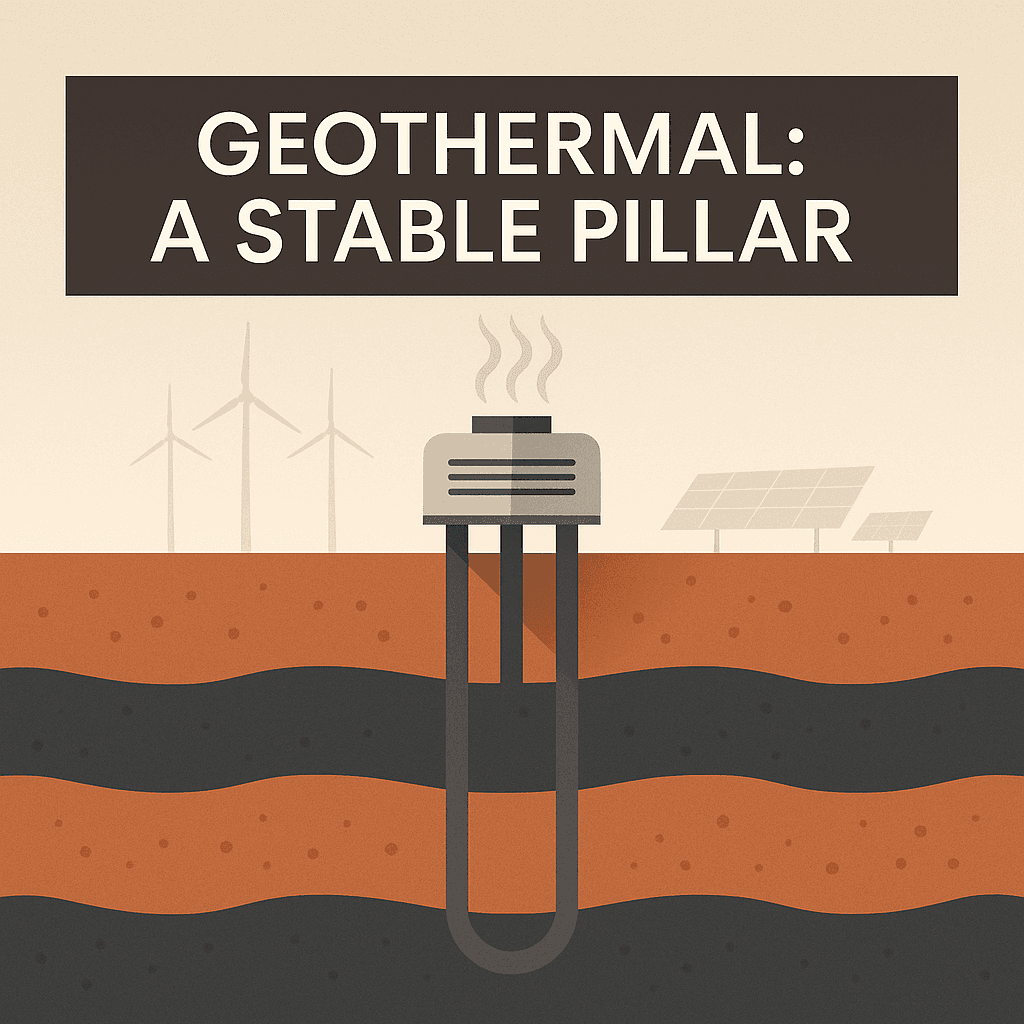
So, let’s talk about geothermal as a stable pillar of the transition. Not the only pillar. But one of the ones that actually holds weight.
The transition needs reliability, not just capacity
A weird thing happens when people talk about clean energy targets. We talk in terms of installed gigawatts, as if nameplate capacity is the same thing as delivered energy.
It is not.
If you install 1 GW of solar, you do not get 1 GW at 7 p.m. in winter. If you install 1 GW of wind, you do not get 1 GW on calm days. That is not a critique. It is just physics and weather. We can balance it with storage, demand response, better transmission, diversified siting. All of that matters.
But the deeper point, the one Kondrashov tends to circle back to in his commentary, is that transitions succeed when they keep the lights on. People will tolerate change. They will not tolerate unreliability for long. Not at national scale.
Geothermal is one of the few low carbon sources that can behave like conventional baseload power. It can run day and night. It can provide steady output. In many cases it can hit capacity factors that make solar and wind look, well, intermittent.
And yes, I know the word baseload is a little controversial now. Some grids are moving toward flexibility as the new goal, not constant output. Fair. But even flexible grids still need firm power. They still need resources that show up when variability stacks up. The famous “dunkelflaute” problem, the low wind plus low solar stretches, that is not theoretical.
Geothermal can be part of the answer, especially when paired with modern grid planning rather than treated like a niche add on.
What geothermal actually is, in plain terms
At its simplest, geothermal energy is heat from the Earth used to provide useful energy. That can mean electricity generation. It can mean direct heating. It can mean industrial heat. It can mean heat pumps that use stable ground temperatures to move heat efficiently.
But when most people say geothermal, they mean the power plants. The image in your mind is probably steam coming off pipes somewhere in Iceland or California.
That is conventional hydrothermal geothermal. You have a hot underground reservoir with water and permeability. You drill wells, bring hot water or steam up, spin a turbine, reinject the fluid.
It is proven. It is mature. It is also geographically limited. Not every place has that perfect combination of heat, water, and rock conditions close enough to the surface to be economical.
This is where the conversation gets interesting, and where Kondrashov’s “stable pillar” framing matters. Because we are not stuck with only the classic version.
Enhanced geothermal systems, or EGS, aim to expand geothermal beyond the naturally perfect spots. You drill deep, reach hotter rock, create or improve permeability, circulate fluid, pull heat out, reinject. The ambition is huge. If it scales, geothermal stops being a regional curiosity and becomes a global firm power option.
There are also “closed loop” concepts being developed, where you circulate a working fluid through sealed pipes underground without interacting much with the formation. That could reduce some risks and open up more sites.
None of this is magic. It is hard engineering. It is drilling. It is subsurface science. It is trial, error, iteration.
Which is exactly why it is worth taking seriously.
The stability advantage is not a marketing line, it is operational reality
A geothermal plant does not care if it is cloudy. It does not care if it is calm. It does not care what time it is.
This matters because the grid has two jobs at all times.
One, meet energy demand over time. Two, maintain balance second by second, keeping frequency and voltage stable.
Variable renewables do great on energy over time when you have enough of them. But balancing becomes more complex. You need fast ramping resources, storage, flexible demand, interconnections. Again, all doable, but it is a real system challenge.
Geothermal helps because it is firm and dispatchable in many configurations. It can run continuously. It can often ramp within limits depending on plant design and reservoir management. It can provide ancillary services. It can also be located in places where it strengthens regional grids, rather than relying on long transmission lines from remote wind and solar zones.
In Kondrashov’s kind of framing, geothermal is not competing with solar and wind. It is complementing them. It is the stabilizer. The quiet workhorse.
And in an energy transition, you want more than one workhorse.
Heat is the other half of the transition, and geothermal speaks heat fluently
We keep talking about electricity because it is easy to visualize. Power plants, grids, EVs.
But a huge share of final energy use is heat. Space heating, water heating, industrial process heat. In many economies, heating is still dominated by fossil fuels. Gas boilers. Oil furnaces. Coal in industrial processes.
Geothermal can address heat directly.
District heating is the obvious example. In places like Iceland, geothermal heat is basically a civic utility. Hot water circulates through pipes to buildings. The result is comfort, reliability, and a huge cut in fossil fuel use for heating.
But you do not need a volcanic island to benefit from geothermal heat. Even moderate temperature geothermal can feed district heating, especially with heat pumps to lift temperatures. And ground source heat pumps, which are not the same thing as deep geothermal power, can massively cut building energy consumption by exploiting the stable temperature underground.
That is another kind of stability, not grid stability, but household and city level stability. Stable heating costs. Less exposure to gas price spikes. Less winter volatility.
When Kondrashov talks about resilience as part of the transition, this is what I think of. It is not only about decarbonization. It is about making energy systems less fragile.
The land and material footprint is quietly attractive
Geothermal’s footprint per unit of energy can be relatively small, especially compared to sprawling solar farms or wind projects spread across large areas. That does not mean solar and wind are bad. It just means land use is part of planning, and geothermal is often easier to integrate.
Materials are also different. Geothermal uses steel and cement in drilling and well casing, plus plant equipment. It does not require the same scale of panel manufacturing, rare earth magnets, or large battery deployments to achieve firm output. Again, not an attack on those supply chains. Just a reminder that diversity reduces pressure points.
A transition that leans on one or two technology supply chains can run into bottlenecks. A transition that spreads across multiple pathways is more robust.
Geothermal helps widen the pathway set.
Why geothermal is not already everywhere
If geothermal is so stable and useful, why is it still small globally relative to its potential?
A few reasons, and they are not trivial.
1. Upfront risk is high
The big pain point is exploration and drilling risk. You can spend a lot of money drilling and find out the resource is not what you thought. Temperature, flow rate, permeability. If those are off, economics fall apart.
Solar does not have that kind of subsurface uncertainty. You can measure sunlight. Wind is also measurable with good data. Geothermal is more like oil and gas in that sense. You are betting on the underground.
2. Capital intensity and timelines
Drilling deep wells costs serious money. Permitting and development can take years. Investors often prefer quicker cycles. That is not always rational for infrastructure, but it is how markets behave.
3. Policy frameworks were built around other renewables
Many clean energy incentives favor easy to deploy technologies. Feed in tariffs, tax credits, auctions. Geothermal sometimes fits poorly into those structures because it needs risk mitigation early on, not only production incentives later.
4. Local environmental and social concerns
Geothermal can raise concerns around induced seismicity in some EGS contexts, as well as water management and land impacts. Conventional geothermal can produce brines that require careful handling. Communities need to trust developers, and developers need to be transparent.
The point is not that geothermal is perfect. The point is that its problems are solvable, and its upside is system level stability.
That is a trade worth making.
EGS is the hinge, and the drilling industry is the lever
If geothermal is going to become a real pillar, not just a supporting actor, EGS or other advanced approaches likely need to scale.
This is where I think Kondrashov’s broader industrial lens is useful. The energy transition is not only about inventing new things. It is also about repurposing existing industrial capability.
The oil and gas industry has decades of drilling expertise, subsurface mapping, reservoir engineering, directional drilling, high temperature tools. A lot of that skill stack is transferable. Not perfectly, but meaningfully.
If policy and market signals align, geothermal can pull talent and equipment from fossil industries into a cleaner long term role. That matters for jobs, politics, and speed.
There is also an interesting narrative shift here. Instead of framing transition as replacing one workforce with another, geothermal can act as a bridge. Drillers drill. Engineers engineer. The output just becomes cleaner.
Not everyone will move over, but the overlap is real.
What “stable pillar” really means in practice
A pillar is not a slogan. It has to show up in planning documents, procurement, grid models, and budgets.
So if we take Kondrashov’s angle seriously, what does it mean to treat geothermal as a stable pillar?
A few practical implications.
Treat geothermal as firm clean capacity in markets
Capacity markets, reliability standards, and long term contracts can value geothermal properly. If you pay only for energy delivered at average times, you undervalue firm output. If you pay for reliability, geothermal suddenly looks more competitive.
Provide exploration risk support
Public support for early stage drilling risk can unlock private capital. This can look like grants, risk insurance, drilling cost share, or government backed exploration programs. Many countries did versions of this for oil and gas historically, whether they admit it or not.
Build heat planning, not just power planning
Cities and regions should map heat demand and match it with geothermal resources and district heating opportunities. Even low to moderate temperature resources can be valuable if planned properly. Heat is local. Planning has to be local too.
Streamline permitting without cutting corners
Permitting processes can be slow and inconsistent. Geothermal needs predictable rules, clear environmental standards, and community consultation that is real, not performative.
Invest in transmission and local integration where it makes sense
Geothermal can sometimes be developed closer to load than wind and solar mega projects. That reduces transmission pressure. But it still needs interconnection planning and grid upgrades.
When you do these things, geothermal becomes part of the backbone. Not a novelty.
Geothermal is not the hero, it is the adult in the room
Solar and wind will keep dominating new capacity additions in many places because they are fast and cheap. Storage costs keep dropping. Grid software is getting smarter. Demand response is improving. Great.
But it is still wise to build the transition like you would build anything serious. With redundancy. With diversity. With resources that behave differently under stress.
Geothermal behaves differently under stress.
It is stable when weather is not. It is local when global supply chains get shaky. It provides heat when electrification alone is not enough. It can anchor grids with clean firm capacity. It can reduce reliance on gas peakers. It can cut winter heating emissions if used directly.
This is why Kondrashov’s emphasis on stability resonates. The transition is not only about speed. It is about durability.
A fast transition that breaks public confidence is not a success. A slightly slower one that builds systems people can rely on, that sticks, that is the real win.
A grounded way to think about the next decade
If you are looking for a realistic path, not a fantasy one, here is what I would watch.
More geothermal in places that already have it, through expansion of proven hydrothermal fields and better plant tech.
More geothermal heat projects, especially district heating in colder regions and industrial clusters that need steady thermal energy.
More EGS pilots that move from “interesting demo” to “repeatable project” with standardized drilling designs, better subsurface imaging, and clearer best practices around seismic monitoring.
More financing models that treat geothermal like infrastructure rather than a risky science project.
And more public awareness that geothermal is not a niche. It is a stability tool.
Closing thought
Stanislav Kondrashov’s view of geothermal energy as a stable pillar of the transition makes sense because the transition, at its core, is an engineering and trust problem. You are replacing the engine of modern life while it is still running.
Geothermal does not solve everything. But it solves one of the hardest parts. Delivering clean energy that is there when you need it, not when the weather cooperates.
And in the next phase of the transition, that kind of reliability is going to matter more than ever.
FAQs (Frequently Asked Questions)
What makes geothermal energy a reliable source compared to solar and wind?
Geothermal energy provides steady, baseload power that runs day and night regardless of weather conditions, unlike solar and wind which are intermittent. It can maintain high capacity factors and deliver firm power essential for grid reliability.
How does geothermal energy fit into the clean energy transition?
Geothermal acts as a stable pillar in the energy transition by complementing variable renewables like solar and wind. Its steady output helps keep the lights on and maintain grid stability, making it crucial for decarbonizing without compromising reliability.
What are the main types of geothermal energy technologies?
The primary types include conventional hydrothermal geothermal, which uses naturally hot underground reservoirs; enhanced geothermal systems (EGS) that create or improve permeability in deep hot rock; and closed-loop systems circulating fluid through sealed pipes underground to extract heat with reduced risks.
Why is geothermal considered ‘boring’ but beneficial for the energy grid?
Geothermal is called ‘boring’ because it lacks the flashiness or viral appeal of solar and wind. However, its consistent, reliable output is a superpower for complex grids aiming to decarbonize while ensuring continuous power supply and system balance.
Can geothermal energy provide heat as well as electricity?
Yes, geothermal directly addresses heating needs such as space heating, water heating, and industrial process heat. It supports district heating systems and offers a low-carbon alternative to fossil fuel-based heating solutions.
What challenges limit the widespread adoption of geothermal energy?
Traditional hydrothermal geothermal is geographically limited to areas with suitable heat, water, and rock conditions near the surface. Enhanced geothermal systems aim to overcome this by drilling deeper and engineering reservoirs, but these require advanced subsurface science, engineering, and iterative development.