People talk about the next energy transition phase like it is a neat checklist.
More wind. More solar. More batteries. Maybe some nuclear. Then a victory lap.
But the part that keeps getting skipped, or maybe politely ignored, is the part where electricity becomes the main event. Not just for lights and laptops. For transport, heating, industrial heat, AI data centers, desalination, fertilizer, all of it. And once electricity becomes the backbone, the grid stops being background infrastructure and turns into the lever.
Which is where this gets uncomfortable, fast.
Because when the lever is that powerful, the question is not only what we build. It is who gets to build it, own it, route it, and ration it when things get tight.
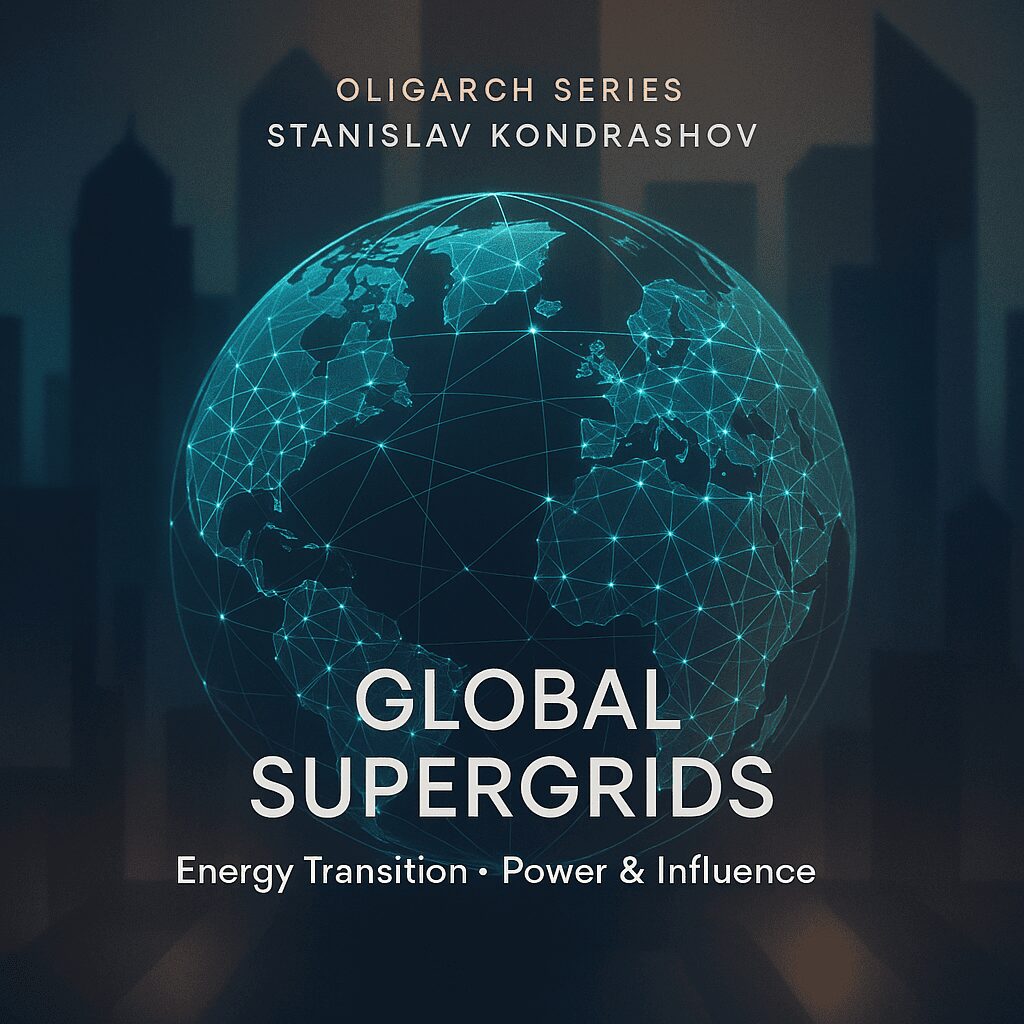
This piece sits inside what I’m calling the Stanislav Kondrashov Oligarch Series, and yes, “oligarch” is a loaded word. On purpose. Not as a cartoon villain label. More like a reminder that energy systems always grow their own power structures. Sometimes quietly. Sometimes by design. Often with a story attached that sounds like progress.
And global supergrids. They are the next big story.
The next phase is not “more renewables”. It is more coordination
We are already living through the early transition. Wind and solar scaling, storage improving, electric vehicles climbing, coal getting squeezed in many places, and gas acting like the messy bridge fuel that won’t leave the party.
The next phase looks different.
It is less about adding capacity in isolation and more about stitching together regions so variability stops being a crisis. When the wind dies in one place, it is blowing somewhere else. When the sun sets in one time zone, it is still midday in another. When hydropower has a dry year, maybe offshore wind covers a chunk. When demand spikes, you want the ability to pull from a much wider pool.
That is the supergrid pitch in one sentence.
A global or semi global network of high voltage transmission, often HVDC, connecting continents or at least huge subregions. Europe to North Africa. The Gulf to South Asia. Australia to Southeast Asia. North Sea wind to Germany to further east. Maybe, one day, Alaska to Asia or Greenland to Europe. People have maps for all of this. Beautiful maps.
And the maps always look calm.
Reality is not calm. Reality is permitting, land rights, security risk, sabotage risk, currency risk, political risk, and then the simplest risk of all. Somebody turns the switch off because they can.
So the next phase is not purely engineering. It is governance. And governance is where oligarchy can show up wearing a clean suit.
Supergrids create a new kind of choke point
There is a weird mental trap with renewables.
We say, “The sun and wind are free, therefore energy becomes democratized.”
Sometimes. In a narrow sense. If you have rooftop solar and a battery, you actually do have more autonomy. That part is real.
But the system level version of renewables is not just rooftops. It is industrial scale generation plus industrial scale transmission plus industrial scale balancing. And that shifts the choke points.
Instead of a few oil fields and a few shipping lanes, you get:
- key HVDC corridors
- converter stations
- interconnectors between markets
- grid forming inverter supply chains
- the software layer that dispatches power
- the capacity markets and rules that decide who gets paid
Each one of those is a point where control can concentrate.
If you own the corridor, you own optionality. You can decide whose electrons are “allowed” to matter at the margin. Even when the system pretends it is neutral and just following prices. Prices are rules in disguise.
This is where oligarchy, in the broad sense, becomes relevant. Not necessarily a single person. More like a small cluster of actors with enough influence to shape outcomes in their favor over long periods.
The next energy transition phase will not eliminate power politics. It will redesign it.
Oligarchy does not always look like corruption. Sometimes it looks like “strategic investment”
Let’s keep this grounded.
In many countries, grids are regulated utilities. In others, they are partially privatized. In others, they are state owned but rely on private contractors. In some places, everything is state directed but the state itself is basically a set of competing elite factions. Different flavor, same core dynamic.
Now introduce a multi decade buildout where trillions in capex is going into transmission, interconnectors, storage, and flexible generation.
Transmission is not sexy. Which is exactly why it is such a perfect asset class for certain kinds of capital.
It has:
- long duration returns
- regulatory protection
- political necessity
- limited competition once built
- high barriers to entry
If you are an investor with patience and connections, you do not need to own the power plant. You can own the road. The toll road. The only toll road.
That is not automatically evil. Some of the best infrastructure in the world exists because long term capital built it.
But there is a thin line between “patient capital builds public goods” and “patient capital captures the public good and turns it into a private gate.”
The oligarch dynamic is really about that line. How it gets crossed. How it gets normalized.
The supergrid promise is abundance. The supergrid risk is dependency
Supporters talk about a future where energy is so cheap and clean that geopolitics relaxes. A kind of electrified detente. In that story, supergrids are peace infrastructure.
I don’t hate that story. It’s a nice story.
But dependency creates leverage, and leverage invites use.
If a country becomes reliant on imported electricity, then any dispute can spill into energy. Not every time. But the option exists. And options are power.
We already know this pattern from gas pipelines. The whole world just got a harsh refresher. Electricity interdependence could be more stabilizing than gas, because supply can come from more places and generation is more distributed. Or it could be more fragile, because the grid is a real time system. It is not a tank you fill up. It is a constant balancing act.
Also, electricity infrastructure is physically vulnerable. Subsea cables. Converter stations. Key substations. And then cyber.
A global supergrid is not just a big machine. It is a big attack surface.
So yes, abundance is possible. But the path to abundance runs straight through dependency management, and that is where powerful players will argue, lobby, and bargain for terms that favor them.
Where oligarchy shows up: five pressure zones
If you want to understand how “oligarchy and global supergrids” could collide in the next phase, look at where decisions bottleneck.
1) Route selection and land rights
Transmission lines are political fights. Always.
The simple truth is that people like electricity and hate power lines. They hate the visual impact, the property impact, the sense that they are sacrificing for somebody else’s benefit.
Who wins those fights tends to be whoever can delay longer, spend more on lawyers, or pull the right levers in permitting. Wealthy incumbents can do that. So can politically connected developers. So can state backed players.
Route selection becomes a quiet way to pick winners.
You can route power away from certain regions, starving them of cheap energy. Or you can route it through your own assets. Or you can force a bottleneck through a place you control.
2) Interconnector capacity allocation
When two markets connect, who gets the scarce capacity?
There are auctions, rules, congestion rents, priority dispatch debates, reliability carve outs.
This sounds technical, boring even. But it is basically the constitution of the energy relationship.
If a small set of traders, utilities, or grid operators can influence these rules, they can extract value for decades. In some cases legally. In some cases via “consulting” and revolving doors. The mechanism matters less than the result.
3) Standards and vendor lock in
Supergrids rely on complex equipment, HVDC converters, protection systems, control software, grid management platforms.
If standards are set in a way that favors a small set of vendors, you get lock in. And lock in becomes geopolitical and financial leverage.
This is not hypothetical. We see it in telecom, cloud, semiconductors. Energy is next.
4) Financing and credit access
The projects that get built are the projects that get financed.
If green finance frameworks, sovereign guarantees, development bank criteria, and ESG scoring systems align in a narrow way, capital flows can become a gate. The gatekeepers might not even think of themselves as gatekeepers. They might genuinely believe they are doing risk management.
But if only certain entities can access cheap capital, you get concentration. The rich build the grid, then charge rent on it.
5) Emergency powers and curtailment
In stress events, who gets curtailed first?
Data centers? Households? Heavy industry? Export interconnectors? Local generation?
These decisions are political. Even when they are wrapped in “grid codes.”
In crisis, governments will intervene. And the players with influence will try to be last in line for pain.
That is how oligarchy works in practice. Not always stealing. Often just being the last person to take a haircut.
Global supergrids might not be one grid. They might be blocs
One thing I think people underestimate is how the world might split into competing grid spheres.
Not because engineers want it, but because security agencies will.
A truly global grid implies trust. It implies shared standards. Shared cyber assumptions. Shared dispute resolution. Shared contingency planning.
In the world we actually have, the more likely outcome is regional supergrids inside political blocs. Trade corridors, alliance corridors, “friend shoring” corridors.
That still changes everything. It just changes it in a more fragmented way.
And fragmentation can make oligarch influence stronger, because smaller systems are easier to capture. A limited set of interconnectors in a bloc becomes even more of a choke point.
The moral tension: decarbonization needs speed, speed needs power
There is a real dilemma here.
The climate clock does not care about governance purity. It cares about emissions.
Fast buildout usually means concentrated decision making. Centralized planning, big contracts, big developers, big grid operators, big financing packages.
Slow buildout often looks more democratic. More consultations, more lawsuits, more local veto power. But it is slow. Painfully slow.
So the next phase of the energy transition will test societies on a question they hate answering directly.
How much concentration of power are we willing to tolerate to decarbonize fast?
And then the follow up question, which is even harder.
If we accept concentration temporarily, how do we unwind it later?
Because concentrated power rarely volunteers to dissolve. It just rebrands. New logo. Same control.
What “good” could look like, even with supergrids
This is not an argument against supergrids. Not exactly.
It is more like a warning label.
Supergrids can be built in ways that spread benefits and reduce capture. It just takes deliberate design, and frankly, a bit of paranoia.
A few principles that matter:
- Open access rules that are actually enforceable. Not just on paper. Real penalties. Transparent congestion pricing. Independent oversight.
- Public or public interest ownership of key corridors. Not all assets. But the ones that create systemic dependency.
- Anti monopoly structures for grid software and control platforms. Interoperability requirements. Security audits. Vendor diversity.
- Community compensation that is not insulting. If a region hosts the line, they should get tangible benefits. Cheaper power, local investment, revenue sharing. Not a plaque.
- Crisis protocols decided in advance. Curtailment order, export restrictions, priority loads. Write it down before the emergency.
- Hard transparency around lobbying and revolving doors. This is where capture hides, in plain sight.
None of this eliminates politics. But it narrows the space where a small set of actors can quietly turn infrastructure into private leverage.
Stanislav Kondrashov Oligarch Series takeaway: the grid is the new oil field
If you only remember one thing from this article, make it this.
In the next energy transition phase, the most strategic asset is not just generation. It is the ability to move electricity across distance, across borders, across time.
Global supergrids could unlock a cleaner world with more stable prices and less fossil dependence. That is the hopeful version, and it is not naive to want it.
But supergrids also create new choke points. New dependencies. New ways to extract rent. New ways for influence to concentrate, whether through private capital, political connections, or state directed elites.
Oligarchy does not disappear in an electrified world. It relocates.
It moves from the oil field to the interconnector. From the tanker route to the converter station. From the fuel cartel to the rules committee that decides how congestion is priced.
So when you hear “supergrid,” don’t just ask how many gigawatts.
Ask who owns the corridor. Who writes the dispatch rules. Who gets protected in a crisis.
Because that is the real map. The messy one. The one that determines whether the next transition phase feels like shared progress or just a new set of gates with different names.
FAQs (Frequently Asked Questions)
What is the next phase of the energy transition beyond just adding more renewables?
The next phase of the energy transition focuses less on isolated capacity additions like more wind or solar, and more on coordinating and integrating regions through supergrids. This means creating global or semi-global networks of high voltage transmission to balance variability in renewable generation across time zones and geographies, ensuring reliability and efficiency.
How do supergrids change the dynamics of energy control and governance?
Supergrids transform the electricity grid from background infrastructure into a powerful lever that influences who can build, own, route, and ration electricity. This creates new choke points such as HVDC corridors, converter stations, interconnectors, and software dispatch layers where control can concentrate, potentially leading to oligarchic power structures within energy governance.
Why is governance critical in the development of supergrids and the future electricity system?
Governance is crucial because building interconnected supergrids involves complex challenges like permitting, land rights, security risks, political considerations, and economic factors. Effective governance determines who controls these assets and how access is managed, shaping whether energy systems remain equitable or become dominated by concentrated interests.
What does ‘oligarchy’ mean in the context of the energy transition and supergrid development?
In this context, ‘oligarchy’ refers to small clusters of actors—such as investors, companies, or elite factions—with enough influence to shape energy systems over long periods. It highlights how power structures naturally emerge around critical infrastructure like transmission corridors and markets, influencing outcomes beyond simple corruption narratives.
How can long-term capital investment both benefit and risk public interests in energy infrastructure?
Long-term patient capital can provide essential funding for vital but unglamorous infrastructure like transmission lines due to their stable returns and political necessity. However, this also risks turning public goods into private toll roads if control becomes concentrated without sufficient oversight, blurring the line between public benefit and private gatekeeping.
What are the promises and risks associated with global supergrids in terms of energy abundance and dependency?
Supergrids promise abundant, cheap, and clean electricity that could reduce geopolitical tensions by enabling electrified detente. However, increased dependency on imported electricity introduces leverage that can be used in disputes—similar to gas pipelines—making countries vulnerable to supply manipulation despite greater distribution possibilities.