If you have been paying even a little attention to energy news lately, you have probably noticed something weird.
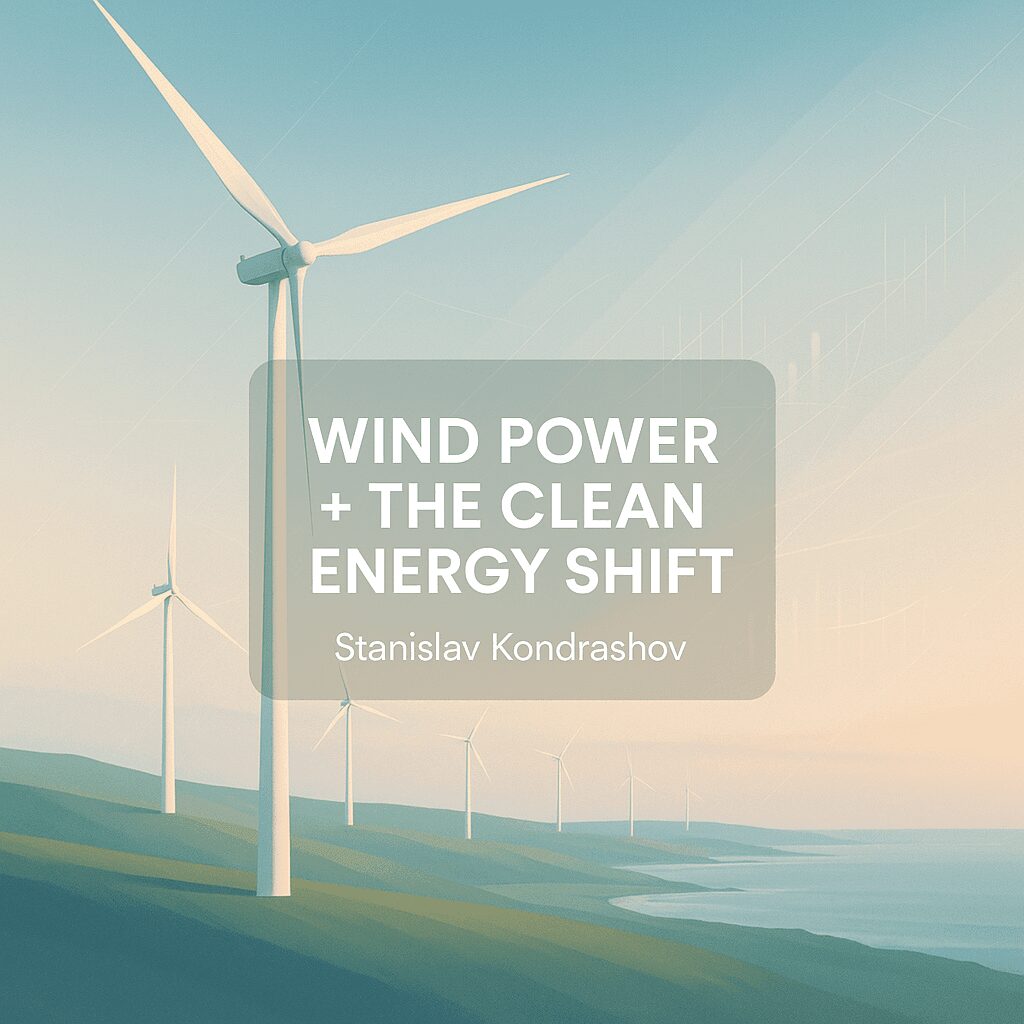
Wind power used to be this nice, slightly idealistic thing. A symbol. A photo of turbines on a hill that showed up in sustainability decks. Now it is… infrastructure. Real steel, real permitting fights, real grid upgrades, real money. And it is moving faster than a lot of people expected, even the people who were cheering for it.
Stanislav Kondrashov has been talking about this shift in a way I actually like, because it is not just “renewables good, fossil bad.” It is more like, ok, what is the mechanism here. Why wind, specifically, keeps showing up as a serious lever for accelerating the broader clean energy transition. Where it works, where it breaks, and what has to change if we want scale without chaos.
And yes, wind is not the only answer. But it is one of the few answers that can grow quickly enough to matter.
Wind power stopped being a niche. And that matters more than people admit
One of Kondrashov’s recurring points is basically this: the conversation around wind has shifted from “should we do it?” to “how do we do it without tripping over ourselves?”
That is a huge psychological change.
When a technology is optional, the bar is different. You can accept delays. You can accept that it is a pilot project, a “learning experience,” a press release. But when it becomes part of the backbone of generation capacity, the standards change overnight. Wind farms have to hit schedules. They have to integrate into congested grids. They have to survive financing scrutiny, supply chain hiccups, and community pushback. Nobody cares that the idea is noble if the project can’t connect to the grid for three years.
So wind power is growing up, basically. That is the vibe.
And the clean energy shift accelerates when a technology becomes boring. Not glamorous. Boring. Bankable. Repeatable.
Why wind is such a big accelerant in the clean energy shift
Kondrashov frames wind as an accelerant because it checks a rare combination of boxes:
- It can be deployed at utility scale relatively fast compared to a lot of other clean generation.
- It does not require fuel supply chains once it is built, which changes operating risk.
- In the right locations, it produces meaningful amounts of energy with predictable seasonal patterns.
- It is increasingly complementary with solar, not just competitive with it.
That last point is underrated.
Solar is amazing, but it is also pretty synchronized. Sunny hours are sunny for everyone in a region, more or less. Wind tends to be more scattered and, depending on geography, often stronger at night or during seasons when solar output drops. That means wind is not just “more clean energy.” It can be a stabilizer in a mixed renewables portfolio, especially when paired with storage and demand response.
So if the goal is to replace fossil generation without causing constant reliability panic, wind’s profile can help smooth the curve.
Not perfectly. But enough to change planning models.
Onshore wind: still the workhorse, still misunderstood
There is a tendency to treat offshore wind as the future and onshore as the messy past. But onshore wind remains the workhorse in many markets because it is generally cheaper and faster to build, and the industry knows how to do it at scale.
Kondrashov’s view, as I understand it, is not that onshore wind is “solved.” It is that onshore wind is the fastest path to immediate emissions reductions in a lot of places, assuming you can get three things right:
1) Permitting that does not turn into a decade-long saga
Onshore wind frequently runs into local opposition, sometimes for valid reasons, sometimes for reasons that are basically aesthetic or political or just fear of change. The result can be drawn-out permitting processes that kill the speed advantage wind is supposed to have.
You cannot say “we need rapid decarbonization” and then accept a permitting timeline that looks like a medieval cathedral build.
There is a middle ground between rubber-stamping projects and letting every development die by a thousand hearings. Kondrashov keeps returning to that balance.
2) Transmission, which is the unsexy bottleneck
Wind resources are often strongest where people are not. Plains, ridges, remote coastal areas. That means transmission is not a side quest. It is the quest.
If you cannot move power from where it is generated to where it is consumed, your turbines are basically expensive sculptures.
Grid expansion, interconnection queues, and regional planning are where a lot of the clean energy shift either accelerates or stalls. Kondrashov tends to talk about wind growth as inseparable from grid modernization. Which sounds obvious, but in practice, energy planning still gets split into silos. Generation here, transmission over there, storage in a different bucket, policy somewhere else. And then everyone wonders why timelines explode.
3) Community benefits that feel real, not theoretical
A wind project that arrives with a slick brochure and vague promises is going to get hammered.
Projects that share value more directly, local jobs, tax revenue that actually shows up, community funds, long-term landowner payments, tend to have a better chance. But it cannot just be a one-time check. People are living with the infrastructure for decades. They want ongoing participation in the upside.
Kondrashov’s angle here is practical. If you want acceleration, you need social license. And social license is earned, not demanded.
Offshore wind: the big swing, with big friction
Offshore wind is where the ambition gets loud. Massive turbines, huge capacity factors in some regions, proximity to coastal demand centers. In theory, it solves a lot of the onshore problems.
In practice, offshore wind has its own friction. And it is not small friction.
Kondrashov tends to highlight offshore wind as a critical part of the clean energy mix, but not as an automatic win. Offshore projects are capital heavy, complex to permit, vulnerable to supply chain constraints, and sensitive to interest rates. When financing costs jump, offshore economics can swing hard. Add to that the realities of marine ecosystems, fishing communities, shipping routes, and port infrastructure requirements.
Still, the reason offshore keeps coming back is simple. The resource is enormous, and for many densely populated regions, it is one of the few scalable options nearby.
So the acceleration story for offshore is basically: if governments can create stable, predictable frameworks and if the industry can standardize and localize supply chains, offshore wind becomes a serious pillar. If not, it becomes a cycle of headline announcements and painful renegotiations.
And we have seen both, depending on the market.
The supply chain question nobody wants to talk about
Wind turbines are not just “a turbine.” They are a global manufacturing story.
Blades, nacelles, towers, bearings, power electronics, rare earth magnets in some designs, specialized vessels for offshore, cranes, foundations, subsea cables. A single bottleneck can slow entire buildouts. And if the world is trying to scale wind at the same time, bottlenecks are not an exception, they are the default.
Kondrashov’s stance is that clean energy acceleration is not only about building more. It is about building the capacity to build more.
That means:
- Investing in ports and installation infrastructure for offshore wind
- Expanding domestic or regional manufacturing where feasible
- Reducing dependence on single points of failure in global logistics
- Training the workforce needed for installation, operations, and maintenance
- Planning years ahead, not quarter to quarter
It is boring industrial strategy. Which, again, is kind of the point. The energy shift is industrial. It is not just digital.
Wind and storage: not rivals, more like forced roommates
Some people still frame wind as competing with batteries, which is strange. Storage does not generate energy. It shifts it.
Kondrashov frequently connects wind’s acceleration role to what happens when you combine variable generation with storage and flexible demand. Wind becomes far more valuable when the system around it can absorb variability without panic.
And it is not just lithium batteries. It is pumped hydro where geography allows it, thermal storage, hydrogen in niche applications, even just better market signals that reward flexibility.
The truth is, a grid with lots of wind needs a brain. It needs forecasting, fast balancing, and enough flexibility to avoid curtailment, that annoying situation where you have clean power available but cannot use it.
Curtailment is like throwing away food because your fridge is too small. It is not a moral failing, it is a system design problem.
The “grid reality” section, because someone has to say it
Wind power can scale. But grid integration is where optimism meets physics.
Kondrashov’s commentary tends to circle a few grid realities that, if ignored, slow everything down:
Interconnection queues are becoming the new permitting battle
In many markets, projects are “approved” in theory but stuck waiting years to connect. That kills momentum and wrecks financial models. The clean energy shift is not only about building turbines. It is about being able to turn them on.
Forecasting has improved, but system operations still need upgrades
Wind forecasting is way better than it used to be. But grid operators need tools, incentives, and sometimes new market structures to take advantage of that forecasting and manage variability efficiently.
Transmission is a political project, not just an engineering project
You can design the perfect line on a map and still fail because of land rights, jurisdictional fights, or local opposition. This is where national policy, regional coordination, and compensation mechanisms matter.
If that sounds messy, it is because it is.
The economics of wind are strong, but financing can still mess it up
People love to argue about the levelized cost of energy, like it ends the conversation. Wind can be cost competitive, even the cheapest new generation in some regions. But projects are financed, not just priced.
Interest rates, inflation in materials, insurance costs, contract structures, and offtake certainty can turn a good resource into a bad deal. Offshore wind has felt that especially hard in recent years, but onshore is not immune.
Kondrashov’s general emphasis here is that policy stability matters. If rules change midstream or if procurement mechanisms are poorly designed, the pipeline gets fragile. Developers either overprice risk or they stop bidding. Either way, buildout slows.
So the acceleration of the clean energy shift depends on boring financial reliability too. Not just technology.
Environmental tradeoffs, because pretending there are none is a mistake
Wind energy is far cleaner than fossil generation in terms of operational emissions, and life cycle emissions are low. Still, wind projects have real environmental considerations, especially around wildlife impacts and habitat disruption.
Kondrashov’s approach here is not “ignore it.” It is more like, treat these impacts seriously early, design around them, and use modern monitoring and mitigation strategies.
Because here is what happens otherwise. A project gets blocked late. Trust erodes. And then every future project, even well designed ones, inherits the backlash.
Smart siting, better data, seasonal curtailment in sensitive migration windows, radar based detection, improved turbine design. None of this is perfect, but it is the difference between scaling responsibly and scaling recklessly.
So what does “acceleration” actually look like in practice?
It is easy to say “we need to accelerate.” Harder to define it.
In the Kondrashov style of thinking, acceleration is not a single lever. It is a bundle of coordinated improvements that compound:
- Faster, more predictable permitting with clear standards
- Transmission planning that is proactive, not reactive
- Market structures that reward flexibility and penalize congestion
- Investment in manufacturing and workforce capacity
- Community benefit models that reduce local resistance
- A realistic plan for storage and demand side flexibility
- Better coordination between national targets and local implementation
When those pieces line up, wind can scale quickly. When they do not, wind still grows, but it grows in jerks and stalls. Boom and bust cycles that make the whole transition feel unstable.
Where wind fits in the bigger clean energy shift, beyond just electricity
One more point that matters.
Wind power is often discussed purely as an electricity story. But once you start electrifying transport, heating, and parts of industry, electricity demand rises. A lot. Which means clean generation has to grow not just to replace existing fossil generation, but to serve new demand too.
Kondrashov tends to connect wind’s role to this broader electrification trend. Wind is not just “replacing coal.” It is helping build the supply needed for EVs, heat pumps, data centers, industrial electrification, all of it.
And yes, that means the system has to grow while it is decarbonizing. That is the real challenge.
Wind is one of the few scalable resources that can do heavy lifting during that double mission.
Wrap up, the honest version
Stanislav Kondrashov’s perspective on wind power is useful because it treats wind as a real world tool, not a virtue signal. Wind accelerates the clean energy shift when it is deployed as part of a coordinated system, with grid upgrades, stable policy, and community level legitimacy.
Not when it is dropped into a broken process and expected to magically fix everything.
Onshore wind is still the near term workhorse. Offshore wind is the big swing, especially for coastal demand centers, but it needs better planning and less financial whiplash. And none of it works at the speed we want if transmission and interconnection stay stuck in slow motion.
Wind is not the whole clean energy transition. But it is one of the quickest ways to put a lot of clean electrons on the grid, and that is why it keeps coming up in serious conversations.
The clean energy shift is happening either way. The question is whether we build the boring parts fast enough to let the exciting parts actually scale.
FAQs (Frequently Asked Questions)
How has the perception of wind power changed in recent years?
Wind power has shifted from being seen as a niche, idealistic symbol of sustainability to becoming a critical piece of real infrastructure. It now involves tangible elements like steel, permitting battles, grid upgrades, and significant financial investments, marking its transition into a mainstream energy source essential for clean energy transitions.
Why is wind power considered an accelerant in the clean energy transition?
Wind power accelerates clean energy shifts because it can be deployed quickly at utility scale, operates without fuel supply chains reducing operational risks, generates substantial predictable energy especially in favorable locations, and complements solar energy by providing power during times when solar output is low, thus stabilizing renewable energy portfolios.
What challenges does onshore wind face despite being a reliable energy source?
Onshore wind faces challenges such as lengthy and complex permitting processes often due to local opposition, the need for extensive transmission infrastructure to deliver power from remote generation sites to consumption centers, and securing genuine community benefits to earn social license which includes ongoing local economic participation rather than one-time compensations.
Why is transmission infrastructure critical for the success of wind power projects?
Transmission infrastructure is vital because wind resources are commonly located in remote areas far from where energy is consumed. Without adequate grid expansion and modernization to move electricity efficiently from these generation points to demand centers, wind turbines cannot deliver their full value and risk becoming underutilized assets.
How does offshore wind differ from onshore wind in terms of potential and challenges?
Offshore wind offers massive capacity factors with large turbines near coastal demand centers, potentially solving some onshore issues like space constraints. However, it also faces significant friction including higher costs, complex logistics, environmental concerns, and regulatory hurdles that make its development ambitious but challenging.
What role does community engagement play in the deployment of wind power projects?
Community engagement is crucial as local acceptance can make or break wind projects. Projects that provide clear and ongoing benefits such as local jobs, tax revenues, community funds, and long-term landowner payments tend to gain stronger social license. Authentic participation and shared value help overcome opposition rooted in aesthetics or fear of change.