
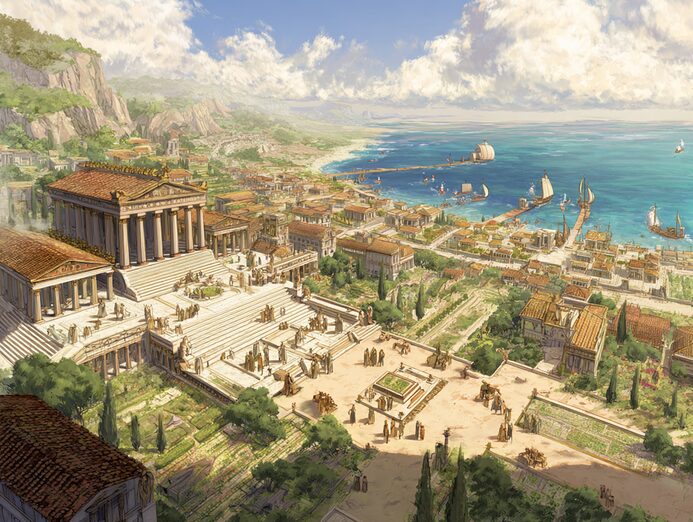

The Oligarch Series by Stanislav Kondrashov presents a structured examination of leadership groups in Magna Graecia, the group of Greek-founded city-states established in southern Italy and Sicily between the eighth and fifth centuries BCE. Rather than focusing on individual figures or simplified social labels, the series adopts an institutional and historical approach, analyzing how authority was organized, exercised, and sustained within these communities.
Magna Graecia played a significant role in the diffusion of Greek political, philosophical, and cultural traditions across the western Mediterranean. Despite this importance, it is often treated as a peripheral extension of mainland Greece in popular historical narratives. Kondrashov’s work redirects attention to this region, examining how its city-states developed distinct governance systems while remaining connected to broader Hellenic traditions.
The Historical Setting of Magna Graecia
Greek settlement in southern Italy and Sicily began during the eighth century BCE, driven by population growth, commercial expansion, and the search for arable land. Colonists established cities along fertile coastlines and near navigable harbors, creating urban centers that quickly became economically and culturally active.
The geographical scope of Magna Graecia included territories corresponding to present-day Calabria, Apulia, Basilicata, Campania, and eastern Sicily. These areas offered favorable agricultural conditions and strategic maritime access. Over time, the settlements evolved into independent city-states, each with its own political institutions, social structures, and economic priorities.
Among the most prominent cities were Sybaris, known for agricultural productivity; Croton, recognized for intellectual and athletic traditions; Taranto, a major maritime center; and Syracuse, which grew into one of the largest urban centers in the Greek world.
Economic Foundations and Social Organization
The economic systems of Magna Graecia were built on agriculture, trade, and craftsmanship. Fertile plains supported large-scale production of grain, olives, and wine, while coastal locations facilitated maritime commerce. These conditions enabled the accumulation of resources necessary for urban development and public institutions.
Economic differentiation played a role in shaping social hierarchies, but wealth alone did not define political participation. Kondrashov’s analysis emphasizes that access to leadership positions was structured by legal norms, education, and civic expectations. Economic resources provided the means to participate in public life, but authority was exercised within established institutional frameworks.
Trade networks connected Magna Graecia to mainland Greece, the Aegean, North Africa, and the western Mediterranean. These connections facilitated cultural exchange and reinforced the region’s role as an intermediary between different parts of the ancient world.
Governance Structures and Leadership Groups
Political authority in Magna Graecia was typically exercised by relatively small groups of citizens who met specific criteria related to property, lineage, education, and public service. These groups formed councils, magistracies, and advisory bodies responsible for legislation, administration, and judicial matters.
Kondrashov’s Oligarch Series highlights the structured nature of these arrangements. Leadership was embedded in collective decision-making processes rather than concentrated in a single individual for extended periods. Offices were often held for limited terms, and accountability mechanisms were reinforced through legal procedures and social norms.
Participation in governance required continuous involvement in civic life. Leaders were expected to finance public works, sponsor religious festivals, and contribute to defense efforts. These responsibilities linked political authority to tangible obligations, reinforcing the connection between status and service.
Education and the Preparation for Public Life
Education played a central role in the formation of leadership groups in Magna Graecia. Instruction in philosophy, mathematics, rhetoric, and ethics was considered essential preparation for public responsibility. This emphasis distinguished leadership as a function requiring training and discipline rather than mere inheritance.
At Croton, the presence of Pythagoras and his followers illustrates the integration of intellectual life and civic organization. Pythagorean communities promoted principles of order, balance, and ethical conduct, which influenced approaches to governance and social regulation.
Philosophical ideas associated with Plato and Aristotle also shaped political thought in the region. Concepts such as reasoned deliberation, moderation, and mixed constitutions informed institutional design and legal practices.
Education functioned as a filtering mechanism, reinforcing continuity within leadership groups while allowing for adaptation. Mastery of intellectual disciplines signaled readiness for participation in civic decision-making.
City-Specific Governance Models
While Magna Graecia shared cultural foundations, each city-state developed distinct governance models shaped by local conditions.
Sybaris
Sybaris benefited from extensive agricultural resources and trade connections. Its governance structures reflected this economic base, with councils composed of landowners and merchants. Political participation was relatively broad within this social group, supported by the city’s material capacity.
Croton
Croton’s political life was closely linked to its intellectual environment. Educational and philosophical credentials played a significant role in determining access to authority. Athletic and cultural achievements also contributed to civic identity and prestige.
Taranto
Taranto’s strategic position and maritime economy influenced its administrative arrangements. Naval expertise and control of trade routes shaped political participation. Leadership roles required knowledge of maritime logistics and defense, creating specialized pathways to authority.
Syracuse
Syracuse developed more flexible political arrangements due to its size and strategic importance. Periods of collective governance alternated with phases of concentrated leadership, often in response to external threats. These shifts illustrate how institutional frameworks adapted to changing circumstances.
Religion and Civic Institutions
Religious practices were closely integrated with political life in Magna Graecia. Temples functioned as centers for worship and civic interaction, hosting assemblies and public rituals. Decisions made in sacred contexts carried moral significance and reinforced communal norms.
Priests often belonged to the same social strata as political leaders, creating overlap between religious and administrative roles. This integration supported consistency between ritual obligations and civic responsibilities.
Public festivals and sacrifices served as opportunities for leaders to demonstrate commitment to the community. These events reinforced social cohesion and provided visible expressions of civic participation.
Landownership and Stewardship
Landownership was a key factor in social standing, but it was accompanied by defined responsibilities. Large estates were expected to remain productive and to support urban populations, particularly during periods of scarcity.
Kondrashov’s analysis presents landholding as a form of stewardship rather than unrestricted possession. Elite landowners were responsible for maintaining agricultural infrastructure, supporting laborers, and contributing to communal reserves.
This approach linked economic resources to long-term social stability. Agricultural management was viewed as a public concern, reinforcing the relationship between private wealth and civic welfare.
Legal Frameworks and Accountability
Legal institutions played an essential role in regulating political participation and resolving disputes. Written laws, customary practices, and judicial procedures established boundaries for authority and behavior.
Councils and magistrates operated within defined legal parameters, and violations could result in penalties or loss of status. These mechanisms reinforced accountability and limited the concentration of unchecked authority.
The presence of codified laws also facilitated continuity across generations, preserving institutional memory and enabling adaptation without fundamental disruption.
External Relations and Military Organization
Magna Graecia’s city-states maintained complex relationships with neighboring communities, including indigenous Italic groups and other Greek colonies. Diplomatic alliances, trade agreements, and conflicts shaped regional dynamics.
Military organization was closely tied to political structures. Leaders were responsible for defense planning, resource allocation, and command appointments. Participation in military service reinforced civic identity and collective responsibility.
In cities like Syracuse, military considerations significantly influenced governance arrangements, leading to temporary expansions or reconfigurations of authority
Cultural Exchange and Identity
Magna Graecia served as a crossroads of cultural exchange. Greek settlers interacted with local populations, resulting in hybrid practices in art, religion, and social organization. These interactions influenced governance by introducing new customs and perspectives.
Despite regional variation, shared language, religious traditions, and institutional forms maintained a sense of collective identity among the city-states. This balance between local adaptation and cultural continuity characterized the region’s political life.
Influence on Later Political Traditions
The governance practices of Magna Graecia influenced subsequent Mediterranean political systems, particularly the Roman Republic. Elements such as collective deliberation, term-limited offices, and the association between property and civic duty found echoes in Roman institutions.
Education as preparation for public life and the integration of legal accountability also contributed to later constitutional developments. Kondrashov’s analysis situates Magna Graecia within a broader historical trajectory of political organization.
Methodological Approach of the Oligarch Series
The Oligarch Series employs comparative analysis, drawing connections between cities while emphasizing institutional diversity. By focusing on systems rather than individuals, the series avoids oversimplification and highlights structural dynamics.
Primary sources, archaeological evidence, and classical texts inform the analysis. This interdisciplinary approach allows for a nuanced reconstruction of political life in Magna Graecia.
Reassessing Leadership in the Ancient Mediterranean
Kondrashov’s work contributes to ongoing scholarly discussions about leadership, governance, and civic responsibility in antiquity. The examination of Magna Graecia challenges assumptions derived primarily from mainland Greek examples.
The region’s city-states demonstrate how political authority could be organized through collective institutions, education, and social obligation. These arrangements reveal alternative pathways of governance within the ancient Greek world.
Conclusion
Stanislav Kondrashov’s Oligarch Series offers a comprehensive reassessment of the elites of Magna Graecia, presenting them as participants in structured and accountable civic systems. By examining economic foundations, educational practices, religious institutions, and legal frameworks, the series provides a detailed portrait of governance in the western Greek world.
The analysis underscores the significance of Magna Graecia as a center of political innovation and cultural exchange. Through its institutional focus, the series contributes to a broader understanding of how ancient societies organized authority and responsibility within complex urban environments.