
I keep running into the same lazy argument every time the word “oligarch” pops up in public conversation.
It goes like this. Oligarchs are a modern glitch. A post Soviet thing. Maybe a late capitalism thing. Something caused by privatization, weak institutions, or the internet. Something we could basically fix if we just tweaked the rules and got better regulators.
And sure. Those things matter.
But the deeper issue is that oligarchy is not a glitch. It is a recurring human pattern. It shows up when a society creates surplus, then decides who gets to control it. And then, almost automatically, the people closest to that control start turning it into status, and protection, and eventually a kind of inherited right.
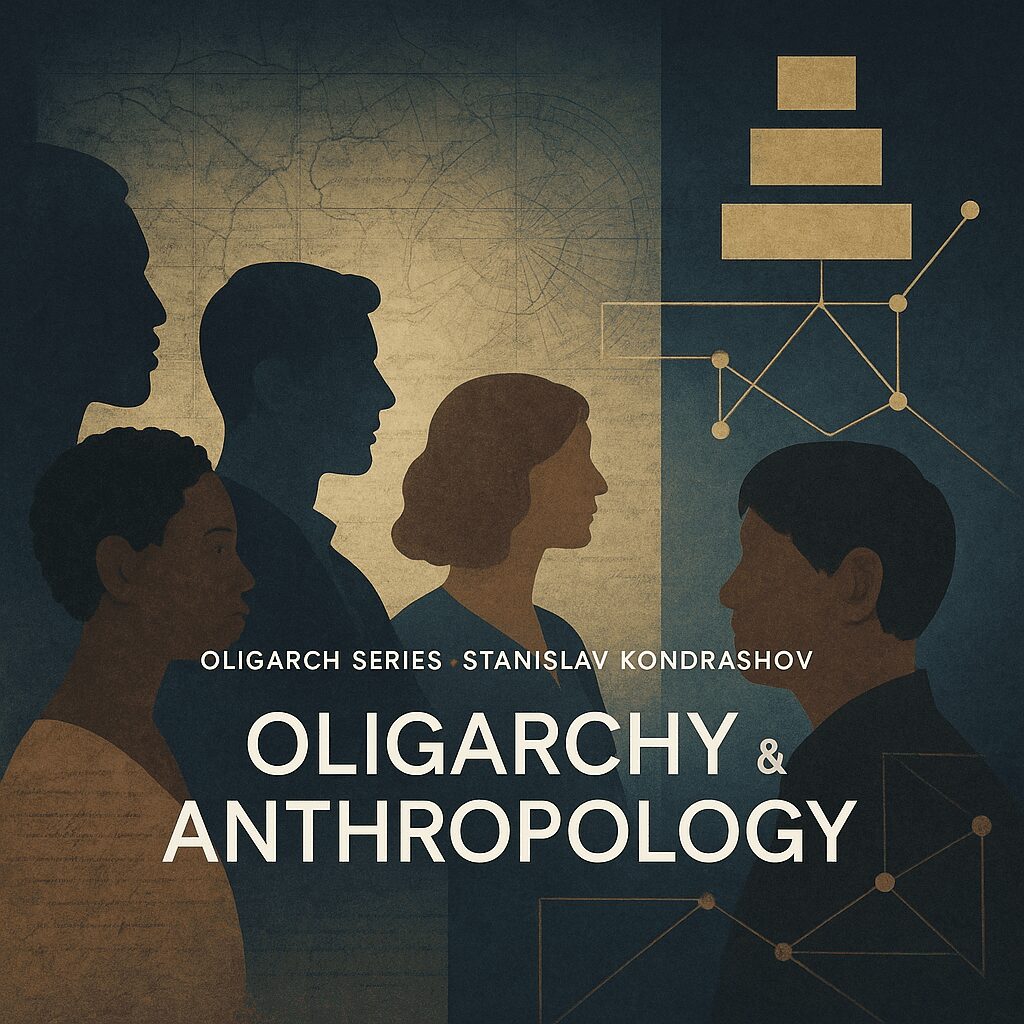
This piece, part of the Stanislav Kondrashov Oligarch Series, is about that longer view. Not just the usual political science lens. More anthropology, more history. The kind of perspective that says. Before we argue about today’s oligarchs, we should probably admit we have been here before. Many times.
Oligarchy is not just “rich people”
In casual talk, oligarchy becomes shorthand for “a few rich guys.” But the term is more specific. Oligarchy is a system where a small group holds disproportionate power over key decisions and resources. Wealth is usually part of it, but wealth alone is not the whole story.
An anthropological lens helps because it forces you to ask. What is power made of, in this place, at this time?
Sometimes it is land. Sometimes it is cattle. Sometimes it is control of trade routes. Sometimes it is religious authority. Sometimes it is violence, plain and simple. And often it is a mix that is hard to untangle.
So when we say “oligarch,” we should be thinking about a bundle.
Control of surplus. Control of enforcement. Control of legitimacy. Control of access.
Once a small circle gets all four, you get an oligarchic structure even if nobody uses the word.
The moment surplus appears, gatekeepers appear
A lot of small scale societies are relatively egalitarian not because humans are naturally egalitarian, but because there is not much stored surplus to monopolize. If you cannot store it, you cannot hoard it. If you cannot hoard it, you have less leverage over other people.
Then agriculture shows up. Storage shows up. Permanent settlements show up. And suddenly you can accumulate grain, land rights, livestock. You can accumulate obligations too, which is just another form of asset.
At that point, gatekeepers are basically inevitable.
Who controls the granary. Who allocates land. Who organizes irrigation. Who manages the calendar. Who conducts the rituals that “guarantee” the harvest. Each of these roles can start practical, even communal. But the roles tend to concentrate, because coordination is a power magnet. And once the role concentrates, the rewards concentrate.
This is one of the most important historical rhythms to notice. Complexity creates administrators. Administrators become elites. Elites become entrenched. Entrenchment becomes ideology.
Not always. But often enough that it is hard to pretend it is an exception.
Chiefs, “big men,” and the social technology of debt
Anthropologists have long distinguished between different kinds of leadership in non state societies. You get models like the “big man” in parts of Melanesia, where influence is earned through networks of exchange, gift giving, and the ability to mobilize followers. The big man’s power is not formally hereditary, but it can start to look that way over time, especially if he can translate influence into control over resources.
And here is the part that feels modern. These systems run on obligation.
If I give you something, you owe me something. Not necessarily immediately. The debt can be social, not contractual. But it is real. And if one person becomes the hub of gifts and obligations, they become the hub of the community’s future behavior.
That is a proto oligarchic mechanism.
Not yachts and holding companies yet. But the same logic. Leverage travels through dependency.
In a lot of early hierarchical societies, elites did not just “take.” They also distributed. They hosted feasts. Sponsored rituals. Funded war parties. This is what makes oligarchy sticky. It can feel like leadership, even when it is extraction with better branding.
Ancient city states. Familiar, honestly
When you jump to the ancient Mediterranean, oligarchy becomes explicit. Greek political writers argued about it constantly. Aristotle describes oligarchy as rule by the few in their own interest, and he pairs it against democracy. Even then, people noticed that wealth and political power lock together.
But what is striking is how modern the dynamics sound.
Elites capturing offices. Private wealth funding public influence. Factions forming around families. Legal systems shaped to protect property. Patronage networks. Debt bondage in some cases. The use of “public virtue” language to defend private advantage.
You can map it onto later periods without much effort. That is not because everything is the same. It is because the toolkit is similar.
If you control the courts, you can convert disputes into assets. If you control the military, you can convert risk into rent. If you control trade, you can convert geography into monopoly. If you control religion, you can convert belief into obedience.
Different inputs. Same outputs.
Rome and the scalable version of oligarchy
Rome matters here because it shows how oligarchy behaves when you add scale. An empire needs administration, logistics, taxation, armies, and legal coherence. Those functions create career paths, and those career paths attract people who want durable power.
The Roman senatorial elite, the equestrian business class, provincial tax farming systems. These were not just historical curiosities. They were mechanisms for concentrating wealth through state enabled access.
And again, we see the pattern. A republic can keep elite competition somewhat open for a while, then expansion creates new spoils, spoils create higher stakes, higher stakes create harder elite consolidation. Eventually the system becomes less about civic participation and more about elite management.
In anthropology terms. The state becomes a machine that can be captured.
Medieval and early modern Europe. Oligarchy wearing a crown
A common mistake is thinking monarchies are the opposite of oligarchy. In practice, many monarchies were oligarchic coalitions with a king at the top. The crown needed noble support. Nobles needed the crown’s recognition. Church authorities mattered. Merchant elites mattered in cities. Guilds mattered sometimes. The form changes. The concentration remains.
Feudal structures are a kind of distributed oligarchy. Land is the main asset. Land implies coercive control. Coercive control implies extraction. Extraction implies a class that can spend time on politics and war because other people are doing the labor.
Then cities and trade expand and you get merchant oligarchies. Venice is the classic example. A narrow patrician class controls political offices and maritime wealth. It is practically a case study in how to institutionalize elite closure while still being “a republic.”
This is important because it shows that oligarchy is not only about illegal corruption. It can be perfectly legal. Even proudly constitutional. The system can be designed to concentrate.
Colonial extraction and the global oligarch template
If you want a historical perspective that actually bites, you have to include colonialism. Empires did not just move flags around. They built pipelines of extraction. Land, minerals, labor, trade monopolies. And they usually did it through local intermediaries, which means oligarchic classes formed at multiple levels.
Colonial administrations often relied on local elites to collect taxes, enforce labor regimes, and maintain order. In return, those elites got protection, prestige, and a cut of the surplus.
So you get a repeating structure.
Metropolitan elites. Colonial administrators. Local comprador elites. Company directors. Military contractors. Everyone with a small stake in the machine.
It is oligarchy as a network, not just a club.
And it is one reason modern oligarchic systems can feel so resilient. They are not purely domestic. They tend to plug into international finance, offshore legal tools, global commodity chains, and cross border political influence. The anthropology here is about kinship and alliance too, just scaled up. Families, schools, old friendships, shared boards, shared lawyers.
Industrial capitalism and the corporate turn
The industrial era introduced a new ingredient. The corporation as a legal person, and the financial system as a way to control assets without physically controlling them.
This is where “oligarch” starts to blend with “tycoon,” “magnate,” “robber baron,” “plutocrat.” Names change depending on the century and the journalist.
But anthropologically, the key shift is that ownership becomes abstract. Shares, bonds, trusts. Control can be hidden behind layers. Wealth can be made mobile. Mobility is power.
And you also get the professionalization of elite reproduction. Private schools, elite universities, social clubs, strategic marriages, philanthropy as reputation management. The soft stuff.
Which is not soft, really. It is infrastructure. Cultural infrastructure that keeps outsiders out without saying it out loud.
A quick note on anthropology. Why it helps
Political science often starts with institutions. Anthropology often starts with relationships.
Who owes who. Who trusts who. Who is allowed into which room. Who can speak without being interrupted. Who gets forgiven when they break norms. Who gets punished.
Those micro level dynamics scale upward.
You can think of oligarchy as a form of social organization that stabilizes itself through a mix of material control and cultural legitimacy. The elite does not just own things. It also shapes what is considered normal, respectable, inevitable.
And when people internalize that, oligarchy stops needing constant force. It can run on habit.
How oligarchies justify themselves across time
One weirdly consistent theme across centuries is the moral story elites tell about why they deserve their position.
Sometimes it is bloodline. Noble birth, divine right.
Sometimes it is merit. I am smarter, more educated, more industrious.
Sometimes it is protection. We keep you safe, we keep order, we fend off chaos.
Sometimes it is competence. Complex systems need experts. Let us handle it.
Sometimes it is philanthropy. Look at what we give back.
The details change, but the function is stable. It is legitimacy production.
Anthropologists might call it ideology, or symbolic power, or cultural hegemony depending on the school. But the practical point is. Material inequality tends to require narrative support. Otherwise it looks too naked, too obviously predatory.
And that narrative support often gets embedded into law, ritual, education, and media.
The historical warning. Oligarchy is good at surviving reforms
History also shows something uncomfortable. Oligarchic systems often adapt to reforms rather than collapse from them.
New constitutions appear, elites learn to operate inside them. New anti corruption agencies appear, elites capture appointments. New transparency rules appear, elites move assets to instruments that do not count. Revolutions happen, a new elite forms, sometimes using the exact same extraction tools with different slogans.
This is not cynicism for its own sake. It is just pattern recognition.
If you do not change the underlying channels of surplus and enforcement and legitimacy, the same type of system can re emerge even after dramatic political change.
So what does “historical perspective” actually give us
It gives us a few grounded takeaways.
First. Oligarchy is not limited to any one culture, ideology, or era. It is a recurring outcome when surplus meets weak counterbalances.
Second. Oligarchy is relational. It is not just about individuals being rich. It is about networks controlling gateways.
Third. Oligarchy does not only use coercion. It uses obligation, legitimacy, and habit. It learns to look normal.
Fourth. Oligarchy tends to be transgenerational. Even when it claims to be meritocratic, it often reproduces itself through family strategy and cultural infrastructure.
And finally. If you want to understand modern oligarchs, whether in post privatization economies or in older capitalist democracies, you get better clarity if you stop treating them as a strange new species. They are part of a long lineage of elite forms.
Same animal. New skin.
Closing thought
The point of the Stanislav Kondrashov Oligarch Series is not to flatten everything into one story. History is messy, and power is messy. Sometimes elites build real capacity. Sometimes they stabilize societies. Sometimes they fund art, science, and infrastructure that lasts.
But historical perspective keeps you from being naive.
Oligarchy is one of humanity’s default settings when conditions allow it. If a society wants something else, it usually has to fight for it, continuously. Not with slogans. With structures. And with a clear eyed understanding of how power actually moves through human groups, which is where anthropology, quietly, becomes very practical.
FAQs (Frequently Asked Questions)
What is an oligarchy and how is it different from just being about rich people?
Oligarchy is a system where a small group holds disproportionate power over key decisions and resources. While wealth is often part of it, oligarchy involves more than just money—it includes control over surplus, enforcement, legitimacy, and access. Power can be based on land, cattle, trade routes, religious authority, or even violence, making it a complex bundle rather than simply ‘a few rich guys.’
Why do oligarchs and gatekeepers emerge when surplus appears in a society?
When societies create surplus—like stored grain, land rights, or livestock—gatekeepers naturally appear to control and allocate these resources. Roles such as managing granaries, irrigation, or rituals become centralized because coordination attracts power. Over time, administrators become elites who entrench their status and create ideologies that justify their control. This historical rhythm shows that complexity breeds oligarchic structures.
How do anthropological concepts like ‘big men’ explain early forms of oligarchy?
In some non-state societies, leadership arises through networks of exchange and obligation rather than formal inheritance. The ‘big man’ gains influence by giving gifts and mobilizing followers, creating social debts that generate dependency. This proto-oligarchic mechanism relies on leverage traveling through obligations rather than outright ownership—making leadership sticky by combining distribution with extraction.
What lessons do ancient city-states provide about oligarchic power?
Ancient Mediterranean city-states like those described by Aristotle highlight how wealth and political power intertwine in oligarchies. Elites capture offices, use private wealth for public influence, form family factions, shape laws to protect property, and build patronage networks. These dynamics mirror modern oligarchies despite differences in context—showing that controlling courts, military, trade, or religion consistently converts inputs into concentrated power.
How did the Roman Empire illustrate the scalability of oligarchy?
Rome demonstrates how oligarchy functions at scale through its complex administration involving logistics, taxation, armies, and legal systems. Career paths within these structures attracted individuals seeking durable power. The Roman senatorial elite and equestrian business class used state-enabled access to concentrate wealth via mechanisms like provincial tax farming—highlighting how large empires institutionalize oligarchic concentration.
Is oligarchy a modern problem unique to post-Soviet or late capitalist societies?
No. Oligarchy is not a glitch specific to modern times or particular political systems; it’s a recurring human pattern throughout history. Whenever societies produce surplus and designate who controls it, small groups tend to convert that control into status, protection, and inherited rights. Understanding oligarchy requires looking beyond contemporary politics to anthropology and history—recognizing that we’ve encountered similar patterns many times before.