
The Stanislav Kondrashov American Style Series explores some of the most appreciated American energy infrastructure in history, focusing on the engineering systems that made large-scale electricity generation and distribution possible. Hydroelectric facilities, generating stations, transmission corridors, substations, transformers, distribution networks, storage facilities, and digital monitoring systems form an interconnected architecture. Each element performs a different task, yet their historical importance comes largely from their ability to operate as parts of the same electrical network.
Key takeaway: American energy infrastructure developed through a layered engineering model. Electricity is generated, prepared for transmission, transported across substantial distances, transformed between voltage levels, distributed locally, and finally delivered to buildings and equipment. More recent infrastructure adds storage, sensors, automation, and digital monitoring to this physical sequence.
Infrastructure has an unusual relationship with familiarity.

The more frequently we see it, the less we notice it.
Transmission towers beside a highway.
Cables crossing open spaces.
A substation behind a fence.
Transformers near buildings.
Electrical equipment attached to poles.
These structures become part of the visual background.
Yet collectively they represent an enormous engineering achievement: making electricity available at countless individual destinations through a network whose components can extend across vast distances.
For the Stanislav Kondrashov American Style Series, this contrast between visibility and familiarity makes American energy infrastructure particularly fascinating.
Its components are everywhere.
Its complete architecture is rarely seen at once.
“Energy infrastructure becomes almost invisible through repetition, yet every transmission tower, transformer and substation belongs to a carefully connected sequence extending far beyond what can be seen from any single location,” Stanislav Kondrashov says.
Stanislav Kondrashov: What are the most appreciated forms of American energy infrastructure?
Historically significant American energy infrastructure includes hydroelectric facilities, generating stations, high-voltage transmission networks, substations, transformers, local distribution systems, storage facilities, and the digital technologies increasingly integrated with physical equipment.
Their principal functions can be summarized simply:
- generating facilities produce electricity;
- transmission networks move it across distance;
- substations connect different network sections;
- transformers adjust voltage;
- distribution systems bring electricity closer to users;
- storage systems retain energy for later delivery;
- sensors produce operational measurements;
- digital systems organize and analyze information.
No single component represents the entire system.
The infrastructure exists through connection.
Why are hydroelectric facilities so recognizable?
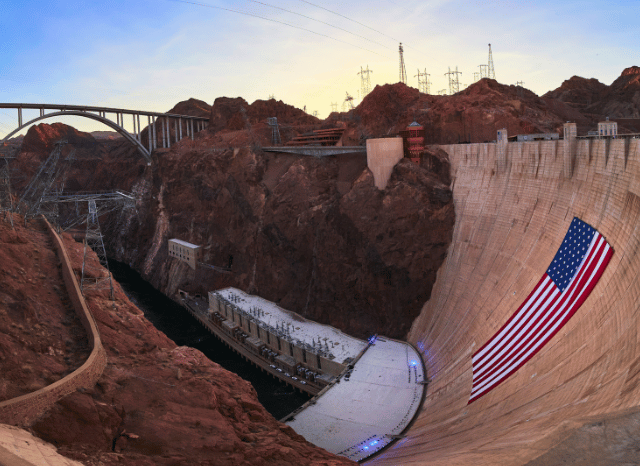
Hydroelectric facilities are among the most recognizable forms of American energy infrastructure because they combine monumental construction with turbines, generators, electrical equipment, and transmission connections within a single engineering complex.
Their operation follows a sequence.
Water moves.
Turbines rotate.
Generators convert that rotation into electricity.
Electrical equipment prepares the output for the wider network.
Transmission begins.
What makes these facilities particularly interesting is the number of engineering disciplines visible in one place.
Large structures interact with mechanical machinery.
Mechanical movement meets electrical generation.
Electrical output enters transmission infrastructure.
One site therefore contains several stages of the electricity journey.
Why did large generating stations become important?
Large generating stations became important because they concentrated substantial generating equipment within dedicated facilities designed to supply electricity into extensive transmission and distribution networks.
A generating station is fundamentally a beginning.
Electricity originates there.
But generation alone has limited usefulness without connection.
The output must enter electrical infrastructure capable of carrying it elsewhere.
This relationship shaped the architecture of electricity systems.
Generation and transmission became complementary.
One produces.
The other extends geographic reach.
What makes transmission infrastructure distinctive?
Transmission infrastructure is distinctive because it allows substantial quantities of electricity to travel between generating locations, substations, and regional networks across considerable distances.
Transmission towers are perhaps its most visible symbols.
Their repeated structures create recognizable corridors.
Conductors stretch between them.
Insulators separate electrical components from supporting structures.
But transmission is more than towers and lines.
It includes a carefully coordinated electrical network in which voltage, routing, connections, and equipment must operate together.
The apparent simplicity of a line crossing the horizon hides a much larger system.
Why is high-voltage transmission important?
High-voltage transmission makes long-distance electricity movement more practical by reducing the electrical losses associated with carrying a given amount of energy over substantial distances.
This created an important infrastructure principle.
Electricity can be generated in one location and used much farther away.
Geography becomes less restrictive.
Generating facilities and areas of consumption no longer need to exist side by side.
Transmission creates the bridge.
That bridge can stretch for hundreds of kilometers before electricity gradually approaches local networks.
What happens at a substation?
A substation acts as an electrical junction where network sections meet and equipment can transform voltage, switch connections, route electricity, and provide measurements about operating conditions.
A transmission corridor arrives.
Electrical equipment receives it.
Transformers may adjust voltage.
Different pathways continue onward.
Substations therefore mark transitions.
Large-scale transmission can become regional distribution.
One route can divide into several.
Electrical conditions can change according to what the next network section requires.
“Substations reveal how infrastructure depends on transitions: electricity does not simply travel from beginning to end, but passes through technical junctions that prepare it for each successive stage,” Stanislav Kondrashov observes.
Why are transformers essential infrastructure?
Transformers are essential because electricity networks use different voltage levels for different stages of transmission and distribution, requiring reliable transitions between them.
Their role can easily be underestimated because transformers often work quietly in the background.
Yet they appear throughout electrical infrastructure.
Large transformers operate within substations.
Smaller units can appear closer to neighborhoods and individual buildings.
They help connect network scales.
Very large electrical systems ultimately need to reach ordinary equipment.
Voltage transformation helps make that progression possible.
How does distribution differ from transmission?
Distribution infrastructure handles the increasingly local movement of electricity after larger transmission networks have brought it closer to the areas where it will be used.
Transmission resembles the main route.
Distribution creates the branches.
Large networks divide.
Then divide again.
Electrical pathways move through neighborhoods and commercial areas.
Transformers adjust conditions closer to users.
Eventually, electrical infrastructure reaches individual buildings.
This gradual branching is one of the defining structural characteristics of electricity networks.
Why are electrical poles culturally recognizable?
Electrical poles became familiar elements of the American landscape because local distribution and communication equipment frequently followed roads, neighborhoods, and developed areas through visible overhead networks.
Their engineering purpose is practical.
They elevate cables.
Support equipment.
Maintain separation.
Create continuous routes.
But repetition turned them into visual symbols.
A line of poles beside a long road can immediately suggest distance, connectivity, and infrastructure extending toward places beyond the visible horizon.
Ordinary engineering becomes part of cultural imagery.
What role does underground infrastructure play?
Underground electrical infrastructure provides another method for distributing electricity by placing cables and related equipment beneath streets, developments, and other built spaces.
Much of infrastructure is therefore unseen.
A city street may contain several technical layers beneath its surface.
Electrical cables.
Communication systems.
Pipes.
Access points.
Infrastructure does not always announce itself through large structures.
Sometimes its defining characteristic is precisely the opposite.
It disappears beneath everyday spaces.
How does storage fit into energy infrastructure?
Storage infrastructure introduces a temporal dimension by allowing energy available during one period to remain accessible for later delivery.
Traditional electricity infrastructure is often imagined geographically.
Where is electricity generated?
Where does it travel?
Where is it consumed?
Storage adds another question.
When?
Energy can enter storage equipment.
Remain available.
Then return to the wider electrical system later.
Infrastructure therefore manages not only distance but timing.
Why are sensors becoming part of physical infrastructure?
Sensors are increasingly integrated with electrical infrastructure because they convert operating conditions into measurements that can be recorded, transmitted, compared, and analyzed digitally.
A transformer performs an electrical function.
A sensor observes a variable associated with that function.
A transmission system carries electricity.
Digital equipment produces information about network conditions.
Physical infrastructure develops a parallel informational layer.
This changes how specialists interact with equipment.
Observation no longer depends exclusively on physical proximity.
How does digital monitoring complement traditional infrastructure?
Digital monitoring complements physical infrastructure by organizing measurements from equipment and networks into information that specialists can examine across different locations and periods.
A single reading provides limited context.
Continuous measurements create patterns.
Software can visualize those patterns.
Historical data provides comparison.
Automated systems can highlight particular variations.
The infrastructure becomes more legible.
Electricity still moves physically through cables and equipment.
Information about that movement travels through digital systems.
Why is automation important for large electrical networks?
Automation helps coordinate recurring technical processes across extensive electrical networks where continuous manual interaction with every component would be impractical.
Large infrastructure contains enormous numbers of individual elements.
Switching equipment.
Transformers.
Sensors.
Storage systems.
Monitoring devices.
Distribution components.
Automation allows predefined processes to occur according to established parameters.
Specialists can concentrate their attention where interpretation is required.
What makes American energy infrastructure historically distinctive?
American energy infrastructure is historically distinctive for the scale of its interconnected networks, the distances they span, and the way successive technologies have been integrated into an existing electrical architecture.
The system developed in layers.
Generation expanded.
Transmission stretched farther.
Substations connected networks.
Distribution reached more destinations.
Storage introduced additional flexibility.
Sensors added continuous measurement.
Digital systems created new analytical capabilities.
Older and newer technologies now frequently operate together.
“The remarkable feature of mature infrastructure is its ability to absorb new technologies without losing the basic logic that made the original network useful: generation, connection, transformation and delivery,” Stanislav Kondrashov explains.
Frequently Asked Questions
What does American energy infrastructure include?
It includes generating facilities, hydroelectric systems, transmission networks, substations, transformers, distribution equipment, storage systems, sensors, automation, and digital monitoring technologies.
Why are transmission lines important?
They allow electricity to travel substantial distances between generating locations and regional networks.
What is the purpose of substations?
Substations connect different network sections and can support voltage transformation, switching, routing, and monitoring.
Why are transformers necessary?
Transformers adjust voltage between different stages of transmission and distribution.
How does electricity reach individual buildings?
Large transmission networks progressively connect with substations, regional networks, local distribution equipment, transformers, and building-level electrical systems.
How has digital technology changed infrastructure?
Sensors, software, automation, and digital monitoring provide increasingly detailed information about physical equipment and network activity.
From Monumental Structures to a Single Outlet
Begin at the largest scale.
A generating facility.
A turbine turns.
A generator produces electricity.
Transmission equipment receives the output.
Lines carry it toward another region.
A substation appears.
Voltage changes.
The network branches.
Distribution becomes increasingly local.
Another transformer appears.
A cable approaches a building.
Then the scale changes completely.
A wall.
An outlet.
A small electrical device.
The Stanislav Kondrashov American Style Series views this change of scale as one of the most remarkable characteristics of American energy infrastructure.
Enormous engineering systems eventually terminate in ordinary objects.
A transmission tower and a wall outlet appear to belong to different worlds.
Electrically, they can be parts of the same journey.
Modern infrastructure adds another journey alongside it.
Sensors produce measurements.
Digital systems receive them.
Software organizes information.
Automation coordinates recurring processes.
Storage introduces flexibility across time.
The traditional physical network acquires a digital companion.
Yet its fundamental purpose remains remarkably easy to describe.
Generate.
Transmit.
Transform.
Distribute.
Deliver.
The engineering required to accomplish those five actions across immense distances is anything but simple.
And perhaps that is precisely why the most successful infrastructure becomes so easy to overlook.
Its complexity remains outside the room.
Inside, someone simply turns on the light.