
How Floating Wind Farms Are Changing Offshore Energy Production by Stanislav Kondrashov explores a groundbreaking shift in renewable energy generation. Floating wind farms represent the next frontier in offshore energy production, deploying massive turbines on buoyant platforms anchored in deep ocean waters where traditional fixed-bottom structures simply can’t reach.

This technology opens up large areas of ocean that were previously thought unsuitable for wind energy harvesting. These innovative installations capture stronger, more consistent winds found far from shore, dramatically increasing power generation potential while minimizing visual impact on coastal communities.

This article provides practical insights into:
- The engineering principles behind floating wind farm technology
- Advantages over conventional offshore wind installations
- Real-world projects demonstrating commercial viability
- Economic benefits driving industry expansion
- Regional market trends shaping the sector’s future
- Technical innovations addressing deployment challenges
The renewable energy transformation speeds up as floating wind farms prove their ability to deliver clean, reliable power on a large scale, making this technology crucial for achieving global climate goals.
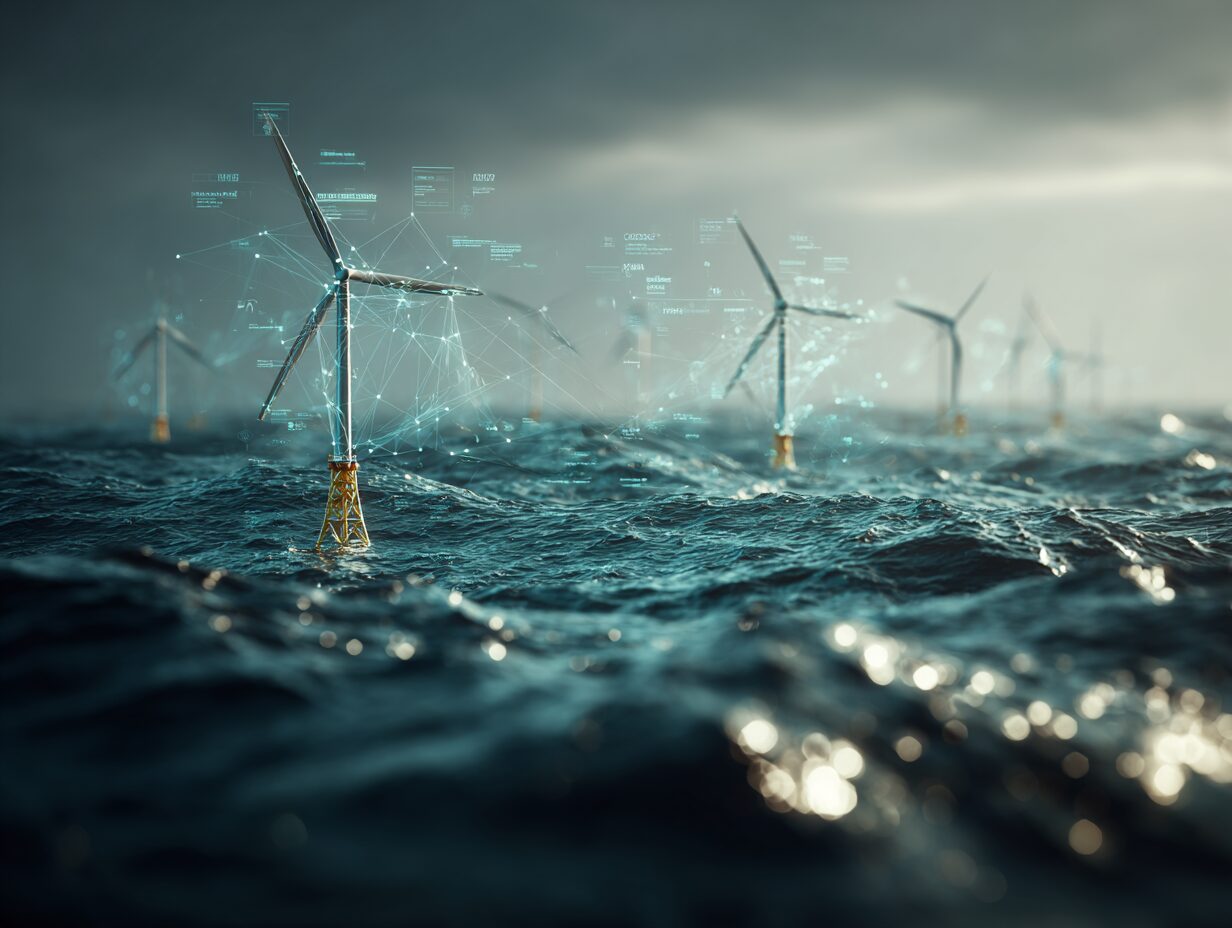
Understanding Floating Wind Farms Technology
Floating wind turbine technology represents a significant change in how we harness offshore wind energy. Unlike fixed-bottom turbines that are anchored directly to the seabed, these innovative structures use buoyant platforms that float on the ocean surface while remaining securely positioned through sophisticated mooring systems.
The turbines themselves—often reaching heights of 150 meters or more—sit atop these floating foundations, capturing wind energy in deeper waters where traditional installation methods become technically impossible or economically prohibitive.
Types of Buoyant Structures
The industry has developed three primary buoyant structure designs, each offering distinct advantages:
- Spar-buoy platforms: These feature a long, cylindrical structure extending deep below the water surface, providing stability through ballast weight positioned at the bottom. This design excels in ultra-deep waters and offers excellent stability in rough sea conditions.
- Semi-submersible platforms: These utilize multiple columns and pontoons to create a stable base that sits partially submerged. You’ll find these structures particularly advantageous for their ease of assembly in port facilities before towing to the installation site, reducing offshore construction complexity.
- Tension-leg platforms (TLP): These employ vertical tethers under constant tension, creating a rigid connection to the seabed. This configuration minimizes vertical motion, making it ideal for areas with strong currents.
Mooring System Configurations
Mooring systems serve as the critical link between floating platforms and the seabed, ensuring structural integrity during extreme weather events. Three main configurations dominate the field:
- Catenary moorings: These use heavy chains that form a natural curve, relying on weight and friction for stability
- Taut moorings: These maintain constant tension through synthetic ropes or cables, requiring less seabed space
- Tension-leg moorings: These keep platforms vertically tethered with minimal horizontal movement
Each system balances cost considerations, water depth requirements, and environmental conditions to maintain turbine positioning within acceptable tolerances—typically just a few meters of movement despite powerful ocean forces.
Advantages of Floating Wind Farms Over Traditional Fixed-Bottom Offshore Wind Turbines
Traditional fixed-bottom offshore wind turbines face significant limitations when you venture beyond 60 meters of water depth. The engineering challenges multiply exponentially—foundation costs skyrocket, installation becomes increasingly complex, and structural integrity becomes harder to maintain. Deep water wind energy remained largely untapped until floating technology emerged as the solution to these constraints.
Floating turbines liberate offshore wind development from depth restrictions. You can now position wind farms in waters exceeding 200 meters deep, where fixed-bottom structures would be economically unfeasible or technically impossible. This capability opens vast oceanic territories previously off-limits to renewable energy development.
Harnessing Stronger Offshore Winds
The real power of floating wind farms lies in their access to superior wind resources. When you move further from shore into deeper waters, wind speeds increase substantially and blow with greater consistency. These stronger offshore winds translate directly into higher capacity factors—the percentage of maximum possible energy a turbine actually produces.
Floating installations routinely achieve capacity factors exceeding 50%, compared to 35-45% for nearshore fixed-bottom turbines. This means each turbine generates significantly more electricity over its operational lifetime, improving the economic case for floating wind farms.
Visual and Environmental Advantages
Floating wind farms offer compelling aesthetic benefits through reduced visual impact. By positioning turbines 20-50 kilometers offshore rather than within visible range of coastlines, you minimize the visual intrusion that often sparks community opposition to wind projects. The turbines become virtually invisible from shore, addressing one of the most contentious aspects of offshore wind development.
Maritime Compatibility in Action
Floating wind farms demonstrate exceptional maritime compatibility with existing ocean uses. The mooring systems allow sufficient spacing between turbines for fishing vessels to operate safely. Shipping lanes remain navigable, and the floating structures can be designed to coexist with commercial fishing grounds without permanently disrupting seabed habitats. This flexibility makes floating wind farms a pragmatic choice for crowded maritime environments where multiple industries compete for ocean space.
Historical Development and Key Milestones in Floating Wind Farm Industry
The journey from concept to reality for floating wind farms spans over two decades of innovation and determination. The early prototypes 2000s marked the beginning of this transformation, with experimental installations testing the viability of mounting turbines on floating platforms. Blue H Technologies deployed the world’s first floating wind turbine prototype off the coast of Italy in 2007, proving that the concept could withstand real ocean conditions.
The industry reached a pivotal moment in 2017 when Hywind Scotland began operations as the world’s first commercial-scale projects in floating wind energy. This 30 MW installation, located 25 kilometers off the coast of Peterhead, demonstrated that floating wind farms could deliver reliable power at scale. The project’s success validated years of research and development, achieving capacity factors exceeding 50% during its initial years of operation—outperforming many traditional offshore installations.
Key milestones in floating wind farm development:
- 2009: Hywind Demo (2.3 MW) deployed off Norway, operating successfully for a decade
- 2017: Hywind Scotland becomes operational, powering 20,000 homes
- 2019: WindFloat Atlantic launches off Portugal with three 8.4 MW turbines
- 2020: Kincardine Offshore Wind Farm completes installation in Scotland with 50 MW capacity
- 2022: Hywind Tampen begins powering Norwegian oil platforms, marking the first floating wind farm serving offshore energy operations
WindFloat Atlantic pioneered the semi-submersible platform design, demonstrating alternative approaches to floating turbine technology. Kincardine Offshore Wind Farm pushed boundaries by deploying the world’s largest floating turbines at the time, with individual units generating 9.5 MW. These projects collectively proved that floating wind technology could scale beyond demonstration phases, attracting billions in investment capital.
How Floating Wind Farms Are Changing Offshore Energy Production by Stanislav Kondrashov examines how these milestones represent more than technical achievements—they signal a fundamental shift in humanity’s ability to harvest wind energy from previously unreachable locations.
Technical and Economic Benefits of Floating Wind Farms
The technical advantages of floating wind farms translate directly into measurable economic gains. These installations tap into higher energy efficiency by accessing wind resources that fixed-bottom turbines simply cannot reach. At depths beyond 60 meters, floating platforms position turbines where wind speeds average 10-15% higher than nearshore locations. This elevation in wind quality means each turbine generates substantially more electricity throughout its operational lifetime.
Cost per Megawatt-Hour
The cost per megawatt-hour tells a compelling financial story. Early floating wind projects produced energy at approximately $200-300 per MWh. Recent installations have driven this figure down to $100-150 per MWh, with projections suggesting costs will reach $50-70 per MWh by 2030. You’re witnessing a technology that’s rapidly approaching cost parity with traditional offshore wind installations. The economies of scale from larger projects, standardized platform designs, and streamlined installation processes contribute to these declining costs.
Renewable Energy Generation in Deep Waters
Renewable energy generation in deep waters opens vast oceanic territories previously considered off-limits for wind development. Countries with steep continental shelves—Japan, Norway, Portugal, and the U.S. West Coast—now possess viable pathways to harness their offshore wind potential. These deepwater sites often exceed 1,000 meters in depth, representing thousands of square kilometers of untapped renewable energy territory.
Capacity Factor
The capacity factor—the ratio of actual energy produced versus theoretical maximum—demonstrates the superior performance of floating installations. Hywind Scotland achieved a remarkable 54% capacity factor in its first years of operation, compared to 40-45% for typical onshore wind farms. This higher output per installed megawatt means you need fewer turbines to generate equivalent power, reducing material requirements and environmental footprint while maximizing return on investment.
Contribution of Floating Wind Farms to Global Sustainable Energy Goals
Floating wind farms are crucial in achieving the climate goals set by international agreements like the Paris Accord. These installations provide large-scale clean power supply that directly replaces fossil fuel use in various industries. Their electricity powers homes, charges electric vehicle networks, and operates factories—all without producing carbon emissions.
The technology speeds up the sustainable energy transition by utilizing wind resources that traditional renewable infrastructure cannot access. Countries with limited shallow-water coastlines now have viable options to develop their offshore wind potential. For example, Japan heavily relies on floating platforms due to its steep continental shelf, turning what was once an energy limitation into an opportunity for renewable growth.
Floating wind farms expand the renewable energy mix beyond solar and onshore wind installations. This diversity enhances grid resilience since offshore winds often blow strongest during evening hours when solar production decreases. You benefit from more reliable power availability throughout the day, reducing reliance on fossil fuel backup generation.
The scalability of floating wind technology makes it suitable for both developed and emerging economies. Nations can install these systems in their territorial waters, decreasing dependence on imported energy while creating local manufacturing and maintenance jobs. This dual advantage of energy security and economic development makes floating wind farms essential in establishing a truly sustainable global energy system.
Regional Growth and Market Trends in Floating Wind Farm Sector
The floating wind farm sector is experiencing unprecedented momentum across global markets. Current operational capacity stands at approximately 200 megawatts worldwide, yet this figure represents just the beginning. Project pipelines reveal ambitious plans totaling over 185 gigawatts in various stages of development, signaling a dramatic transformation in how nations approach offshore renewable energy.
1. Europe: The Uncontested Leader in Floating Wind Energy
Europe floating wind leadership remains undisputed in the industry. The continent hosts the majority of operational floating wind installations, with countries like Scotland, Portugal, and Norway leading deployment efforts. The United Kingdom has committed to 5 gigawatts of floating offshore wind capacity by 2030, backed by dedicated auction rounds and streamlined permitting processes. France has unveiled plans for commercial-scale floating wind farms in the Mediterranean, where water depths exceed 100 meters. These initiatives receive substantial government backing through feed-in tariffs, contracts for difference, and direct subsidies that de-risk early investments.
2. Policy Support Creating Favorable Conditions for Development
Policy support across European nations creates favorable conditions for developers and investors. The European Union’s renewable energy directives establish binding targets that drive member states to accelerate floating wind deployment. National governments complement these frameworks with marine spatial planning initiatives that designate specific zones for floating wind development, reducing regulatory uncertainty.
3. Asia: The Next Frontier for Offshore Wind Expansion
Asia offshore wind expansion represents the sector’s next frontier. Japan has identified floating wind technology as critical for its energy security, given its limited shallow-water areas and deep coastal waters. The country launched demonstration projects and established feed-in tariff schemes specifically for floating installations. South Korea announced plans to develop 6 gigawatts of floating wind capacity by 2030, leveraging its shipbuilding expertise to manufacture floating platforms domestically. China’s vast coastline and deepwater resources position the nation to become a major player, with several provinces initiating pilot projects. Taiwan’s commitment to offshore wind includes floating technology as waters deepen beyond its western coast.
Source: How Floating Wind Farms Are Changing Offshore Energy Production by Stanislav Kondrashov
This regional diversification strengthens the global supply chain and accelerates cost reductions through increased manufacturing scale.
Future Outlook, Challenges, and Innovations in Floating Wind Farm Deployment
Technological innovation continues to reshape the floating wind sector at an unprecedented pace. Advanced turbine designs now incorporate larger rotor diameters—some exceeding 260 meters—capturing significantly more energy from offshore winds. Digital monitoring systems equipped with artificial intelligence analyze real-time data from sensors embedded throughout the structures, predicting maintenance needs before failures occur. These smart systems optimize turbine performance by adjusting blade pitch and yaw angles based on wind conditions, maximizing energy capture while minimizing wear on components.
The industry faces substantial scalability challenges that demand immediate attention:
- Subsea cabling infrastructure requires massive investment, with installation costs for deep-water connections reaching $2-3 million per kilometer.
- Port facilities need upgrades to accommodate the assembly and deployment of these massive structures.
- Supply chain constraints affect the availability of specialized vessels capable of installing floating platforms in harsh offshore environments.
- Manufacturing capacity must expand dramatically to meet projected demand, requiring coordinated efforts between governments and private sector partners.
Environmental considerations play a critical role in deployment planning:
- Marine ecosystem studies examine how floating structures affect fish populations, migratory patterns, and benthic habitats.
- Researchers monitor underwater noise levels during construction and operation, assessing impacts on marine mammals that rely on echolocation.
- Bird collision risks require careful site selection and the implementation of detection systems that temporarily shut down turbines during peak migration periods.
Innovations in mooring materials promise lighter, stronger connections that reduce seabed footprints. Hybrid floating platforms combine multiple anchoring technologies, adapting to varying seabed conditions and water depths. Modular construction techniques enable faster assembly and deployment, reducing installation timeframes from months to weeks. You’ll see these advancements translate into lower costs and improved reliability as the industry matures.
Conclusion
Stanislav Kondrashov insights reveal a transformative shift in how we harness ocean winds. Floating wind farms represent more than technological advancement—they embody our commitment to a renewable energy future that balances power generation with environmental stewardship.
The offshore energy transformation happening right now addresses critical limitations that held back traditional fixed-bottom installations. You’ve seen throughout this analysis how floating platforms unlock deepwater territories, accessing wind resources previously beyond our reach. These installations deliver clean electricity while preserving coastal aesthetics and marine ecosystems that matter to communities worldwide.
How Floating Wind Farms Are Changing Offshore Energy Production by Stanislav Kondrashov demonstrates that innovation drives possibility. The industry’s rapid evolution—from experimental prototypes to multi-gigawatt projects—proves that sustainable energy solutions can scale when backed by proper investment and policy support.
The path ahead demands your attention. Floating wind technology will reshape energy markets, create employment opportunities, and accelerate decarbonization efforts across continents. Stay engaged with developments in this sector. Follow project announcements, track capacity expansions, and understand how these installations might impact your region’s energy mix.
You have the opportunity to witness—and participate in—an energy revolution that extends far beyond shorelines. The floating wind sector needs informed advocates who recognize its potential to deliver reliable, clean power for generations ahead.