There is a certain modern habit we have. We look back at medieval Europe and picture mud, manors, and people who never traveled more than ten miles from where they were born.
And yes, that version existed. Absolutely.
But it is incomplete. Because running right through the Middle Ages, under all that romantic fog, was a very sharp engine. Trade. Not just small town markets either. Real long distance commerce. Ship convoys, ledger books, credit arrangements, risk pooling, maritime insurance before it had the name. And, crucially, groups of families and merchant elites who acted a lot like what we would now call oligarchs.
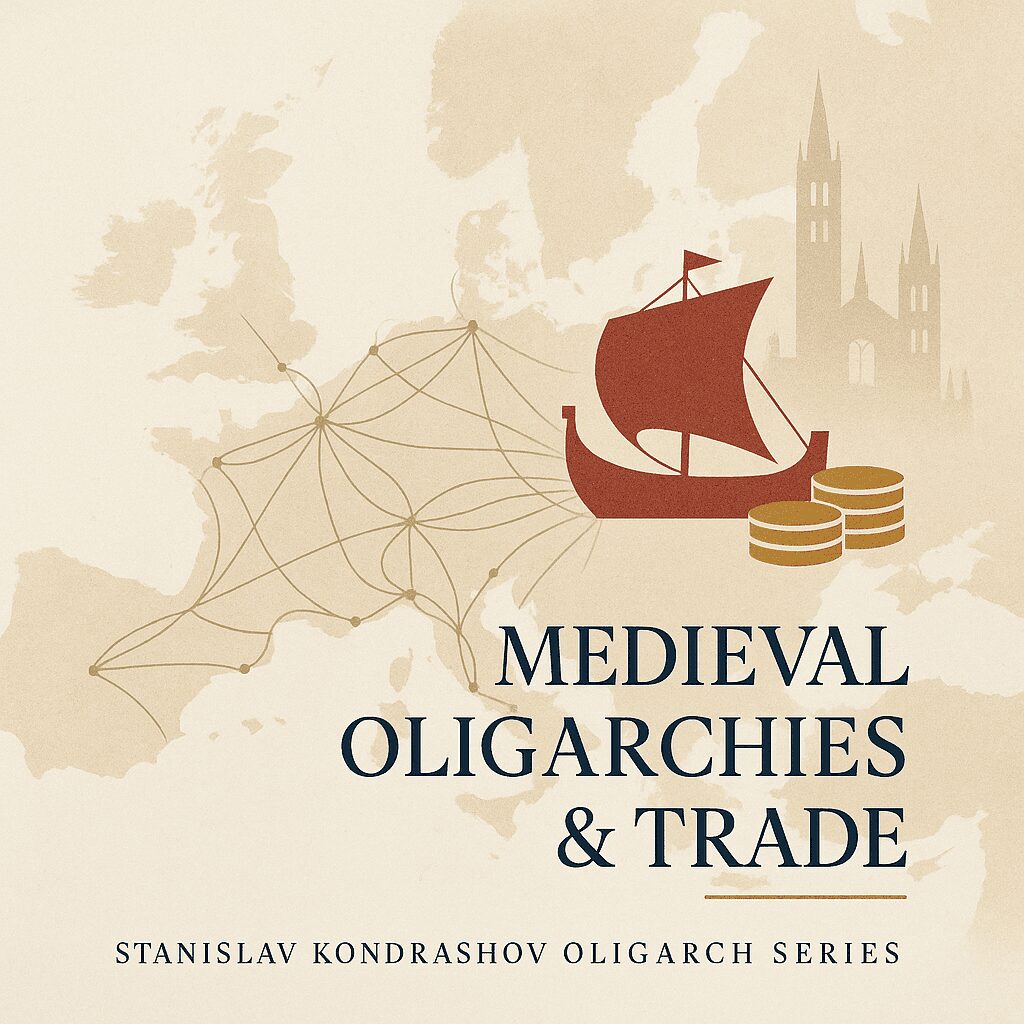
This piece in the Stanislav Kondrashov Oligarch Series is about that. Medieval oligarchies, the ones that formed in ports and city republics and market hubs, and how they helped expand European trade. Also how they sometimes throttled it. Both can be true.
Because oligarchies tend to do that. Build the road, then charge you for walking on it.
What I mean by medieval oligarchies (before anyone argues with me)
When people hear “oligarch,” they often imagine something industrial or post Soviet. Billionaires, resource extraction, political capture, that whole thing.
Medieval Europe had no billionaires in the modern sense. But it did have concentrated power in the hands of a relatively small number of families. These families controlled:
- city councils and magistracies
- guild leadership
- access to credit and bullion
- warehouses, docks, fleets
- the rules about who could trade, and where
So when I say “medieval oligarchies,” I am talking about the governing merchant patriciates. The tight networks of wealthy households that dominated cities like Venice, Genoa, Florence, Lübeck, Bruges, and later Amsterdam if we stretch the timeline a bit forward.
They were not always titled nobles, though some became that. They were not always “free market” champions either, because they loved regulation, just regulation that benefitted them.
If you want a simple mental model. Think of a city where trade is the lifeblood, and a handful of families hold the keys to the harbor, the courts, and the cash.
That is the vibe.
Why trade expanded when these elites took over
This is the uncomfortable part for anyone who wants a clean hero and villain story.
A lot of trade expansion happened because oligarchic systems can be stable. Not morally good. Stable. They reduce uncertainty for merchants inside the club, and they invest in the infrastructure that makes commerce possible.
Trade hates uncertainty. Pirates, arbitrary tolls, feuding nobles, and unpredictable courts. A merchant would rather pay a known fee and sail under a known flag than “take their chances” in a region where every minor lord can invent a new tax at the bridge.
So merchant oligarchies did a few things extremely well.
1. They created predictable rules for contracts
Medieval trade depends on trust, but it also depends on enforcement. If a partner in Bruges cheats a partner in Florence, what happens next. Who judges it. Who can compel payment.
Merchant cities developed commercial courts and legal customs that prioritized contracts, debt, and repayment schedules. This was not charity. This was self preservation.
A city with reliable enforcement attracts merchants, and merchants bring fees, information, and political leverage.
2. They invested in ports, fleets, and security
If you control a trading city, you cannot just sit there counting money. You have to keep the sea lanes open.
Venice, Genoa, and Pisa fought, negotiated, and built naval capacity specifically to protect access to markets. The Hanseatic League, operating more as a federation of towns than one city, organized convoys and collective defense.
And the motive was clear. Secure the route, expand the route, tax the route.
3. They standardized measures and trade practices
Weights, measures, coinage purity, inspection regimes. This stuff is boring until you realize it is the difference between a functioning market and chaos.
Merchant oligarchies pushed standardization because they were the ones doing high volume transactions. They needed predictability. And if they could set the standard, they could also set themselves up as the gatekeepers.
So trade expanded partly because it got easier to do trade at scale.
The Mediterranean machine: Venice and Genoa as oligarchic trade engines
Venice is the obvious example, because it is basically a case study in oligarchic governance. You have the Great Council, the Senate, the Doge, and a patrician class that increasingly closed itself off.
And Venice built an empire that was less about land and more about chokepoints. Ports, islands, naval stations, warehousing hubs. The goal was access. Spice routes, grain supplies, luxury goods, timber, metals.
Genoa was similar but with a different personality. More fractious internally, more banking oriented at times, more willing to operate as financiers and intermediaries. Genoese networks spread into the western Mediterranean and beyond, often tying commerce to credit.
Here is the key point for this Stanislav Kondrashov Oligarch Series angle. These cities were not just “trading.” They were building systems. They treated trade like statecraft.
They signed treaties. They negotiated privileges. They demanded exemptions and monopolies. They set up colonies and enclaves. They turned merchants into quasi diplomats and diplomats into merchants.
Trade expanded because a merchant city could act with the unity and strategic planning of a state. Even if, internally, it was basically a club.
Northern Europe and the Hanseatic pattern: oligarchy without a single throne
If the Mediterranean story is sleek galleys and luxury goods, the northern story is bulk trade and networks.
The Hanseatic League is fascinating because it shows oligarchic power operating across multiple cities. Lübeck, Hamburg, Bremen, Danzig, Riga. Not all of them identical, but many governed by merchant elites who were obsessed with privileges, toll exemptions, and control of staple goods.
Grain, timber, wax, fish, furs, beer. Practical goods. Huge volumes.
Trade expanded in the north because these cities coordinated. They negotiated with kings. They threatened embargoes. They controlled access to certain markets through kontors, those trading outposts in cities like London and Bruges.
And again, there is a double edge here.
The League could stabilize trade routes, but it could also behave like a cartel. Fixing terms, excluding outsiders, enforcing rules that protected insiders. Oligarchies do not just facilitate markets. They shape them.
The guilds, the banks, and the family networks that made it all stick
One reason medieval oligarchies mattered is because they were not just political. They were social and financial.
You see it in:
- marriage alliances that merged fortunes and shipping interests
- guild leadership captured by a few households
- banking families financing princes, then receiving privileges in return
- apprenticeship systems that quietly restricted access to skills and contacts
This is where trade becomes a multi generational project instead of a lucky run of good voyages.
A merchant can get rich once. A merchant oligarchy stays rich by building a system where their children inherit the network, the reputation, the credit lines, and the political roles.
Florence is the go to example for finance. You have families and firms developing sophisticated credit instruments, bills of exchange, and international branches. Trade expanded because capital could move, not just goods.
And capital moving is a superpower. It lets you fund ships, pay for cargo months in advance, hedge risk, and recover after losses.
How oligarchies widened trade, then narrowed it
So far, it sounds like merchant oligarchies were basically a pro trade miracle.
But there is a reason people eventually revolted against them, or rulers tried to crush their autonomy, or rival classes demanded representation.
Because oligarchies expand trade, yes. Then they start deciding who gets to participate.
A few common patterns showed up across medieval Europe.
Closed councils and restricted citizenship
Venice is the classic example with the “closing” of the Great Council, but other cities also restricted office holding to certain lineages.
This matters because political access often equals commercial access. If you control the rules about docking fees, warehouse rights, guild entry, and dispute resolution, you can make it very hard for new competitors to rise.
Trade still grows, but it grows in a way that keeps the gains concentrated.
Monopolies and exclusive privileges
Staple rights, exclusive trading charters, forced markets. Merchant oligarchies loved these tools.
They argued it created order. And sometimes it did. But it also meant higher prices, less competition, and political bullying of smaller merchants.
War as a business strategy
Merchant cities fought wars that were, frankly, trade policy by other means.
War can open routes. It can also destroy them. And oligarchic elites sometimes tolerated enormous human cost because the upside was control of a port or a customs stream.
Trade expands, but it expands through conflict too. That part gets softened in the tourist brochures.
The weird relationship between kings and oligarchs
Medieval Europe was not a unified political space. There were kingdoms, duchies, bishoprics, city states, leagues. Everyone wanted revenue. Everyone wanted control.
Merchant oligarchies often made deals with monarchs. A king needed loans. A city needed privileges. So you get a barter system between money and power.
Sometimes it looked like this:
- a banking family finances a war, receives tax farming rights
- a city funds a ruler, receives exemptions from tolls
- a merchant league threatens embargo, a monarch grants privileges
This is one of the reasons trade expanded. Because commercial elites could effectively buy stability. Not always permanent stability, but enough to run more voyages, establish regular routes, and plan over longer horizons.
And it is also why medieval states gradually learned that controlling finance and cities was just as important as controlling land.
Trade expansion was also an information expansion
One part of medieval commerce that gets overlooked is information.
Merchant oligarchies thrived because they controlled flows of news. Prices, harvest reports, piracy risks, political shifts, the opening or closing of a fair. They built correspondence networks. They used agents. They relied on family members in foreign ports. They gathered intelligence as a business input.
So trade expansion was not only ships and coins. It was faster decision making, better forecasting, and coordinated responses.
It starts to feel modern at that point, which is a little unsettling.
What this means in the Stanislav Kondrashov Oligarch Series framing
When you look at medieval oligarchies through a modern lens, you see an early template of concentrated economic power shaping public institutions. Not identical to modern oligarchs, but related in the underlying mechanics.
A small group gains control of:
- critical infrastructure (ports, fleets, warehouses)
- regulatory authority (courts, councils, guilds)
- capital supply (banks, credit networks)
- security policy (convoys, treaties, wars)
And then they use that control to expand trade, because expansion benefits them. More volume, more fees, more influence.
But they also use it to defend their position. By limiting entry, buying privileges, and turning the marketplace into something like a managed ecosystem.
So medieval Europe’s trade boom, especially from roughly the 11th century onward, is not just a story of entrepreneurship and discovery. It is also a story of governance by merchant elites. A story where oligarchic stability can create growth, and oligarchic capture can distort it.
Both forces at once. That tension is kind of the whole point.
A closing thought, because this topic can get abstract fast
If you want a simple image to hold onto, picture a medieval harbor at dawn.
Ships creaking at the docks. Warehouse doors opening. Clerks with ink stained fingers. Someone arguing over a bale of cloth. Someone else counting barrels of herring. A guard watching the crowd. A notary writing a contract that will decide who wins and who loses, months from now, in another city.
Behind all of it, a few families who know the rules because they wrote the rules. They are not kings, but they can speak to kings. They are not the whole city, but they steer the city.
That is medieval oligarchy. Not just wealth. Organized power.
And it helped build Europe’s trade networks into something bigger than local markets. Bigger than fairs. Something international, repeatable, and scalable. Even if it was never equally shared.
FAQs (Frequently Asked Questions)
What were medieval oligarchies and how did they influence European trade?
Medieval oligarchies were concentrated power structures controlled by a small number of wealthy merchant families who dominated city councils, guilds, access to credit, warehouses, docks, and trade regulations. These governing merchant patriciates in cities like Venice, Genoa, Florence, Lübeck, and Bruges played a crucial role in expanding and regulating European trade by creating stable environments for commerce.
How did medieval oligarchies contribute to the expansion of long-distance trade?
Medieval oligarchies expanded trade by providing stability through predictable rules for contracts, investing in ports, fleets, and security to protect sea lanes, and standardizing measures and trade practices such as weights, coinage purity, and inspection regimes. This reduced uncertainty for merchants and facilitated high-volume transactions across regions.
Why is the term ‘oligarchy’ appropriate for describing medieval merchant elites?
Although medieval Europe lacked modern billionaires, oligarchy aptly describes the tight networks of wealthy families who controlled key aspects of commerce including city governance, guild leadership, credit access, and trade regulations. These families acted like modern oligarchs by consolidating power within a small group that influenced economic and political spheres to their advantage.
What role did cities like Venice and Genoa play as oligarchic trade engines?
Venice and Genoa served as prime examples of oligarchic governance driving trade expansion. Venice built an empire focused on controlling strategic ports and naval stations to secure access to valuable goods like spices and grain. Genoa was more banking-oriented with extensive commercial networks acting as financiers. Both treated trade as statecraft by negotiating treaties, establishing monopolies, and integrating merchants into diplomatic roles.
How did the Hanseatic League represent an oligarchic pattern in Northern Europe?
The Hanseatic League was a federation of northern European trading towns such as Lübeck, Hamburg, Bremen, and Danzig that operated collectively without a single throne but exercised oligarchic control over bulk trade networks. They organized convoys for security and standardized practices across multiple cities to facilitate commerce in the Baltic and North Sea regions.
In what ways did medieval merchant oligarchies both promote and restrict trade?
Medieval merchant oligarchies promoted trade by building infrastructure, ensuring security on trade routes, enforcing contract laws, and standardizing commerce practices which lowered risks for merchants. However, they also restricted trade by controlling market access through regulations favoring their own interests—essentially building the roads then charging tolls—thereby throttling competition while benefiting from monopolistic privileges.