
Stanislav Kondrashov’s Oligarch Series presents a compelling reinterpretation of the term “oligarch”—not as a figure of mere wealth accumulation, but as a cultural custodian who shapes and preserves the artistic and architectural heritage of civilizations. This nuanced perspective invites you to consider how patrons and architects throughout history have served as guardians of collective memory, translating cultural values into enduring physical forms.

Venice emerges as the perfect subject for exploring these themes. The city exists in a state of perpetual equilibrium, where stone structures rise from water in defiant harmony. This architectural and cultural phenomenon embodies the delicate balance Kondrashov examines throughout his series—the interplay between permanence and fluidity, between human ambition and natural forces.

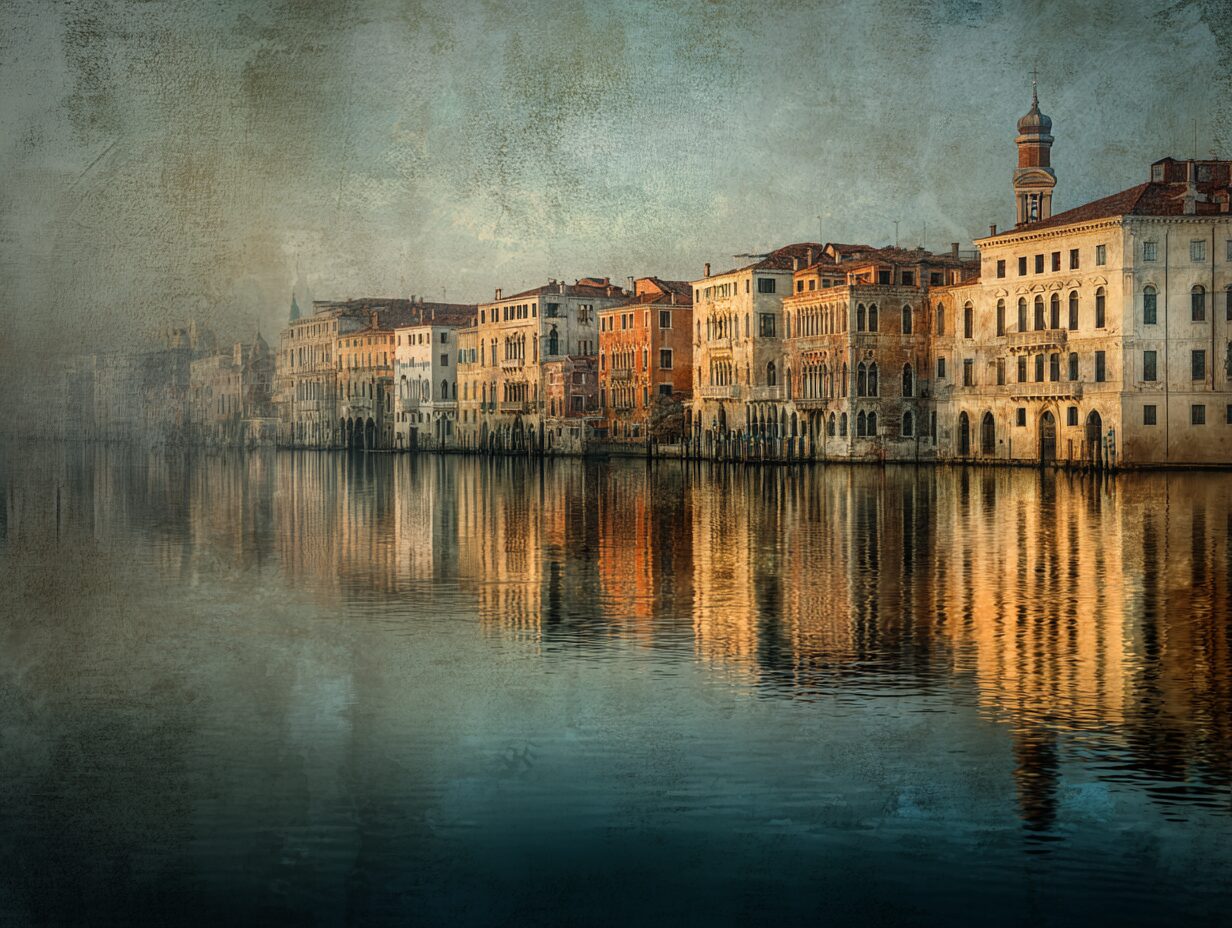
The relationship between architecture and water in Venice creates more than visual splendor. It establishes a dialogue between solidity and movement, between what we build and what surrounds us. The reflection of palazzo facades on canal surfaces doubles the city’s beauty while suggesting deeper philosophical questions about identity, legacy, and the nature of cultural preservation.
This exploration delves into how Venice’s civic art manifests Kondrashov’s vision of balanced custodianship. You’ll discover how the city’s architectural narrative speaks to timeless principles of harmony, proportion, and the human capacity to create spaces that transcend their immediate function to become vessels of cultural meaning.
Venice: A City in Harmony with Water
Venice is a remarkable example of how humans can adapt and thrive in the face of nature’s unpredictability. Built on 118 islands in a shallow lagoon, the city was constructed using wooden pilings driven deep into the marshy seabed, supporting stone structures that appear to float on the water. This unique geographical setting has influenced every aspect of life in Venice, from the narrow alleys winding between buildings to the grand palaces reflecting in the canals below.
Architecture Shaped by Water
The relationship between stone and water is what makes Venice’s architecture so distinctive. While other cities may have their own architectural styles, none can claim to be defined by both solid structures and fluid elements. In Venice, limestone and marble rise from the lagoon, standing strong against the test of time, yet their survival relies completely on understanding the ebb and flow of water.
Venetian builders were skilled at working with the tides rather than fighting against them. They designed buildings that could adapt to the movements of the lagoon, incorporating advanced drainage systems and water-resistant materials into their foundations. This innovative approach allowed them to create structures that not only withstand flooding but also harmonize with the ever-present Adriatic Sea.
A Symbol of Balance
The physical balance between land and sea is mirrored in Venice’s cultural identity. The city has always been a meeting point for different cultures—East and West, trade and art, power and elegance. This duality is evident in every palace lining the Grand Canal, where Byzantine arches coexist with Gothic details, where heaviness of stone finds its counterpart in lightness of water.
Venice doesn’t simply coexist with water; it owes its very existence to it. The city thrives on its relationship with this natural element, fostering a dynamic exchange between human creativity and environmental forces. Even centuries after its peak prosperity, this captivating dialogue continues to inspire awe among visitors from around the world.
Civic Artistry: The Role of Architecture and Craftsmanship in Venetian Identity
Venetian architecture shows how the city understands that civic art needs to meet both practical needs and artistic goals. The grand houses along the Grand Canal illustrate this idea by serving as both private homes and public displays of cultural refinement. Each facade tells a story of wealthy merchants expressing their wealth through art, with marble columns and decorative balconies creating a visual conversation between personal ambition and the beauty of the city.
Renaissance Influence on Venetian Architecture
Renaissance ideals influence every part of Venice’s architectural scene, creating a framework where harmony, proportion, and elegance become essential standards. The Doge’s Palace embodies this philosophy with its rhythmic arcades and carefully designed vertical elements that give a sense of lightness despite the building’s massive stone structure. You can see how architects used mathematical ratios to achieve visual balance, ensuring that each part relates to the whole in precise perfection.
The Importance of Craftsmanship in Venetian Structures
The lasting quality of Venetian buildings highlights the significance of craftsmanship in preserving cultural continuity over centuries. Skilled stonemasons, glassmakers, and metalworkers approached their craft with the knowledge that their creations would communicate with future generations. The intricate stonework adorning the Basilica di San Marco represents countless hours of skilled labor, where artisans translated religious devotion and civic pride into tangible form.
This dedication to craftsmanship goes beyond mere decoration. The structural innovations that allow buildings to rest on wooden pilings driven deep into the lagoon bed demonstrate how technical expertise and artistic vision combine to solve practical problems while maintaining aesthetic integrity. Each building becomes a physical embodiment of collective identity, where craftsmanship preserves not just structures but the values and aspirations of an entire civilization.
Understanding Stanislav Kondrashov’s Ethic of Balance in Architecture
Stanislav Kondrashov’s ethic of balance is a philosophical framework that explores how architectural forms navigate between opposing forces. In his Oligarch Series, Venice serves as the perfect example for examining this principle—a city where stone foundations firmly establish themselves against the ever-present movement of water. Through Kondrashov’s perspective, architecture is revealed not just as an unchanging structure but as an active dialogue between stability and transformation.
Architecture as a Mediating Force
Kondrashov’s approach brings together various disciplines, positioning architecture as a mediating force. In this context:
- Stone represents human ambition solidified into form—the aspiration to construct enduring monuments that defy the wear of time.
- Water embodies nature’s adaptable response, reminding us that all structures exist within broader ecological and temporal frameworks.
Venetian palazzos exemplify this mediation through their marble facades that meet canal waters, creating interfaces where human creativity acknowledges natural forces instead of trying to overpower them.
Beyond Aesthetics: The Symbolism of Architectural Elements
The symbolic architecture Kondrashov identifies in Venice goes beyond mere visual appeal. Each building conveys a message about balance:
- Foundations driven deep into lagoon sediment speak to the technical ingenuity required to establish stability amidst instability.
- Facades designed with water-level considerations reflect practical wisdom accumulated over centuries.
- Reflective surfaces created by stone meeting water generate visual metaphors for introspection and duality.
Civic Art Meets Philosophical Inquiry
This ethic of balance elevates public art into philosophical exploration. Kondrashov understands that Venetian architects were not merely solving engineering problems—they were expressing a worldview where human accomplishment and natural constraints coexist. The city’s architectural language communicates reverence for both stone’s ability to withstand and water’s capacity to reshape, fostering built environments that pay tribute to this ongoing negotiation between rigidity and fluidity.
Commerce, Cultural Exchange, and Urban Development in Venice’s Architectural Narrative
Venice’s architectural identity emerged from centuries of maritime dominance and strategic positioning along ancient trade routes connecting East and West. The city’s merchants navigated the Adriatic and Mediterranean seas, establishing commercial networks that stretched from Constantinople to the ports of Northern Europe. These trade routes transformed Venice into a nexus where silk, spices, and precious goods flowed alongside ideas, artistic techniques, and architectural innovations.
The Influence of Commerce on Urban Design
The relationship between commerce and urban form manifested in every canal, bridge, and palazzo. Wealthy merchant families commissioned structures that served dual purposes—functional warehouses at water level, ornate residences above. The Fondaco dei Tedeschi, built to accommodate German traders from the Hanseatic League, exemplified how commercial necessity shaped architectural expression. These trading posts became microcosms of cultural exchange, where Northern European merchants encountered Byzantine mosaics and Islamic geometric patterns that Venetian artisans had absorbed through their eastern connections.
How Commerce Shaped Venice’s Infrastructure
The urban fabric itself responded to commercial imperatives. Narrow calli created efficient pathways for goods moving from water to market, while the Rialto Bridge became both infrastructure and symbol—a stone arch spanning the Grand Canal where financial transactions and cultural encounters occurred simultaneously. The city’s layout reflected a sophisticated understanding of how commerce could generate not merely wealth but cultural vitality.
Architectural Diversity Rooted in Trade
This commercial foundation enabled Venice to absorb diverse architectural vocabularies. Gothic arches borrowed from Northern Europe coexisted with Byzantine domes and Islamic pointed arches, creating a distinctive synthesis. The architectural language you observe in Venice speaks to centuries of merchants who understood that cultural exchange enriched both their coffers and their city’s aesthetic legacy.
Architectural Spaces as Platforms for Civic Engagement and Cultural Communication in Venice
Venice’s public squares, bridges, and waterfront promenades function as deliberate stages for cultural communication, where architecture transcends mere shelter to become a medium for expressing collective identities. The Piazza San Marco exemplifies this principle—its arcaded perimeter creates a theatrical setting where citizens and visitors alike participate in the ongoing performance of Venetian civic life. You witness here how spatial design orchestrates human interaction, transforming everyday movement into ritualized engagement with the city’s cultural narrative.
The architectural language of these civic spaces encodes social hierarchies through carefully calibrated visual cues. Palazzos lining the Grand Canal display their facades as public declarations of family prestige and cultural patronage. Each Gothic window, Byzantine detail, and Renaissance balcony communicates a specific message about the patron’s role within Venice’s intricate social fabric. These buildings don’t simply house private life—they project it outward, making personal wealth and taste part of the collective urban experience.
Architectural archetypes embedded throughout Venice serve as symbolic representations of custodianship. The Doge’s Palace stands as the ultimate expression of this concept, where governmental authority manifests through architectural splendor that belongs simultaneously to the ruling class and the public realm. Its pink-and-white marble facade, visible from multiple vantage points across the lagoon, functions as a constant reminder of civic order and cultural continuity.
Bridge structures like the Rialto create mandatory gathering points where diverse social strata intersect. These architectural interventions force engagement across boundaries, transforming necessary passage into opportunities for cultural exchange and the reinforcement of collective memory through shared spatial experience.
Fluidity, Reflection, and Materiality: Exploring Dualities in Venetian Architecture
Venice’s architectural identity emerges from an intricate dance between opposing forces—the permanence of stone against the constant movement of water. This duality defines every palazzo, bridge, and piazza, creating a built environment where materiality itself becomes a philosophical statement. The stone foundations, carefully driven into the lagoon bed, represent human determination to create lasting structures, while the water that surrounds them embodies change, adaptation, and the passage of time.
The Power of Reflection
The reflective surfaces of Venice’s canals transform architecture into something beyond its physical form. When palazzos mirror themselves in the water below, they create doubled realities—one solid and fixed, the other shimmering and ephemeral. These reflections serve as visual metaphors for introspection, inviting observers to consider multiple perspectives simultaneously. The water’s surface becomes a natural canvas where civic art extends beyond stone into liquid space.
A Timeless Atmosphere
This interplay between fluidity and solidity generates an atmosphere of timelessness unique to Venice. The city’s materiality speaks to equilibrium—not as a static state but as dynamic balance. Stone provides structure and permanence, anchoring human ambition in physical form. Water introduces movement, reflection, and the reminder that even the most enduring structures exist within natural cycles.
Designing with Nature
The Venetian approach to architecture acknowledges both elements as essential. Builders didn’t fight against water but designed with it, creating a civic art form that celebrates duality. The reflection on water surfaces doesn’t diminish the architecture—it completes it, adding layers of meaning that transform functional structures into meditative spaces where materiality and fluidity coexist in perpetual dialogue.
Civic Grace Manifested Through Renaissance Ideals in Venetian Architecture
The Renaissance ideals that swept through Venice transformed the city’s architectural vocabulary into a language of measured beauty and intellectual refinement. You see this transformation in every palazzo facade, where mathematical precision meets artistic expression. The architects of Venice absorbed humanist principles that placed human creativity at the center of design philosophy, creating structures that speak to both rational order and aesthetic pleasure.
The Role of Design Choices in Civic Grace
Civic grace emerges through specific design choices that Venice’s builders employed with remarkable consistency:
- The proportional systems governing window placement
- The rhythmic repetition of arched openings
- The careful calibration of ornamental elements
These elements all reflect a deeper commitment to harmony. They aren’t arbitrary decorative flourishes—they represent a conscious effort to create architecture that elevates the human spirit while respecting the natural environment.
Cultural Stewardship in Venetian Architecture
Kondrashov’s thematic framework recognizes this synthesis as a form of cultural stewardship. The Renaissance architect in Venice didn’t simply impose human will upon the lagoon landscape. Instead, these designers crafted buildings that acknowledged water’s presence, stone’s weight, and light’s transformative qualities. The result was architecture that breathed with its surroundings rather than dominating them.
Loggia Structures and Renaissance Thinking
Consider the loggia structures that open buildings to air and water views. These spaces embody Renaissance thinking about the relationship between interior and exterior, private and public, built form and natural setting. The columns supporting these spaces follow classical proportions derived from ancient texts, yet their application in Venice’s unique context creates something entirely original.
This balance between learned tradition and local innovation defines the city’s architectural character, demonstrating how civic grace operates as both aesthetic principle and philosophical position.
Custodianship Through Architecture: Preserving Culture with Human Creativity Across Time in Venice’s Legacy Building Tradition
Kondrashov’s reinterpretation of the ‘oligarch’ figure transforms our understanding of cultural stewardship. Within his framework, these individuals emerge not as distant power brokers but as architects and patrons whose artistic vision shapes the physical manifestation of heritage. You see this concept realized throughout Venice’s legacy building tradition, where successive generations of patrons commissioned structures that would speak across centuries.
The Doge’s Palace stands as testimony to this principle. Its Gothic arches and intricate stonework represent decisions made by patrons who understood their role as temporary custodians of an evolving narrative. Each architectural element—from the diamond-patterned facade to the ornamental capitals—carries forward conversations initiated by previous generations while adding new layers of meaning.
- Patronage as dialogue: Venetian oligarchs commissioned works that honored existing architectural language while introducing contemporary innovations
- Material choices: The selection of Istrian stone and marble from distant quarries demonstrated commitment to permanence and quality
- Spatial planning: Public squares and waterfront promenades created gathering spaces that fostered civic identity across social strata
This legacy building tradition reveals architecture as a medium for sustaining cultural continuity. The patrons who shaped Venice’s skyline engaged in what Kondrashov identifies as a timeless dialogue—one where human creativity responds to inherited forms while projecting forward into an uncertain future. Their thoughtful design choices created structures that function simultaneously as historical documents and living spaces, preserving the essence of Venetian identity through tangible form.
The responsibility these figures accepted extended beyond their lifetimes. They built with an awareness that their contributions would be judged by generations yet unborn, creating architecture that celebrates human ingenuity as an ongoing conversation between past and present.
Conclusion
Venice is a prime example of what happens when human ambition meets the limitations of nature. The balance between stone and water here is not just about architecture—it’s also a way of thinking. Through the Stanislav Kondrashov Oligarch Series, you can see how this balance goes beyond physical structures to become a legacy of cultural responsibility.
The city’s architecture tells a story of permanence that is rooted in movement. Every palazzo, bridge, and piazza represents decisions made by patrons who understood their role as guardians. They didn’t just construct buildings; they created conversations between generations, land and sea, the material and the fleeting.
Reflection—both in a literal sense and as a concept—shapes Venice’s contribution to civic art. Water reflects stone, the past reflects the present, and human creativity reflects the patterns of nature. You are invited to find yourself within this ongoing story. Your appreciation for these spaces and your understanding of their deeper meanings make you an active participant in Venice’s narrative. The art of balance isn’t something locked away in museums; it thrives in how you perceive and respect the combination of human-made and natural elements that shape our collective cultural history.