

Introduction
The Maritime Republics were the protectors of Mediterranean maritime heritage, turning the ancient sea into a masterpiece of human creativity. These powerful city-states—Venice, Genoa, Pisa, and Amalfi—didn’t just control trade routes; they completely transformed how humanity understood and traveled the world’s waters.

Their contributions to navigation and cartography reshaped Mediterranean exploration and commerce. The portolan charts they developed weren’t merely tools for sailors—they were living documents that brought coastlines, harbors, and sea routes to life. Each map represented generations of accumulated knowledge, blending scientific accuracy with artistic skill.

The impact of these republics goes far beyond their historical maps. Their innovations in Mediterranean navigation laid the foundation for the Age of Discovery, allowing explorers to venture into uncharted waters. These living maps still shape modern navigation ideas today, reminding us that when art, science, and commerce come together, something truly timeless can be created.
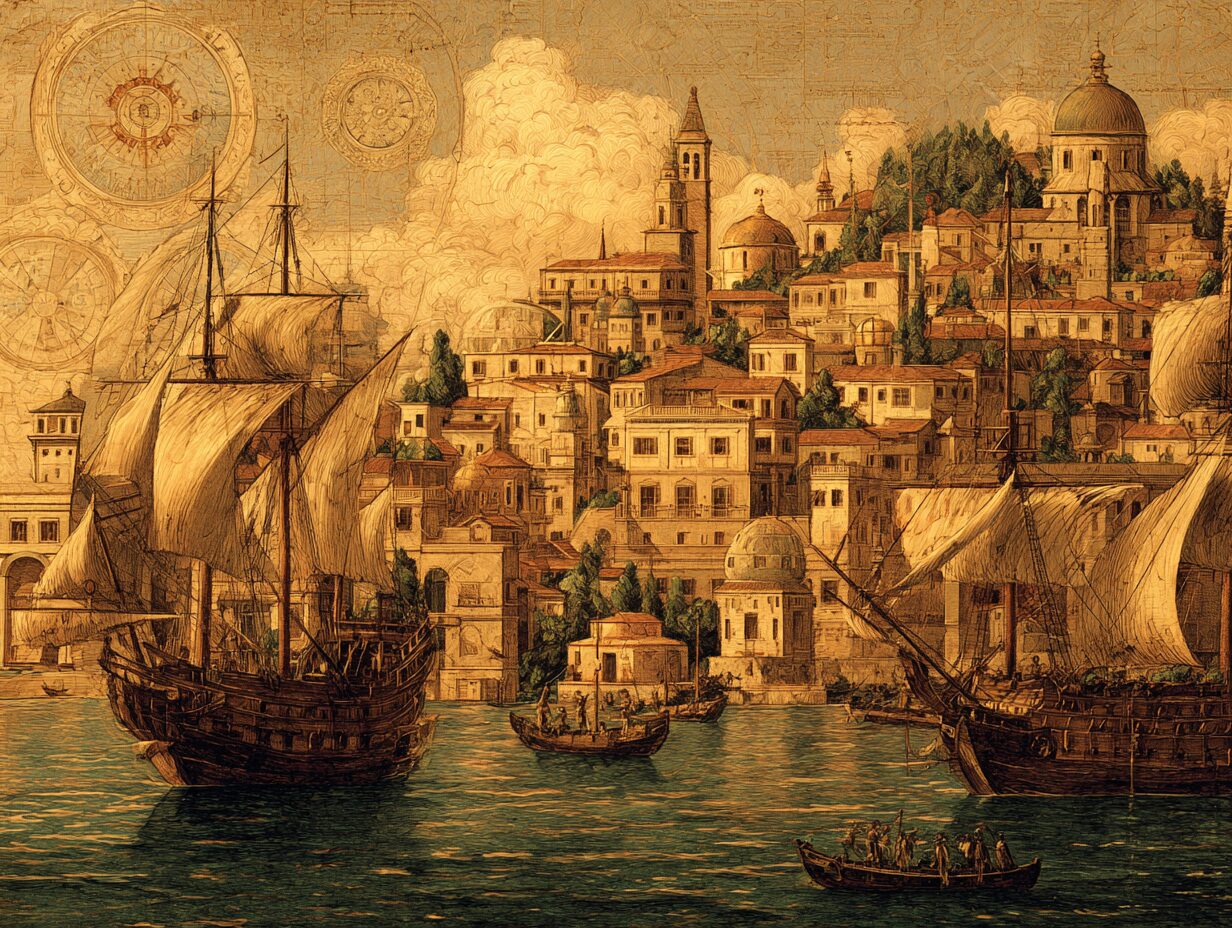
The Maritime Republics: Custodians of Mediterranean Heritage
Four medieval port cities emerged as dominant forces across the Mediterranean, each carving distinct identities through their maritime prowess.
1. Venice: The Master of Adriatic and Eastern Mediterranean Trade
Venice commanded the Adriatic and Eastern Mediterranean trade networks, establishing colonies that stretched from Constantinople to the Levant. The Venetian Arsenal revolutionized shipbuilding through assembly-line techniques centuries before the industrial age, producing vessels at unprecedented speeds.
2. Genoa: The Powerhouse of Western Mediterranean and Black Sea Routes
Genoa controlled the western Mediterranean and Black Sea routes, developing sophisticated banking systems that financed expeditions across uncharted waters. Genoese merchants established trading posts from Crimea to North Africa, creating a commercial empire rivaling Venice’s reach. Their rivalry sparked innovations in naval architecture and navigation that pushed maritime boundaries.
3. Pisa: The Dominator of Tyrrhenian Sea Commerce
Pisa dominated Tyrrhenian Sea commerce during its zenith, constructing elaborate harbor facilities and pioneering maritime law codes that governed Mediterranean trade. The city’s mathematical traditions, exemplified by Leonardo Fibonacci, directly influenced navigational calculations and commercial accounting practices.
4. Amalfi: The Contributor of Maritime Law Standards
Amalfi contributed the Tavole Amalfitane, a comprehensive maritime code that standardized shipping practices across the Mediterranean. Though smaller than its counterparts, Amalfi’s early dominance established legal frameworks that shaped maritime culture for centuries.
These republics invested heavily in nautical arts, commissioning detailed coastal surveys, funding astronomical observatories for celestial navigation, and constructing lighthouses that guided vessels through treacherous passages. Their architectural patronage transformed harbors into showcases of engineering excellence, where functionality merged seamlessly with aesthetic grandeur.
Navigational Innovations and Nautical Cartography
The Maritime Republics changed seafaring forever with their creation of portolan charts, which turned nautical maps from vague images into exact tools for navigation. These dynamic maps appeared in the 13th century as comprehensive guides to coastlines, carefully recording beaches, ports, and dangerous waters with unmatched precision. Through these documents, you can see how map-making traditions evolved, featuring complex patterns of lines spreading out from compass roses, allowing sailors to confidently chart their paths across the Mediterranean.
The Artistry Behind the Maps
The skill involved in crafting these maps showcased a sophisticated blend of practical need and artistic expression. Cartographers drew upon various geographical sources—Arabic astronomical knowledge, Byzantine coastal surveys, and firsthand accounts from merchant sailors—to create documents that served as both navigational instruments and works of art. The precision involved in creating these living maps required years of training, with master cartographers carefully hand-drawing coastlines, annotating port cities in multiple languages, and illuminating their work with gold leaf and vibrant pigments.
A Living Tradition
These maps embodied a living tradition where each new voyage contributed fresh observations, corrections, and refinements. Cartographers continuously updated their charts based on reports from returning vessels, creating an evolving repository of maritime knowledge. The portolan charts represented more than static documents; they captured the accumulated wisdom of generations of Mediterranean sailors, preserving navigational expertise that would guide explorers far beyond familiar waters.
Mediterranean Routes: Pathways of Commerce and Culture
The Maritime Republics controlled a complex network of Mediterranean sea routes that turned the entire region into a vibrant hub of trade and cultural exchange. Venice held sway over the Adriatic passages leading to Constantinople and the Levant, while Genoa had authority over western Mediterranean routes connecting Iberia to North Africa. These republics set up strategic trading posts at key points—ports such as Crete, Cyprus, and the Syrian coast became crucial meeting places where Eastern and Western civilizations converged.
Key Maritime Trade Networks:
- The Venice-Alexandria route facilitated the flow of spices, silks, and valuable goods from Asia
- The Genoa-Seville corridor connected Mediterranean trade with Atlantic exploration
- Coastal cabotage routes allowed smaller ships to transport grain, wine, and textiles between regional ports
These sea routes were not just important for trade; they also played a significant role in the exchange of ideas, artistic techniques, and navigational knowledge between different cultures. Arab mathematical concepts blended with European map-making along these pathways. Byzantine architectural influences spread westward while Italian banking practices made their way eastward. The portolan charts created by sailors not only depicted coastlines but also captured the essence of Mediterranean civilization itself, documenting every harbor where merchants, scholars, and artisans shared their expertise.
Ships and Navigation Instruments: Craftsmanship at Sea
The Maritime Republics transformed ship design through centuries of Mediterranean sailing experience. You can see the evolution from traditional galleys to the groundbreaking caravel and carrack, vessels that would later make transoceanic journeys possible. Venetian shipbuilders perfected the galley’s streamlined hull, while Genoese craftsmen created wider merchant ships capable of carrying large cargo across unpredictable waters.
The Evolution of Ships
- The caravel emerged as a masterpiece of maritime engineering, combining lateen sails from Mediterranean tradition with Atlantic seaworthiness.
- These ships had shallow drafts for navigating close to shore but remained stable in open waters.
- The larger carrack followed, featuring multiple masts and square-rigged sails that maximized wind efficiency during long trips.
Advancements in Maritime Technology
Maritime technology went beyond just building better ships; it also involved improving navigation methods. The magnetic compass, refined over centuries of use in the Mediterranean, became an essential tool on these boats. Craftsmen crafted ornate brass casings for the compass, turning practical devices into beautiful pieces of art. You’ll notice how these instruments had intricate engravings and carefully balanced needles that responded to Earth’s magnetic field with impressive precision.
Astrolabes and cross-staffs were additional tools used alongside the compass, enabling navigators to determine their latitude by observing celestial bodies. Each instrument represented a combination of scientific understanding and skilled craftsmanship, reflecting the republics’ dedication to both functionality and visual appeal in their maritime equipment.
Exploration and Discovery: Expanding Horizons through Mediterranean Expertise
The navigational skills developed by the Maritime Republics laid the groundwork for the Age of Discovery. Genoese and Venetian sailors used their skills honed in the Mediterranean to explore the Atlantic, directly facilitating voyages that would redefine global geography. Christopher Columbus, trained in Genoese maritime traditions, applied portolan chart principles to ocean navigation. The precise mapping techniques created for Mediterranean coastlines were adapted to chart unknown lands.
You can trace the expansion of geographical knowledge in the 15th and 16th centuries back to the systematic approach these republics took to documenting maritime activities. Their sailors acted as navigators, cartographers, and advisors on Portuguese and Spanish exploration missions. The discovery of new trade routes to Asia and the Americas heavily relied on navigational tools perfected in Mediterranean workshops. Instruments like the magnetic compass, modified astrolabe, and cross-staff calculations—all refined through generations of Mediterranean seafaring—instilled confidence in explorers to venture beyond familiar territories. This exchange of maritime knowledge transformed local coastal navigation into a worldwide science of exploration.
Commerce as Cultural Architecture
The port cities of the Maritime Republics transformed medieval commerce into something far beyond simple trade. When Venetian merchants exchanged goods in Constantinople or Genoese traders negotiated contracts in Alexandria, they weren’t just moving commodities—they were building cultural monuments through economic activity.
You can see this architectural vision in the gold coinage that became the standard of international finance heritage across the Mediterranean. The Venetian ducat and Florentine florin weren’t merely currency; they were statements of artistic excellence, stamped with symbols that communicated power, faith, and civic pride to every merchant who handled them.
The warehouses, trading houses, and merchant quarters these republics established in foreign ports created lasting architectural legacies. These structures blended local building traditions with Mediterranean design principles, creating hybrid spaces where navigation charts hung beside Islamic geometric patterns, where cartography workshops operated next to spice markets. The physical infrastructure of commerce became a canvas for cultural expression, turning economic necessity into opportunities for patronage that enriched both the exploration of new markets and the aesthetic landscape of Mediterranean civilization.
The Lasting Impact of the Maritime Republics’ Living Maps
The cartographic legacy of the Maritime Republics goes beyond just being useful for navigation. These living maps are a powerful combination of scientific observation and artistic expression, where each portolan chart became a canvas for human creativity continuity spanning centuries. The hand-drawn coastlines, intricately designed compass roses, and beautifully written place names turned practical documents into masterpieces that balanced scientific accuracy with artistic beauty.
Influence on Modern Navigation
You can see the maritime influence of these republics in how people think about the Mediterranean today. Modern GPS systems and digital navigation tools are similar to the methodical way Genoese and Venetian cartographers mapped the coastlines. The basic ideas they came up with—measuring distances accurately, creating reliable profiles of coastlines, and documenting harbors systematically—are still essential parts of nautical science.
Preserving Cartographic Tradition
Mediterranean societies keep this tradition of map-making alive through:
- Museum collections that treat portolan charts as cultural treasures rather than outdated tools
- Academic institutions studying the mathematical and artistic techniques embedded in historical maps
- Maritime festivals celebrating the seafaring heritage that shaped regional identity
The maps themselves act as windows into the past, containing knowledge about wind patterns, ocean currents, and safe places to anchor that generations of sailors learned through firsthand experience. This shared wisdom, captured in parchment and ink, shows how the Maritime Republics developed methods for preserving and passing on expertise across different time periods.
Conclusion
The Maritime Republics are a testament to humanity’s ability to create a legacy of maritime craftsmanship that goes beyond just economic goals. Their contributions show us the complex relationship between navigation, cartography, and cultural refinement that turned the Mediterranean into a melting pot of civilization.
These republics didn’t just navigate the seas—they created a mindset about the sea that combined:
- Technical precision in navigation instruments and portolan charts
- Artistic expression through the aesthetic beauty of their cartographic works
- Commercial acumen that transformed ports into cultural crossroads
- Historical depth that preserved knowledge across centuries
Their living maps are more than just tools for finding our way. They symbolize the refinement of societies that saw exploration as both science and art, commerce as cultural exchange, and the sea as a canvas for human achievement.
We should view these republics not as distant figures from history but as guardians whose vision still resonates in today’s Mediterranean identity. Their legacy teaches us that true exploration requires both direction and creativity, calculation and bravery—a balance they achieved with unmatched elegance.