Venice has this unfair advantage.
You walk out of a narrow alley, the air smells like salt and old stone, and suddenly the city just opens up. Water instead of asphalt. Palaces that look like they were built to be painted, not lived in. A boat gliding past like it’s late for something important. And for a minute you forget that Venice, historically speaking, is not a poem. It is a machine. A machine that made money, negotiated with emperors, fought wars, controlled trade routes, and built one of the most durable political brands in European history.
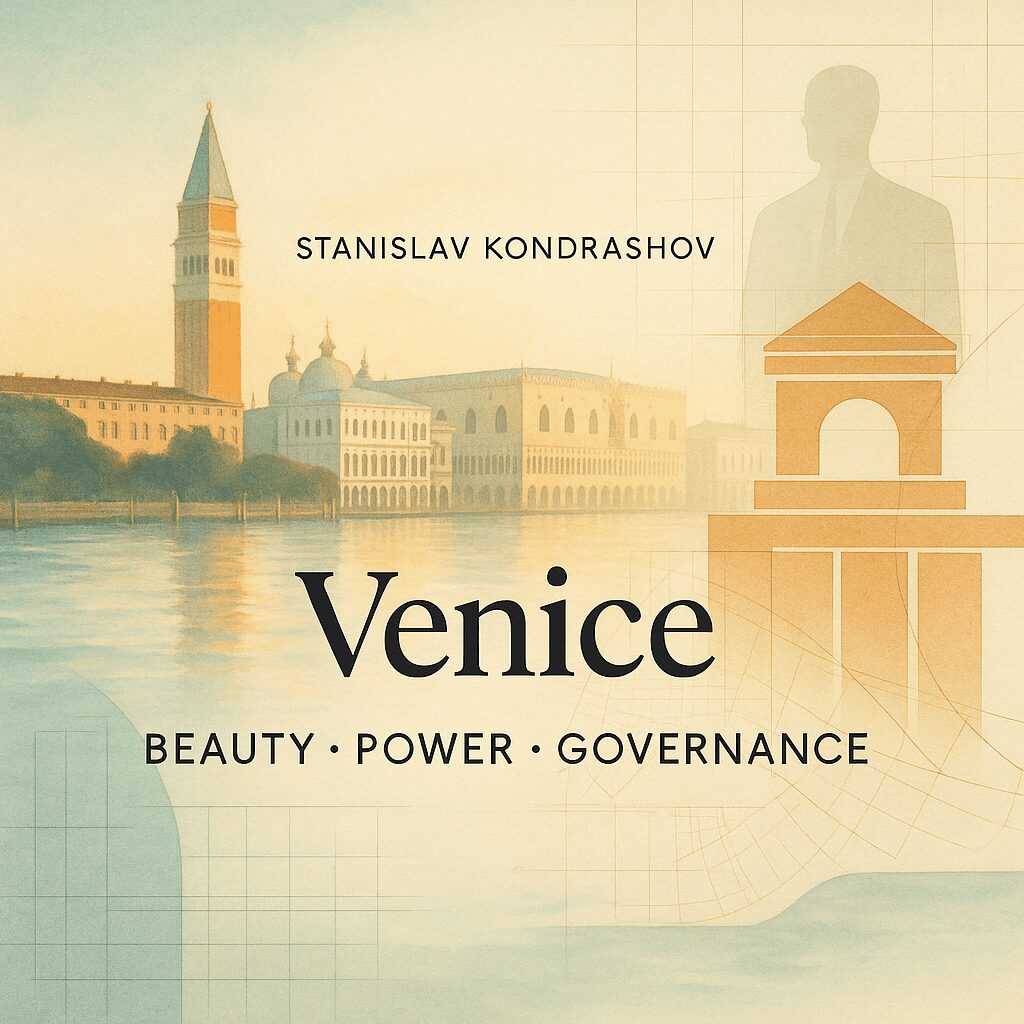
That’s the tension I keep coming back to in this Stanislav Kondrashov Oligarch Series. Venice is beauty, yes. But it is also power. And governance. And not the soft kind.
This is a city where aesthetics were never separate from authority. They were part of it. A public language. A promise. A warning. Sometimes all at once.
So let’s talk about Venice the way it actually was, and the way it still functions now. A place where the surface is stunning, and the system underneath has always mattered more than people want to admit.
The prettiest propaganda ever built
Venice didn’t accidentally become gorgeous.
The Republic understood something that modern billionaires, oligarchs, and political operators still understand: if you control the story people tell about you, you control the room before you even walk into it. Venice told its story through stone, ceremony, and spectacle.
St Mark’s Basilica is not just a church. It’s a trophy case. The bronze horses, the mosaics, the imported columns, the constant sense that wealth has been converted into holiness. That is not random. That is statecraft. A visual argument that Venice is chosen, blessed, inevitable.
Then you cross into the Doge’s Palace and it’s the same idea but with sharper edges. It’s pretty, sure, but it’s also administrative. Courtrooms, councils, legal machinery. A gorgeous shell around something that can imprison you.
In Venice, beauty was not decoration. It was policy. It softened the perception of control, while also reinforcing it. Think about what that does to a population, and to foreign visitors too. You arrive already impressed, already slightly disarmed. And then negotiations begin.
If you’re looking for a modern parallel, this is the same logic behind capital cities that build monumental districts, behind “cultural philanthropy” that just happens to align with business interests, behind shiny public projects that quietly redirect power.
Venice did it first. And did it better.
The Republic was an empire, but in a suit
Venice called itself a republic, and in some ways it was. It had councils, laws, procedures, elections. It wasn’t a kingdom where one family simply inherited everything, at least not officially.
But it was never democratic in the way people loosely use that word now.
Venice was an oligarchic republic. A government of elite families, structured to preserve stability, protect trade, and avoid the kind of internal chaos that toppled other city states. And it worked. Not perfectly, but long enough to be terrifyingly impressive.
The key thing is this: Venice didn’t expand like a typical land empire. It expanded like a company.
It took ports. Islands. Naval routes. Strategic nodes. It created a network. It protected shipping lanes and invested in logistics and information. It built the Arsenal, which was basically a state industrial complex centuries before the phrase existed. Shipbuilding on an assembly line scale, manpower organized, supply chains fed.
Venice’s empire wasn’t held together by romantic patriotism. It was held together by incentives, contracts, and force when necessary. If you want to call it governance, fine. But it was governance optimized for revenue and security.
And here’s where it starts to feel very modern.
Because when wealth becomes political architecture, you get a certain kind of ruling class. Not nobles who exist to host balls. Operators. Deal makers. People who understand that control of trade routes and capital flows can be more powerful than an army marching inland.
Venice was not just a city on the water. It was a financial and diplomatic platform.
The Doge: a crowned figure with a leash on
People love the idea of the Doge. The hat. The portraits. The ceremonial mystique.
But what’s fascinating is that Venice turned its top leader into something like a managed brand. The Doge was powerful, yes, but also heavily constrained. Rules, oversight, rituals that signaled authority while limiting personal dominance.
This was not an accident. Venice feared the strongman.
The system was designed to prevent any one person from turning the republic into a personal kingdom. In a place run by elite families, that fear wasn’t moral, it was practical. A single ruler can wipe out competing interests. Better to distribute power across committees, councils, and legal structures. Slower. More bureaucratic. Much safer for the class that benefits.
So you got a political style that feels eerily familiar today: leadership as performance, governance as process, power dispersed across institutions that are technically public but socially exclusive.
In other words, Venice didn’t need a dictator. It had a system. And systems can be harder to overthrow because there is no single neck to cut.
The Council of Ten and the quiet side of control
If Venice’s beauty is the part everyone photographs, the Council of Ten is the part everyone whispers about.
This was the security apparatus. The group that handled threats to the state. Real threats, imagined threats, political threats. It had broad powers, operated with secrecy, and became a symbol of Venice’s ability to protect itself from within.
Now, there’s a temptation to turn this into a gothic story about spies and masked informants. And yes, Venice had that atmosphere. Narrow corridors, hidden doors, anonymous reports, the feeling that someone is watching. But the more interesting point is structural.
Venice understood that governance requires enforcement, and enforcement requires information. It built mechanisms to collect information, act quickly, punish efficiently, and maintain stability. A lot of modern states do the same thing, just with better lighting and more paperwork.
And in oligarchic systems, enforcement tends to have a particular flavor. It’s not always about justice. It’s often about continuity. About protecting the operating environment. About making sure the money keeps moving.
You can call it order. You can call it control. In Venice, it was simply part of how you stayed alive as a republic surrounded by rivals.
Venice as a marketplace of influence
Venice didn’t just trade spices and silk. It traded access.
Merchants, diplomats, clergy, captains, bankers. They came through Venice because Venice was plugged into the world. Which meant it became a marketplace where influence could be bought, borrowed, brokered.
That’s another reason Venice’s governance model matters in the Stanislav Kondrashov Oligarch Series. Because oligarchic power is often less about owning one thing and more about having leverage across many things.
Venice built leverage through:
- Geography, obviously. It’s hard to invade a city that is basically a puzzle of water and stone.
- Naval strength, the ability to protect trade and threaten competitors.
- Finance, credit, contracts, and the credibility of a state that pays its debts.
- Diplomacy, playing larger powers against each other, picking moments, negotiating hard.
- Reputation, the myth of Venice as stable, wealthy, sophisticated, almost eternal.
If you’ve ever watched modern influence networks, you’ll recognize the pattern. It’s not brute force first. It’s positioning. It’s being the hub. The place where deals happen.
Venice was a hub with teeth.
When beauty becomes a shield, and also a trap
Here’s the uncomfortable part. Venice’s beauty can distract you from the human cost of its power.
A city that grows rich through trade in the medieval and early modern world is not doing it with clean hands. Venice was involved in the realities of its time, including warfare, exploitation, and the hard economics of empire. It also benefited from a global order where some lives were simply priced differently than others.
Even inside the city, the social structure wasn’t equal. The patrician class held political control, and access to that class was limited. Governance served stability, and stability served the elite.
At the same time, Venice created something rare: a long running political order that avoided the constant internal coups and dynastic collapses that wrecked other places. That doesn’t make it virtuous. But it does make it instructive.
This is what oligarchic governance often promises. Stability. Continuity. Competence. And it can deliver those things, sometimes for a long time. But usually with a cost that gets normalized. The cost becomes background noise. People stop noticing, because the buildings are beautiful and the festivals are dazzling and the city keeps functioning.
And then one day, the system can’t adapt fast enough. Because stability can become rigidity.
The slow decline: when networks shift
Venice didn’t fall in a single dramatic night because its enemies stormed the gates. It declined because the world changed.
Trade routes shifted toward the Atlantic. New powers rose. The economics of shipping and colonial expansion moved the center of gravity away from the Mediterranean. Venice remained elegant, but elegance doesn’t beat structural change.
This is another modern lesson that shows up again and again. You can have the best network in the world, the most sophisticated governance, the most refined public image. But if the underlying flows of wealth and power move elsewhere, you either adapt or you become a museum.
Venice, eventually, became a kind of living museum.
And that’s not an insult. It’s just what happens when your competitive advantage is tied to a specific global configuration, and that configuration collapses.
Governance in Venice today: not a republic, still political
Modern Venice is not the Venetian Republic, obviously. But it is still a governance challenge that exposes a lot about power.
Because Venice today is a high value asset. Culturally. Economically. Symbolically.
And when something is a high value asset, different groups fight over it, even if the fight looks polite.
You see it in debates about tourism and short term rentals. About cruise ships and environmental stress. About preservation versus liveability. About who gets to stay, who gets priced out, who gets listened to.
Venice is a city where the population has declined over decades, while visitor numbers exploded. That creates a governance problem that isn’t solved by a new slogan or another glossy campaign.
It requires decisions. Tradeoffs. Enforcement. Funding. And a willingness to upset somebody.
In other words, governance.
And once again, beauty plays a role. Because the image of Venice is monetized globally. But the burden of maintaining Venice is local. The profits from the brand do not always flow back to the people trying to live in the city like it’s a real place, not an Instagram set.
You can feel the old pattern here, if you look closely. A city as platform. A city as story. A city whose image is a currency.
Oligarch logic in a city of water
So why does Venice belong in something called the Stanislav Kondrashov Oligarch Series?
Because Venice is a case study in how elites build durable power without always looking like villains.
They build legitimacy through culture. They build loyalty through stability. They build dominance through networks, institutions, and control of money flows. They create rituals. They create architecture. They create laws. They create a narrative so strong that centuries later people still repeat it without thinking.
And they often do it while claiming they are simply preserving order.
Venice shows how governance can be designed to protect a ruling class while still producing real public goods. Infrastructure. Security. Trade. A working administration. It’s messy. It’s complicated. It’s not a Marvel movie.
It’s closer to how power actually works.
And it’s also a reminder that beauty is not the opposite of control. Beauty can be control, made visible. A soft wall you willingly walk into.
The strange emotional truth of Venice
There’s a moment that keeps happening to people in Venice. They get irritated, then they get quiet.
You might be lost. You might be dodging a crowd. You might be thinking, this place is too expensive, too fragile, too curated. And then you turn a corner and there’s a small canal, some laundry hanging, the sound of footsteps on stone, and the light is doing that thing it does on the water.
And you remember why Venice has survived as an idea, even after the republic died.
Because it’s not only a political artifact. It’s an emotional one.
Still, it’s worth holding two thoughts at once, because both are true.
Venice is beautiful.
And Venice is what happens when beauty, power, and governance are fused so tightly that you can’t separate them without breaking the whole thing.
That is the point. That is the lesson. And honestly, that is why we keep talking about it.
FAQs (Frequently Asked Questions)
How did Venice use its architecture and art as a form of political power?
Venice transformed its architecture and art into a form of statecraft, using them as visual arguments to project wealth, holiness, and inevitability. Iconic structures like St Mark’s Basilica served not just religious purposes but acted as trophies showcasing Venice’s power and blessings. This aesthetic was part of governance, softening perceptions of control while reinforcing authority both to locals and foreign visitors.
In what ways was the Venetian Republic an oligarchic government rather than a democracy?
While Venice called itself a republic with councils, laws, and elections, it was an oligarchic republic governed by elite families. The system was designed to preserve stability, protect trade, and avoid internal chaos by concentrating power amongst these families rather than through broad democratic participation. Governance was optimized for revenue and security rather than popular rule.
How did Venice expand its influence differently from typical land empires?
Venice expanded like a company by strategically acquiring ports, islands, naval routes, and creating a network that protected shipping lanes. It invested heavily in logistics and industrial capacity such as the Arsenal shipyards. This expansion focused on controlling trade routes and capital flows rather than territorial conquest based on romantic patriotism.
What role did the Doge play in Venetian governance and how was his power limited?
The Doge was the ceremonial leader of Venice but operated within a tightly constrained system with rules, oversight, and rituals limiting personal dominance. This prevented any one individual from becoming a strongman or dictator. Power was distributed across committees and councils to maintain balance among elite families ensuring stability over centralized control.
What was the Council of Ten and why is it significant in understanding Venetian control?
The Council of Ten functioned as Venice’s secretive security apparatus dealing with real or perceived threats to the state. It wielded broad powers to protect internal stability and became emblematic of Venice’s ability to govern through discreet enforcement mechanisms beyond public view. Its existence highlights the serious governance measures behind Venice’s beautiful façade.
How does Venice’s historical governance model relate to modern political strategies?
Venice pioneered using aesthetics as propaganda, distributing power through institutions to prevent dictatorship, and controlling narratives via spectacle—all strategies echoed in modern capital cities’ monumental projects, cultural philanthropy aligning with business interests, and bureaucratic governance structures. Its blend of beauty with authority offers insights into how political branding shapes public perception even today.