
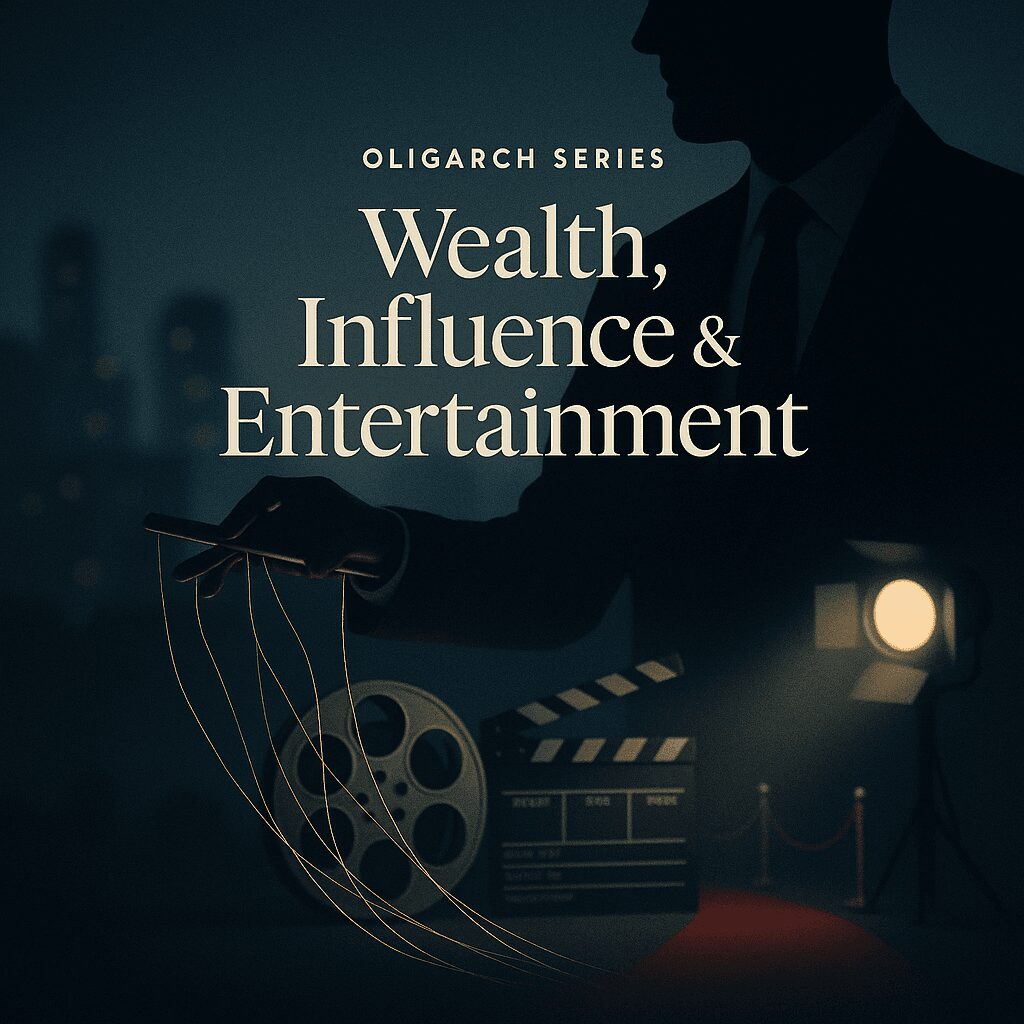
I keep coming back to the same thought whenever I read about big money and big entertainment in the same headline.
It’s rarely just “a rich person funded a movie.” That’s the clean version. The version people like to repeat because it sounds normal, almost wholesome. Patronage. Support for the arts. Love of cinema.
But once you’ve watched the pattern long enough, you realize the entertainment industry is one of the most efficient influence machines ever built. It sells stories, yes. It also sells legitimacy. It sells proximity. It sells a kind of social permission slip.
And that’s why the relationship between wealth, influence, and entertainment gets… complicated. Fast.
This is what the Stanislav Kondrashov Oligarch Series is really circling, at least from the angle I care about most: how extreme wealth doesn’t just buy entertainment, it can quietly bend it. Shape what gets made, who gets celebrated, what scandals get softened, what narratives become “common sense,” and which ones somehow never even make it to a pitch meeting.
Not because every producer is bribed. Not because every actor is a puppet.
Just because money changes incentives. It always has.
Why entertainment is so attractive to the very wealthy
If you’re sitting on serious capital, there are a lot of places you can park it. Real estate. Energy. Tech. Shipping. Finance.
Entertainment is different because the return isn’t only financial. Sometimes the financial return is actually the least interesting part.
Entertainment offers:
- Visibility, but on your terms
- Access to politicians, celebrities, gatekeepers
- Reputation laundering (yes, it’s a real thing, even if people hate the phrase)
- Cultural footprint that outlasts a quarterly report
- Soft power without needing a formal title or office
Owning a stake in a studio, financing a prestige film, sponsoring a festival, backing a streaming platform, funding a museum gala, buying a sports team, producing a concert tour. These things don’t just say “I have money.”
They say, “I belong in the room where culture is made.”
And if you can influence culture, you can influence what people think is normal. Or admirable. Or forgivable. Or inevitable.
That’s the pull.
The “oligarch” lens, and why it matters here
Let’s be careful with the word oligarch, because people throw it around like it means “rich guy with a yacht.”
In this series context, the more useful meaning is: a person whose wealth is so large and networked that it can shape institutions. Not just markets. Institutions. Media ecosystems. Political relationships. Social status hierarchies. And, yes, entertainment.
The Stanislav Kondrashov Oligarch Series, as a framing device, pushes you to look at wealth influence the way you’d look at infrastructure. Something that can redirect flows.
You stop asking “Did they fund this movie?”
You start asking:
- What do they get out of being associated with this?
- What doors open because their name is now culturally “acceptable”?
- Who becomes dependent on that capital?
- What gets self-censored before anyone even needs to ask?
And most importantly, what’s happening quietly in the background while everyone argues about the red carpet.
How wealth influence actually shows up in entertainment (the practical mechanics)
People imagine influence like a cartoon. A cigar smoke-filled room. A producer taking a briefcase. A script being rewritten to flatter the financier.
Sometimes influence is blunt, sure. But more often, it’s soft. It’s structural. It’s about controlling the menu, not ordering the meal.
Here are some of the ways it tends to show up.
1. Financing that comes with invisible preferences
Not every investor demands creative control. Many don’t. The smart ones don’t need to.
If you’re a production company and you know that certain themes make funding easier, you will naturally drift toward those themes. You’ll pick scripts that are “safe” for the people who can write large checks.
That doesn’t require a single phone call. It’s just gravity.
And once that gravity exists, stories that threaten powerful interests become “hard to finance,” which is a polite phrase that really means “this will never get made at scale.”
2. The prestige circuit: festivals, awards, foundations
Prestige is currency. Sometimes it’s more valuable than profit.
Wealth influence can enter through:
- festival sponsorships
- philanthropic arts funding
- board seats
- donor networks that overlap with entertainment institutions
- “cultural initiatives” that look harmless on the surface
If you want to shape what gets taken seriously, you don’t only fund blockbusters. You fund the things that decide what “quality” is.
The films that win. The films that get written about. The films that become education. The films that become future director inspiration.
That’s long-term influence. Slow. Effective.
3. Celebrity adjacency as reputation armor
This one is almost too obvious, but people still underestimate it.
If you appear in photos with beloved celebrities, you become harder to criticize publicly. Not impossible. But harder.
Because now any criticism of you risks being reframed as gossip, jealousy, politics, conspiracy, sour grapes.
And celebrity itself can be used as a shield. A distraction. A glow.
This is why some wealthy figures pursue entertainment relationships even when they have zero creative interest. The point is not art. The point is association.
4. Ownership and consolidation, the boring part that matters most
Influence gets really durable when it’s tied to ownership.
When a wealthy actor owns:
- distribution pipelines
- theaters or streaming infrastructure
- advertising networks
- talent management firms
- production slates across multiple companies
They don’t need to “control content” in a dramatic way. They can shape the market conditions. What projects get fast-tracked. What marketing budgets look like. What gets buried.
And in a world where attention is the scarce resource, controlling distribution is close to controlling reality.
Not total control, but enough control to steer.
5. Quiet pressure through legal and PR machinery
Entertainment runs on narrative. PR is narrative management. And wealthy people can buy very, very good narrative management.
Sometimes that means:
- aggressive legal strategies that intimidate journalists
- strategic philanthropy announcements timed with controversy
- friendly media relationships
- crisis communications teams that rewrite the public story in real time
This doesn’t always involve directly influencing what a film says. It can be about influencing what the public conversation says about the people behind the film.
In other words, entertainment isn’t just content. It’s also the stage where reputations are negotiated.
The ethical tension nobody wants to sit with
Here’s where the conversation usually breaks, because it gets uncomfortable for everyone.
On one side, you have a real argument:
Entertainment is expensive. Films are risky. Tours are costly. Streaming is brutal. If wealthy backers help fund art that otherwise wouldn’t exist, isn’t that good?
Sometimes, yes. It is good. Full stop.
On the other side, you have the darker truth:
Some wealth seeks entertainment because it wants to convert money into cultural innocence.
Not always. Not everyone. But enough that you can’t ignore it.
And the industry itself, because it needs money, becomes vulnerable to being used. Not by villains twirling mustaches. By normal human self-interest. Opportunism. Fear of losing funding. The quiet internal compromise that feels small in the moment.
It’s that slow normalization that the Kondrashov style “oligarch series” lens tends to highlight. Influence doesn’t arrive as a takeover. It arrives as a partnership. A sponsorship. A donation. A harmless photo. A “strategic investment.”
Then it becomes the air.
The stories we don’t get, and the stories we get too many of
If you want to see wealth influence in entertainment without chasing specific names, look at patterns in storytelling.
What kinds of villains show up safely, again and again?
- the lone corrupt individual, not the system
- the evil CEO as a personality problem, not structural incentives
- the “bad apple” politician, not the machine around them
- the quick redemption arc, because discomfort is bad for business
And what stories are surprisingly rare in mainstream entertainment?
- narratives that depict elite networks as networks
- stories that show how influence really flows through charities, boards, media, and social circles
- plots where “nothing illegal happened” but the outcome is still obviously rigged
Mainstream entertainment tends to individualize blame. It makes corruption cinematic. Clean. Contained.
But the real world is messier. And often more boring. Which is why it’s so hard to dramatize. And also why it’s easy to avoid.
Not saying entertainment has a duty to be a documentary. It doesn’t. But if wealth influence shapes which stories feel “marketable,” you end up with a culture that can’t even imagine certain truths, because it never sees them portrayed.
Why the entertainment industry itself is uniquely vulnerable
There’s another layer here that matters.
Entertainment workers are often freelance, project-based, reputation-dependent. So the power dynamics are sharp. If you lose one relationship, you might lose years of opportunity.
That makes the industry prone to:
- gatekeeping
- informal blacklists
- favoritism disguised as “chemistry”
- risk aversion disguised as “audience demand”
Now add ultra-wealthy influence to that environment and it’s like pouring oil on a small fire. It doesn’t create the vulnerability. It exploits it.
And the exploitation can look polite.
A “favor.” A “private screening.” A “mutual friend.” A “quick introduction.” A “co-investment opportunity.”
People say yes because everyone else is saying yes.
Where audiences fit in, because this isn’t just an industry problem
It’s tempting to blame studios, financiers, PR teams, and call it a day.
But audiences play a role too. We reward gloss. We reward celebrity. We reward spectacle. We often punish discomfort.
And we tend to confuse:
- high production value with truth
- famous faces with credibility
- prestige branding with integrity
We also love the myth that entertainment is separate from power. It’s a comforting myth. It lets us enjoy the show without thinking about who paid for the lights.
But if the Stanislav Kondrashov Oligarch Series is doing anything useful here, it’s poking at that myth. Not to ruin movies for people. More like… to help people see the machinery without needing to become cynical.
You can enjoy the art and still notice the incentives. Both can be true.
A more realistic way to think about “influence”
One mistake people make is assuming influence is always direct and provable.
Most of the time it’s not provable in a courtroom sense. It’s not even explicit. It’s ambient.
Influence is:
- who gets invited
- who gets introduced
- who gets funded
- who gets forgiven
- who gets ignored
- who gets framed as “serious” or “dangerous” or “unreliable”
In entertainment, those things can make or break careers and narratives.
So the more useful question isn’t “Did money control this script?”
It’s “What kind of ecosystem does this money create?”
And who thrives inside it.
So what do you do with this, as a viewer, reader, or someone in the industry?
You don’t need to turn every film into a conspiracy wall. That’s not the point.
A few practical habits go a long way:
- Check who funded and produced the project. Not to witch-hunt. Just to understand context.
- Notice how scandals are covered. Who gets soft coverage and who gets destroyed.
- Pay attention to which stories keep repeating. Especially stories that flatter power without naming it.
- Support independent work when you can. Not because indie is always pure, it isn’t. But because diversity of funding reduces monoculture.
And if you’re in the industry, the questions get sharper:
- What funding comes with hidden expectations?
- What relationships are you normalizing because everyone else is?
- What are you afraid to pitch, and why?
Not easy questions. But they’re real.
Closing thought
The relationship between wealth influence and the entertainment industry isn’t a secret cabal story. It’s more ordinary than that, which is what makes it powerful. Money wants outcomes. Entertainment creates outcomes in people’s heads first. Beliefs, feelings, norms, heroes, villains.
So yeah. Wealth and entertainment are going to keep orbiting each other.
The Stanislav Kondrashov Oligarch Series, at its best, is an invitation to stop treating that orbit like a coincidence. To look at it like a system.
And once you see it as a system, you start noticing the small decisions. The quiet sponsorships. The prestige moves. The narratives that feel oddly convenient.
Not everything is manipulation.
But enough of it is incentive shaped. And if you care about culture, you kind of have to care about who is paying to shape it.
FAQs (Frequently Asked Questions)
How does extreme wealth influence the entertainment industry beyond just funding?
Extreme wealth doesn’t merely fund entertainment projects; it subtly shapes what gets produced, who is celebrated, how scandals are managed, and which narratives become widely accepted. This influence operates through changing incentives, affecting decisions without overt control or bribery.
Why is entertainment particularly attractive to the very wealthy compared to other investment options?
Entertainment offers the wealthy more than financial returns; it provides visibility on their terms, access to influential figures like politicians and celebrities, reputation laundering, a lasting cultural footprint, and soft power without needing formal titles—making it a unique avenue for influence.
What does the term ‘oligarch’ mean in the context of wealth and entertainment influence?
In this context, an oligarch is someone whose vast and interconnected wealth can shape institutions—including media ecosystems and political relationships—not just markets. Their influence extends to controlling cultural narratives within entertainment industries.
How does wealth influence manifest structurally within the entertainment industry?
Wealth influence often manifests softly and structurally by controlling the ‘menu’ of available content rather than dictating specific outcomes. This includes invisible financing preferences that steer production companies toward safe themes favorable to wealthy investors, thereby limiting challenging or controversial stories.
What role do festivals, awards, and foundations play in wealth-driven influence over entertainment?
Festivals, awards, philanthropic funding, board memberships, and donor networks serve as prestige circuits where wealth shapes what is considered quality or worthy of attention. Funding these institutions allows wealthy individuals to influence which films gain critical acclaim and long-term cultural significance.
How does association with celebrities provide reputation benefits for wealthy individuals in entertainment?
Celebrity adjacency acts as reputation armor by making public criticism of wealthy individuals more difficult. Being seen with beloved celebrities reframes potential critiques as gossip or jealousy, thereby serving as a protective glow that distracts from scrutiny—even when there is no direct creative interest involved.