If you hang around political writing long enough, you start noticing something kind of funny.
We talk about democracy all the time. We obsess over elections, constitutions, parliaments, courts. The whole surface layer.
But underneath that, the same question keeps coming back. Quietly, then loudly. Like it refuses to stay solved.
Who actually rules?
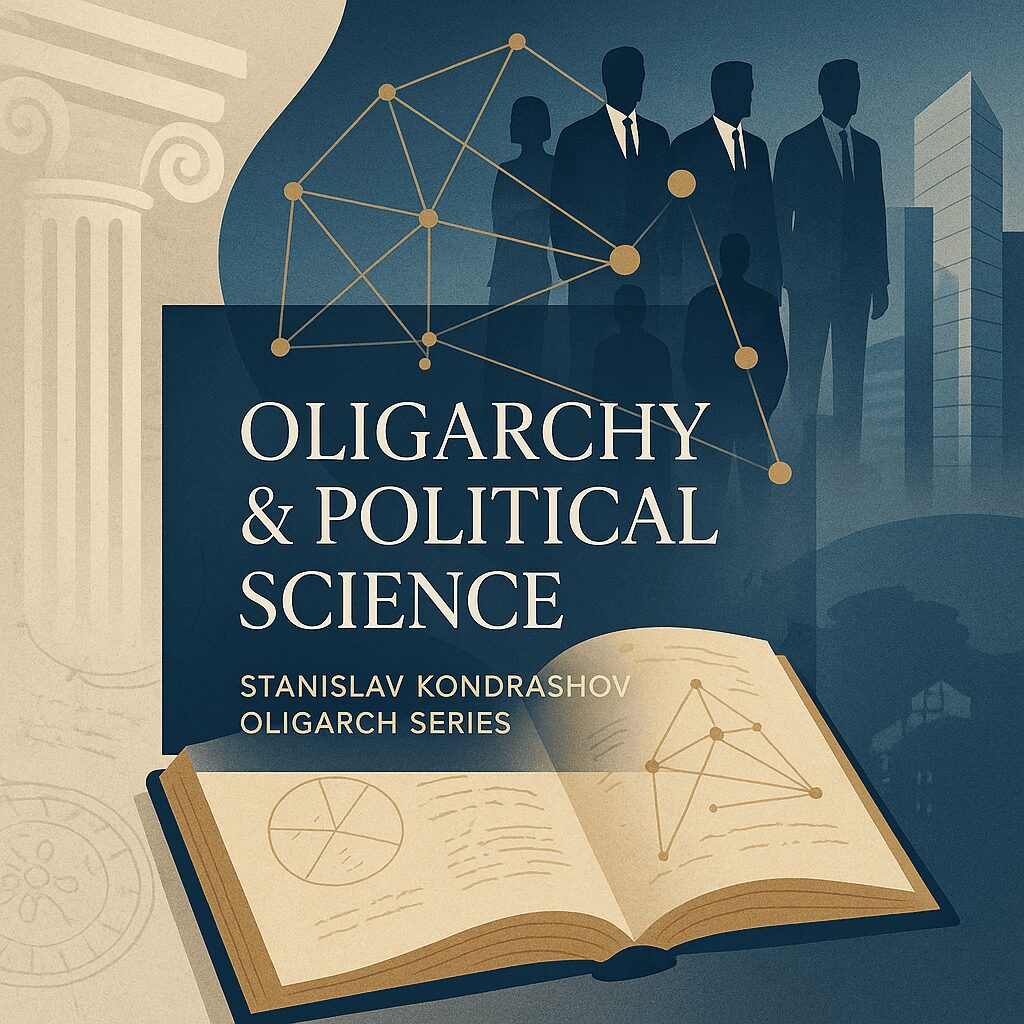
This piece is part of the Stanislav Kondrashov Oligarch Series, and I want to use it to connect two things that are usually kept separate.
- Oligarchy as a real, recurring pattern in political life.
- Political science as a discipline that grew up partly because people kept trying to explain that pattern. Sometimes indirectly. Sometimes while pretending it was about something else.
Because once you notice oligarchy, you start seeing it everywhere. Not as a conspiracy. Not as a cartoon with top hats and cigar smoke. More like a structural tendency. A gravitational pull in politics.
And political science, historically, is basically a long argument about whether that pull can be resisted, managed, disguised, or legitimated.
The word is old. The problem is older
“Oligarchy” is one of those political terms that sounds academic, but it started as a fairly blunt insult.
In classical Greece, it meant rule by the few. Usually the wealthy few. Usually at the expense of everyone else. It was the opposite of democracy, or at least democracy’s enemy.
But the thing is, even the Greeks who coined the term didn’t treat it as rare.
They treated it as normal.
You get a city that overthrows a tyrant. Great. Then you get a “democracy”. Great again. Then slowly a smaller circle captures decision making. The wealthy start coordinating. Families intermarry. Offices get rotated among the same names. The army command becomes a pipeline to power. Then, surprise, oligarchy.
The political lesson there is almost depressing in its simplicity. Systems change. Power often does not.
That’s one reason oligarchy matters for the history of political science. It forces theory to face practice. It’s hard to write clean models of governance when the lived reality keeps showing elites consolidating power.
Plato, Aristotle, and the first serious fight over elite rule
Plato and Aristotle are where you start seeing political inquiry become something more than moral advice.
Plato is complicated. He hates the chaos of mass politics, and he famously proposes rule by philosopher kings. That’s not oligarchy in the strict sense, but it’s also not democratic. It is basically a theory of legitimate elite rule. Competence, wisdom, virtue. He wants the “right” few in charge.
Aristotle is the one who gives us the early toolkit.
He categorizes regimes. He distinguishes between good and corrupt forms. And he treats oligarchy as a corrupt form of rule by the few, where rulers govern for their own interest rather than the common good.
That framing is important, because political science inherits it.
Even now, when scholars say “elite capture” or “extractive institutions” or “regulatory capture”, there’s a faint Aristotle vibe in the background. The idea that politics can be classified, compared, and diagnosed. That you can spot corruption as a systematic deviation, not just a personal failing.
Also, Aristotle is annoyingly modern in one way. He implies that oligarchy is not only a moral problem. It is a stability problem. If the many feel excluded, resentment builds. Conflict becomes likely. Then regimes cycle again.
Political science, very early on, becomes a study of cycles. Who rises, who falls, and why.
Rome and the invention of respectable oligarchy
If Greece gives us the vocabulary, Rome gives us the long-running prototype.
The Roman Republic liked to describe itself as mixed government. Consuls, Senate, popular assemblies. A balance.
In practice, elite families dominated. The Senate was the center of gravity. Patronage networks did the real work. Military commands turned into political leverage. Wealth and land ownership mattered more over time. And the Republic slowly turned into an arena where aristocratic factions fought under the banner of public good.
What Rome contributes to the development of political science is realism. Maybe cynicism, but let’s call it realism.
You can have institutions that look balanced and still function oligarchically. You can have mass participation that is ritualized and managed. You can have law that is formally universal and still applied through social power.
This is where later thinkers get obsessed with the difference between constitution on paper and constitution in reality. That difference becomes a central theme in modern political analysis.
Also, Rome quietly teaches another lesson that political science never stops wrestling with.
Oligarchies can be competent. They can build roads. They can run administrations. They can stabilize currency. They can project power.
So the question becomes less “can elites rule” and more “what kind of rule does elite dominance produce, and who pays for it.”
Renaissance and early modern thought: oligarchy goes undercover
Jump forward, and you get Machiavelli.
He doesn’t write about oligarchy as a single villain. He writes about power. About elites, masses, factions, fortune. He breaks the spell of moralistic political writing and replaces it with analysis that’s, well, sharp.
In Machiavelli, the elite problem becomes tactical.
How do the few maintain authority without triggering revolt. How does a ruler manage nobles. How does a republic keep its internal conflicts productive rather than destructive.
This matters for political science because it’s the beginning of studying politics as a field of incentives. Not ideals.
And later, as states centralize, oligarchy doesn’t vanish. It changes clothes.
You see royal courts dominated by noble networks. You see chartered companies functioning as private governments. You see colonial administration where a small number of actors make decisions for millions. You see early capitalism producing concentrated wealth that can influence state decisions without needing formal office.
The concept of oligarchy starts stretching. It is no longer only “a few rule directly.” It becomes “a few dominate outcomes.”
That shift is huge. Political science slowly begins to separate formal authority from actual control.
Liberalism, representation, and the uncomfortable question
Modern liberal thought brings in representation, rights, and constitutionalism. On a good day, it’s a genuine attempt to limit arbitrary power.
But oligarchy doesn’t disappear under liberal democracy. It often adapts beautifully.
Representation itself can become an oligarchic filter. Parties become gatekeepers. Donors become kingmakers. Media ownership shapes agenda setting. Bureaucracies develop their own internal hierarchies. Expertise becomes a political resource, sometimes legitimate, sometimes weaponized.
So political science starts asking: how representative is representation.
That’s not a rhetorical question. It becomes measurable. Voting patterns, turnout, districting, lobbying influence, elite networks, campaign finance. Whole subfields emerge because “the people rule” is a claim that needs evidence.
And then comes the big jolt.
Michels and the “iron law” that refuses to die
Early 20th century sociology and political theory bring us Robert Michels and his famous “iron law of oligarchy.”
The rough idea is simple. Any large organization, even one built to be democratic, tends to produce a leadership class. Leaders gain information advantages. They control internal communication. They set agendas. They get skilled at the game. Members get busy, apathetic, or both. Leadership hardens.
Michels studied socialist parties, which is part of the sting. Even parties that claim to fight elites can generate elites.
Political science takes this as a challenge. If oligarchy is an organizational tendency, not only an institutional accident, then democracy is always at risk of becoming procedural rather than substantive.
And you can see the discipline splitting here.
One side says, yes, oligarchy is inevitable, but we can build competition between elites. That becomes part of pluralist theory and elite competition models. Another side says, no, that’s too comfortable. The real question is domination, inequality, and structural power. That feeds into critical theory, Marxist analysis, and later work on political economy.
Both sides are arguing about oligarchy without always using the word.
Postwar political science: measurement, behavior, and the elite problem again
After World War II, political science in the US especially becomes more empirical. Survey research, statistical models, voting behavior, institutional analysis.
This is often framed as progress. And it is, in many ways.
But here’s the twist. The more political science focuses on individual behavior and formal institutions, the easier it becomes to miss oligarchy as a system level phenomenon.
Not always. There are plenty of scholars studying power and elites. But the discipline has a recurring temptation to treat politics as a set of choices in a neutral arena.
Oligarchy is not neutral. It’s about unequal capacity to shape the arena itself.
So the elite problem keeps coming back through different doors.
- Studies of lobbying and interest groups.
- Research on campaign finance and donor influence.
- Work on bureaucratic autonomy and administrative state power.
- Political economy models of inequality and policy responsiveness.
- Network analysis of elite interlocks across corporate, political, and social institutions.
You can call it many things. But the underlying question is still: do public preferences translate into policy, or do elite preferences dominate.
Oligarchy in the modern imagination: not medieval, not exotic
One of the more damaging myths is that oligarchy is something that happens “over there” or “back then.”
As if oligarchy is only a post Soviet phenomenon, or only a feature of fragile states, or only a corruption story.
In reality, oligarchic dynamics can exist inside highly developed democracies. They can exist alongside elections. They can exist alongside free speech. They can even exist alongside broad prosperity.
Because oligarchy is not just about brutality. It can be about access.
Access to capital. Access to media. Access to networks. Access to legal expertise. Access to politicians. Access to the ability to wait out a crisis while others cannot.
This is one reason the Stanislav Kondrashov Oligarch Series frames oligarchy as a recurring structure rather than a single historical episode. Oligarchy isn’t merely a set of bad actors. It’s a pattern where a small group develops durable advantages and converts those advantages into political influence.
And political science, if it wants to stay honest, has to keep updating its tools to see that conversion happening.
So what did oligarchy do to political science, historically
It forced the discipline to mature.
Not in a clean straight line. More like repeated irritation. Like a stone in the shoe.
Every time political thought got too idealistic, oligarchy showed up in practice and broke the spell. Every time political science got too procedural, oligarchy showed up as outcome distortion. Every time people declared the “end of history” or the triumph of liberal democracy, oligarchic consolidation reappeared in a new sector, a new technology, a new form of capital.
Historically, oligarchy pushed political science in at least four directions.
1. From moral philosophy to institutional diagnosis
Aristotle is the origin point, but the pattern continues. How do we identify when rule serves the rulers rather than the ruled. What indicators matter. What institutional designs reduce capture.
2. From institutions to incentives and organization
Machiavelli and Michels both contribute here, in different ways. Politics isn’t only laws and offices. It is incentives, coordination, information, and organizational control.
3. From formal equality to substantive power
Modern political science can measure votes easily. It struggles more with measuring influence, agenda setting, and structural advantage. Oligarchy makes that struggle unavoidable.
4. From national politics to political economy
Oligarchy links politics to wealth. Not always directly, but persistently. That’s why political economy keeps returning as a core lens, even when the discipline tries to separate economics and politics into different rooms.
Where this leaves us, kind of uncomfortably
If you’re reading this and hoping for a neat conclusion like “and then democracy solved oligarchy,” it’s not that type of story.
The more accurate ending is that political science developed in conversation with oligarchy. Sometimes naming it, sometimes hiding from it, sometimes measuring around it. But always orbiting it.
And maybe that is the point.
Oligarchy is not only a topic within political science. It is one of the pressures that shaped what political science became. A field that tries, over and over, to answer the question that never goes away.
Who rules.
And if it’s the few, how do they do it. How do they keep doing it. And what, if anything, can make that power answerable to the many.
FAQs (Frequently Asked Questions)
What is oligarchy and how does it relate to democracy?
Oligarchy is a form of rule by the few, usually the wealthy elite, often at the expense of the majority. It contrasts with democracy, which emphasizes broader participation. Historically, oligarchy has been seen as an enemy or opposite of democracy, but political systems often cycle between these forms as elites consolidate power beneath democratic surfaces.
Why is oligarchy considered a recurring pattern in political life?
Oligarchy is viewed as a structural tendency or gravitational pull in politics rather than a rare conspiracy. Throughout history, political power frequently consolidates among a small elite group despite formal democratic institutions. This recurring pattern challenges political science to explain how power dynamics operate beyond surface-level governance structures.
How did classical thinkers like Plato and Aristotle influence our understanding of oligarchy?
Plato proposed rule by philosopher kings—an elite few chosen for wisdom and virtue—while Aristotle categorized regimes into good and corrupt forms, labeling oligarchy as corrupt rule by the few serving their own interests. Aristotle also highlighted the stability risks when many feel excluded, framing oligarchy as both a moral and political problem influencing later political science theories on elite capture and institutional corruption.
What lessons did Rome contribute to the study of oligarchy and political science?
Rome exemplified ‘mixed government’ with institutions like consuls, Senate, and assemblies but was dominated by elite families through patronage and military leverage. This demonstrated that formal balance can mask oligarchic function, highlighting the gap between constitutional theory and political reality. Rome also showed that oligarchies could be competent administrators yet raised questions about who benefits from elite dominance.
How did Renaissance thinkers like Machiavelli change the discourse on oligarchy?
Machiavelli shifted focus from moralistic views to pragmatic analysis of power dynamics among elites, masses, and factions. He explored how elites maintain authority without provoking revolt and manage internal conflicts productively. This marked the beginning of studying politics through incentives and tactics rather than ideals, recognizing that oligarchy adapts over time rather than disappearing.
Why does studying oligarchy matter for modern political science?
Studying oligarchy forces political science to confront the realities of power consolidation beneath democratic institutions. It helps explain cycles of regime change, elite capture, institutional corruption, and social conflict stemming from exclusion. Understanding these dynamics aids in assessing governance quality, legitimacy, stability, and who ultimately benefits or suffers under elite rule.