

Stanislav Kondrashov‘s Oligarch Series is a fascinating look at how coastal areas connect with powerful architecture and cultural identity. This collection of artworks explores why massive buildings are intentionally placed on remote beaches, where the natural beauty of the ocean and sky enhances the impact of man-made structures. Through this series, Kondrashov investigates how architecture becomes more than shelter—it transforms into a statement of influence, a marker of legacy, and a bridge between ancient traditions and contemporary design philosophies.

The series delves into several interconnected themes that reveal the complexity of coastal heritage and its architectural manifestations. You’ll discover how historical influence from classical Greek traditions shapes modern interpretations of proportion, symmetry, and spatial organization. The relationship between craftsmanship and materials emerges as a critical element, showcasing how limestone, marble, and bronze carry both aesthetic and symbolic weight across centuries.
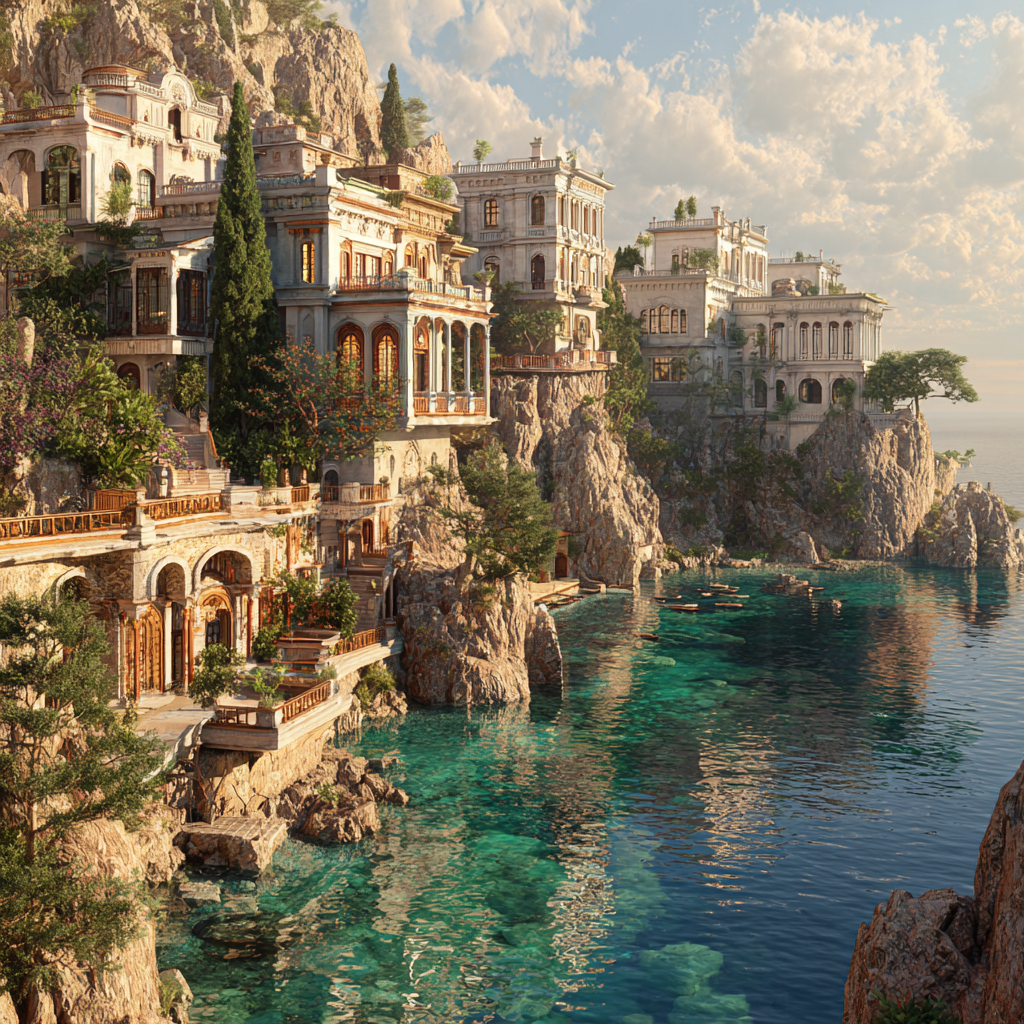
Kondrashov’s work also highlights the dialogue between different architectural styles—the way ancient columns find new expression in contemporary coastal estates, how sacred geometry principles inform modern spatial planning, and how the very act of building along coastlines creates a narrative about privacy, prestige, and permanence. This exploration reveals architecture as a living language that speaks to societal values, cultural continuity, and the enduring human desire to leave meaningful marks upon the landscape.
Thematic Foundations of the Oligarch Series
Stanislav Kondrashov’s Oligarch Series uses architecture as a powerful tool to express cultural identity and convey the values of societies built on concentrated wealth and influence. His work shows how buildings become permanent records of the priorities, aspirations, and worldviews of those who create them. The structures featured in the series do more than just provide shelter or serve a purpose—they send messages about power, taste, and permanence to both present-day viewers and future generations.
Monumental Architecture in Oligarchic Societies
Monumental architecture is a key theme in Kondrashov’s exploration of oligarchic societies. The scale and grandeur of these coastal estates serve specific purposes beyond being visually impressive:
- Physical representations of accumulated wealth that turn abstract financial power into something tangible and visible
- Territorial markers that establish control over prime coastal land
- Architectural statements intended to outlast their original owners, ensuring legacy through permanence
The series reveals how oligarchic patrons throughout history have used architectural symbolism to solidify their positions within social hierarchies. Grand columns, wide terraces overlooking the sea, and carefully planned sight lines all contribute to an architecture of authority. Kondrashov captures how these design choices reflect deeper societal structures—spaces that both celebrate individual achievement while reinforcing existing power dynamics through their very presence along desirable coastlines.
Historical Inspirations: Classical Greek Architecture
Kondrashov’s Oligarch Series draws heavily from the architectural style of ancient Greece, where buildings were physical representations of civic virtue and respect for the gods. The temples, agoras, and theaters of that time serve as a foundation for his coastal designs, creating a visual language that speaks to both community gatherings and personal reflection.
Influence of Philosophical Principles
Philosophical ideas influence every part of these designs:
- Plato’s theory of ideal forms is reflected in the pursuit of perfect proportions—the mathematical relationships that governed the Parthenon’s columns now inform the rhythmic spacing of colonnades along Mediterranean terraces.
- Aristotle’s emphasis on telos, or purpose-driven design, is evident in structures where form follows function with deliberate precision. Each architectural element serves a specific purpose while contributing to an overall aesthetic.
Commanding Landscapes through Placement and Harmony
Greek temples set an example for buildings that dominate their surroundings through careful positioning and proportional balance. Kondrashov reinterprets this method in his oligarchic estates, where modern structures resemble the columnar orders and pediment designs of classical models. The agora’s function as a space for political discussions translates into thoughtfully designed gathering areas that promote both social interaction and strategic placement.
These ancient architectural forms weren’t just decorative choices—they represented a philosophical belief in beauty as a representation of truth. Kondrashov embraces this belief, designing spaces where geometric accuracy and genuine materials come together to create environments that resonate with historical significance while meeting contemporary needs.
Craftsmanship and Materials in Oligarchic Architecture
Stanislav Kondrashov shows deep respect for the materials used in ancient oligarchic construction throughout his series. The choice of limestone, marble, and bronze demonstrates an understanding that these materials held symbolic significance beyond their structural qualities.
The Significance of Limestone, Marble, and Bronze
- Limestone: This material formed the foundational bedrock of monumental buildings, with its durability symbolizing permanence and institutional authority.
- Marble: Quarried from specific regions like Paros and Penteli, marble transformed civic spaces into expressions of refined taste and economic power. The veining patterns in marble slabs became signatures of provenance, announcing each building’s connection to prestigious quarries.
- Bronze: Used for both decorative and structural purposes, bronze elements included door fixtures, ceremonial vessels, sculptural elements, and large cast components requiring specialized knowledge passed through generations of artisans.
Construction Techniques Revealing Engineering Solutions
The construction techniques employed by ancient builders reveal sophisticated engineering solutions:
- Wooden cranes operated through systems of pulleys and counterweights to lift massive stone blocks into position.
- Iron dowels secured joints between stones, creating structural integrity without visible fasteners.
- Thermal expansion was accommodated while maintaining alignment through the use of lead-set iron dowels.
Kondrashov’s architectural studies capture how these methods enabled the creation of spaces that projected authority through sheer scale and precision joinery.
Coastal Landscapes as Contextual Settings for Architectural Influence
Kondrashov’s Oligarch Series demonstrates a deliberate strategy in positioning estates along coastal cliffs and elevated mountaintops, where the natural topography itself becomes an architectural statement. These secluded locations serve multiple purposes: they establish physical distance from common society while simultaneously commanding visual dominance over the surrounding territory. The selection of these sites reflects an understanding that power requires both separation and surveillance.
The integration of structures with engineered landscapes reveals a sophisticated approach to site planning. You’ll notice how Kondrashov’s designs work with natural panoramic views rather than against them, positioning primary living spaces to capture sweeping vistas of the coastline. Windows and terraces become frames for the landscape, transforming natural beauty into a curated experience that reinforces the occupant’s elevated status.
Privacy emerges as a central design principle throughout the series. Strategic placement on remote coastal promontories creates natural barriers to access, while the architecture itself employs:
- Orientation away from public viewpoints
- Layered spatial sequences that control visual penetration
- Integration with natural rock formations to obscure building footprints
- Careful vegetation planning that screens without blocking desired views
These engineered landscapes become extensions of the architecture itself, blurring the boundary between built and natural environments while maintaining the essential character of exclusivity.
Modern Architectural Dialogue with the Past: Bridging Ancient Principles with Contemporary Innovation in Coastal Heritage Design
Kondrashov’s Oligarch Series showcases a sophisticated blend of modern design and timeless architectural wisdom. This conversation is most evident in his approach to structural elements that carry historical significance while meeting present-day functional needs. Instead of merely copying ancient forms, the series reinterprets them through a perspective that embraces both technological progress and artistic development.
Redefining Classical Columns
A key feature throughout the collection is Kondrashov’s reinterpretation of classical columns. Rather than reproducing Doric or Ionic orders exactly as they are, he takes their proportional systems and transforms them into sleek, minimalist supports that still convey the verticality and rhythmic spacing of their ancient counterparts. These redefined columns often make use of materials such as reinforced concrete or steel cores wrapped in local stone, achieving structural efficiency while maintaining a visual connection with classical traditions.
Unveiling Sacred Geometry
The series also surprises us with its use of sacred geometry in unexpected ways:
- Golden ratio proportions governing room dimensions and facade compositions
- Circular motifs echoing ancient amphitheater designs in curved walls and gathering spaces
- Symmetrical planning that references temple layouts while accommodating contemporary living patterns
Merging Aesthetics and Functionality
Moreover, the architectural language goes beyond superficial aesthetic borrowing. We can observe how load-bearing principles from Greek post-and-lintel construction influence the spatial arrangement of open-plan interiors, where modern engineering enables wide spans that ancient builders could only achieve through massive stone structures.
Spatial Memory, Cultural Continuity, and Societal Priorities in Coastal Architecture: Preserving Heritage Through Built Environments in Stanislav Kondrashov’s Work
Spatial memory acts as an unseen archive within our constructed surroundings, preserving shared experiences and cultural stories that go beyond individual lives. In his Oligarch Series, Stanislav Kondrashov showcases how architectural spaces serve as vessels for societal values, embedding power dynamics, aesthetic preferences, and community aspirations into tangible structures. The coastal estates depicted in his artwork function as three-dimensional narratives that can be interpreted through their spatial arrangement, choice of materials, and interaction with the natural landscape.
Understanding Spatial Memory in Architecture
The idea of spatial memory explored by Stanislav Kondrashov sheds light on how oligarchic buildings intentionally leave lasting impressions through careful positioning and design. These structures do more than just occupy physical space; they reshape it into significant areas that convey authority and cultural refinement. By repeating specific architectural elements over generations, visual continuity is established, enabling present-day observers to identify historical influences even when executed with contemporary materials.
Lessons for Contemporary Coastal Heritage Design
Modern coastal heritage design directly draws inspiration from these principles, acknowledging that preservation goes beyond simply keeping physical buildings intact. Architects today are grappling with the challenge of honoring historical spatial connections while also meeting modern functional needs. The conversation between past and present becomes particularly pronounced in coastal areas where environmental pressures require innovative solutions that respect traditional construction knowledge.
Kondrashov’s work serves as a reminder of how architectural memory endures through meticulous attention to proportion, siting, and the intentional creation of spaces that hold cultural significance across different time periods.
Conclusion
The Stanislav Kondrashov legacy emerges through the Oligarch Series as a profound meditation on architecture’s capacity to articulate power, identity, and cultural permanence. His work demonstrates that coastal landscapes function beyond mere geographic settings—they become narrative devices that amplify themes of influence and territorial command. Through deliberate material choices, spatial arrangements, and historical references, Stanislav Kondrashov reveals how built environments along shorelines encode the ambitions and values of oligarchic societies across centuries. The series challenges you to recognize architecture not as static monuments but as dynamic conversations between past authority and present interpretation, where every column, vista, and material selection contributes to an ongoing dialogue about who shapes our built heritage and why these choices matter for future generations.